Glory on the Roubaix Cobbles Confirms Deignan’s Place Among the Very Best

By claiming victory on the first ever Paris-Roubaix Femmes, Britain’s Lizzie Deignan added another historical page to her incredible career story thanks to one of 2021’s stand-out sporting performances.

Paris-Roubaix is arguably the jewel in cycling’s one-day race crown; it features unrivalled spectacle with the mud or dust (depending on the weather), the brutal cobbled roads and the iconic finish in the Roubaix velodrome.

2021’s edition of the race was its 118th, showing the incredible longevity and tradition that this runs through the soul of this event, one in which is held in the greatest of esteem. Which begs the question – why did it take so long for there to be a female version?

After pandemic postponements in 2020 and spring 2021, Saturday 2nd October saw professional female cyclists finally given the opportunity to tackle the race known as the Hell of the North, breaking down yet another anachronistic barrier perpetuated by sporting patriarchy.

Recent editions of the Women’s Tour, Giro Rosa and Ronde van Vlaanderen have shown that female cycling is, in its own way, equal to or greater than its more established male equivalent in regards to action, excitement and certainly unpredictability. In many ways, as women’s cycling continues to develop in terms of professionalism and organisation, it avoids much of the structure and regimentation that makes male cycling often predictable.

As an event, Paris-Roubaix is best known for the cobbled roads and tracks which make it the ultimate test of strength and endurance. Being the first female edition of the race would add to the element of unknown, as even though the riders and their teams could have carried out plenty of preparatory training rides to understand the characteristics of the surface, there’s no substitute for actually riding in race conditions and handling the fatigue that comes from this kind of situation.

While the topography of this part of France may lack the long, torturous mountain passes of the Alps or the leg-burning gradients of neighbouring Flanders, there is nothing quite like the draining effect of riding through wind, rain and mud combined with the repeated efforts of surfing the cobbles, where each contact with the ground feels like being punched through your front wheel.

This first edition of Paris-Roubaix for female riders would always hold a place in the record books, with whoever won forever being the first winner, but that it should be Britain’s Lizzie Deignan who stood head and shoulders above the other 128 riders was testament to her steel and resolve to continue what has already been a glittering career.

With a total of 17 cobbled sectors on the menu for the riders, it must have come as a surprise to the vast majority of the incredibly strong field, featuring star names such as Marianne Vos, Chantal van den Broek-Blaak, Kasia Niewiadoma, Annemiek van Vleuten, Lotte Kopecky and Lisa Brennauer, when Deignan launched her attack, solo, with over 80km to go and not a single cobblestone traversed.

Moves of this nature are often doomed to failure, with the chasing riders able to work together in order to either prevent a significant lead being built or to allow the breakaway enough licence to accrue a margin, yet never being in danger of losing the race altogether. For a rider to win by way of a long range solo attack is surely among the most revered of sporting successes; the ultimate demonstration of courage, commitment and determination by effectively taking on and beating everyone else. One versus 128.

However, perhaps because of the course or maybe the wet and muddy conditions which saw many riders hit the deck and either lose time, motivation or both, Deignan was able to steadily build and hold a lead of over two minutes, while the field behind her whittled down to just a select few.

Into the final 20km, with the riders’ bike handling skills under stress being increasingly tested, it was perhaps the greatest competitor of them all, Vos, who struck out to try and reel in Deignan, both to eviscerate the remaining chasers but also to make what she hoped would be the winning move.

The race became a classic cat-and-mouse chase, with the Dutch superstar gradually eating into the British former World Champion’s cushion. It was impossible not to keep one eye on the clock, counting down the remaining KMs while also taking in the suffering of both riders, digging increasingly deeper to either hold on or break through. This was attack versus defence in cycling form; a nervy head-to-head, yet one where the two opponents were roughly a kilometre apart and unable to look each other in the eye.

Moments like this are among those which make road racing such a captivating sport. In a race which takes roughly three hours, it’s these periods of action where the outcome is completely in the balance that make this kind of endurance event enduring. Both riders on the rivet, giving everything to try and win the race, to take a unique place in the sport’s history, knowing that the tiniest lack of concentration or something totally out of their control, could derail their effort and hand victory to their rival.

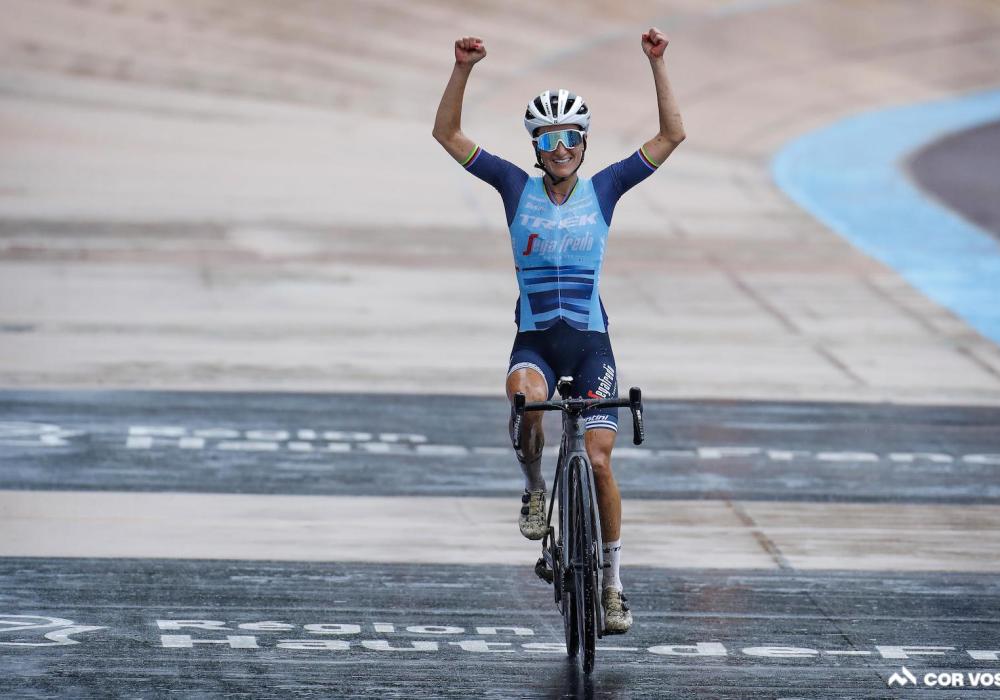
Deignan dug in, keeping Vos at arm’s length and reached the velodrome on her own, able to enjoy the final KM as a victory lap-and-a-bit. Crossing the line and raising her arms in victory gave perhaps the final insight into the effort it took to win this race, known as the Queen of the Classics, showing blood running from open blisters on her hands, worn down by the vibrations through her handlebars. Despite this, her grip never faltered, either on the bars or on the race, as she deservedly became the first ever winner of the Paris-Roubaix femmes.

This was a performance of the ages, one initiated with bravery and audacity but maintained through guts and a refusal to give in. It was fitting of the occasion and history it would create that the inaugural women’s Paris-Roubaix should end this way, with the riders spent physically, faces covered in mud and a field split to pieces, adding to the gravity and spectacle of the event.

Long may Lizzie’s win be remembered and celebrated as a landmark in cycling and female sport.
Spurs Trio Send a Message to Conte in Impressive Liverpool Performance

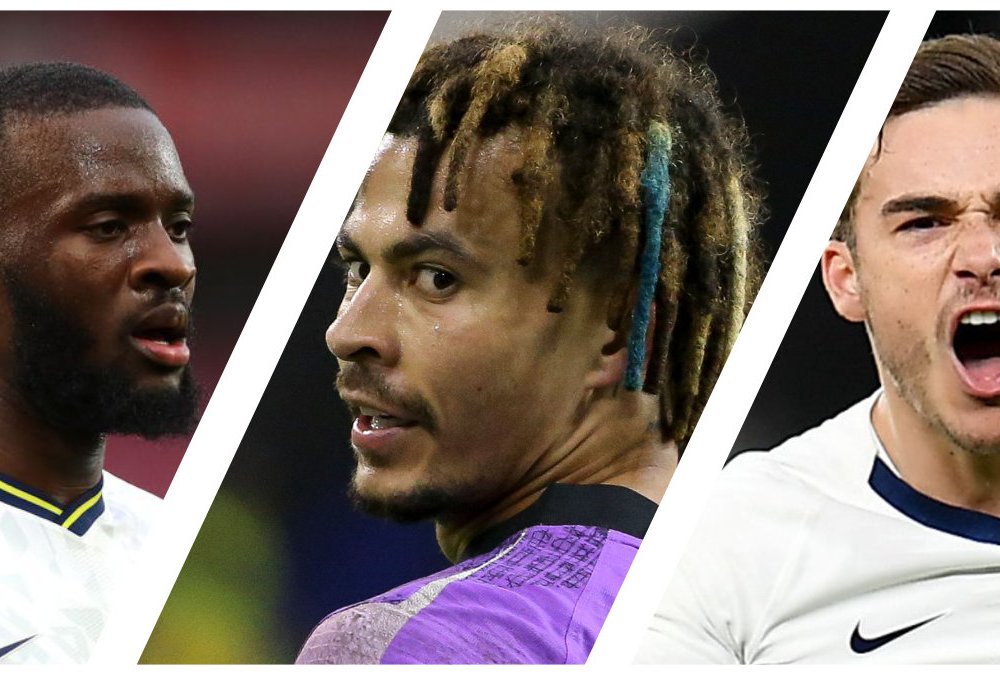
Whether it was by luck or design as a result of contending with a flurry of Covid cases in his squad, Tottenham manager Antonio Conte made a series of changes for the Premier League clash with Liverpool at the weekend, with Dele Alli, Tanguy Ndombele and Harry Winks returning to the side after respective spells on the sideline.

All three turned in strong performances and sent the Italian coach reminders that their futures might be in North London after all despite persistent rumours suggesting they might all be headed for the exit in the upcoming January transfer window. 

In a game that was played out with little in the way of a settled pattern or structure, ultimately resulting in an action-packed 2-2 draw, Spurs took the lead through another player looking to send a reminder of his talent, Harry Kane, after an excellent through ball from Ndombele.

The Frenchman is the definition of a mercurial talent; one who arrived at White Hart Lane in the summer of 2019 while Mauricio Pochettino was still in charge. Including the Argentinian, Spurs are now on their fourth full-time manager since Ndombele’s arrival and it is arguable that none of those bosses have been able to coax his best performances out on a regular basis.

A player who, when at his most confident and secure, can be a wizard on the ball, conjuring tricks and skills to occupy a dozen YouTube showreels, Ndombele may be stifled by the pace and physicality of the Premier League, although his successful time in France with Lyon and Amiens, where the game is hardly pedestrian, would suggest otherwise.

What seems more likely is that a player and character who thrives on freedom and being given space tactically to express himself is finding the transition to structure and discipline to be difficult, unsurprisingly. This is further exacerbated when you consider that his full-time bosses at the Lane include Jose Mourinho and Nuno Espirito Santo, two managers who prioritise the collective and solidity over individuality and expression.

Whether or not Conte can find a role that suits Ndomble will be pivotal to how his spell with the club plays out, as shoe-horning him into a hard-running, up-and-back midfield duty looks unlikely to get the best from him – especially when there are others in this squad capable of doing that particular job to a higher level.

Alli, meanwhile, has been the Premier League player most consistently linked with a move to Newcastle United, with the newly-rich Mapies rumoured to be keen on just about any player not holding down a regular place in their current side.

After exploding onto the League One scene in 2011 with his local side, MK Dons, including an eye-catching performance in a 4-0 win over Manchester United in the League Cup, Alli rapidly ascended to exulted levels, lighting up the Premier League and the Champions League at the heart of Pochettino’s energetic Spurs team.

He seemed to be a perfect, modern footballer – equal parts athletic, technical and creative with an eye for a goal and a keen sense for a late run into the box. His footballing relationships with Kane and Heung-Min Son were devastating for opponents and endearing for Spurs fans as he quickly became something of a darling for the White Hart Lane faithful.

Standout moments for Alli in his early Spurs days were a spectacular goal against Crystal Palace where he juggled the ball before turning and volleying home and a brace in a 3-1 win at Chelsea, the club’s first success at Stamford Bridge in 28 years. He collected the PFA Young Player of the Year Award in 15/16 and 16/17, becoming only the third player to claim the trophy twice in succession since its inception in 1974 and a strong showing in the 2018 World Cup sparked rumours of a possible move to Real Madrid.

However, after signing a six-year contract in 2018, Alli’s career has somewhat stalled – under Mourinho, he struggled to nail down a regular place in Spurs’ starting eleven, with the Portuguese manager feeling that he wasn’t a midfield player but seemingly not trusting him enough to find a place for him in attack.

Despite making 38 appearances in 18/19 and 19/20, Alli had drifted into something of a peripheral position at Spurs and only featured in 15 Premier League games in the whole of 20/21, a season which saw Mourinho’s side initially start well before fading badly after football’s restart following the suspension for Covid. If anything, Alli made more headlines that season for his on-screen dealings with Mourinho during the Amazon All Or Nothing documentary than for his on-field performances.

This campaign started promisingly for Alli, with Nuno finding a regular role for him in a deeper midfield position, but by the end of October there was frustration on both sides, with the former Wolves manager eventually omitting him from his matchday squads.

In the end, somewhat predictably, things didn’t work out for Nuno at Spurs and the former Porto goalkeeper was relieved of his duties after just four months in charge, making way for Conte’s arrival in November.

The Italian coach is known for playing a 3-5-2 or 3-4-3 formation where hard work and sacrifice are key, suggesting that it might be difficult for Alli to find a place – however, there were similar thoughts around another player with Spurs connections, Christian Eriksen, during the 20/21 season at Inter Milan. Conte was thought to not be a fan of the Danish playmaker, to the point of looking to offload him in the January transfer window. However, Inter’s owners insisted that the former Juventus boss should play with the toys he already had before any further additions, and after some tactical tinkering, Eriksen played a central role in the Nerazzuri claiming their first league title in a decade.

Against Liverpool, Alli showed the kind of verve and intelligence that makes him a dangerous player for Spurs, joining rapid breaks to either create opportunities for others or find himself in position to take chances himself – in fact, it was only an excellent save from the Reds’ ‘keeper Alisson that denied Alli from doubling his goal tally for the season.

If Alli could return to something like his form of 2016, 17 or 18, then Spurs would have an outstanding player on their hands, capable of match-winning moments on the biggest stages. Remarkably, he is still only 26 years old, so to write off a player of his undoubted talent would be a huge waste and one that could come back to haunt Spurs if he were to join a rival Premier League club.

Winks, meanwhile, is perhaps a player who has yet to find his place or to reach his peak. A busy midfielder who connects play and shuttles the ball to different areas rather than springing open defences with splitting passes, Pochettino described him as being in the mould of Barcelona icons Xavi and Andrés Iniesta, which might seem like lofty praise, but indicates his disposition as a contrast to more physical athletes in the squad at the time like Victor Wanyama or Moussa Sissoko.

Fast-forward to 2021 and Winks remains with Spurs while many others in midfield have moved on. At the same time, the club have shelled out on the likes of Giovani Lo Celso, who operates in similar spaces to Winks, reducing his opportunities to hold down a place in the side.

His role in a team is probably more along the lines of a deep-lying playmaker, attracting the ball from his team-mates in defence and then recycling possession before creating space for others to catch the eye further up the field.

Players like Winks have often struggled in the English game, where pace, power and getting stuck in will always be favourable characteristics. This is perhaps best characterised at Spurs by the arrival of Pierre-Emile Højbjerg, who has seemingly secured a regular place through a combative and industrious approach to the game.

The issue for Winks is that it is hard to imagine him being a regular starter for any of Spurs’ rivals; that said, against Liverpool he played an important role in Spurs’ midfield and demonstrated that he is more than capable of mixing it with the likes of Naby Keita in the Reds’ midfield.

This season he has only appeared in five Premier League fixtures, but if he can show more of the kind of performance he put in against one of the League’s best sides, there’s no reason to think he shouldn’t feature in Conte’s future plans. 

Crash! Bang! Wallop! Sport’s Fight for Market Supremacy

Wow! What an incredible spectacle: the world’s finest athletes going head-to-head in a winner-takes-all fight to the finish. Scenes everywhere.

It seems as though a growing number of sports are in their own deathmatch in a quest to claw their share of the television and therefore monetary pie, with triathlon’s SuperLeague being the example that immediately springs to mind.

Admittedly, triathlon is a difficult sport to televise and monetise: there’s three disciplines to cover, possibly closing down a city centre or out-of-town venue with races that range from just under two hours to almost eight hours depending on the format.

One of the perceived troubles with endurance sport is that there will always be long periods of non-action when looking on as a spectator – anyone who watched the entirety of last week’s Milan-San Remo bike race, all 300km of it, would testify to that, with the race only really coming to life in the final 30 minutes.

So why not just get rid of all the boring stuff and condense it down into a YouTube-friendly package? After all, we are constantly told that attention spans are dwindling, social media controls all and people get bored super easily – what fans want is all the action, constant dicing for position and sprinting for the line.

SuperLeague looks to deliver this by the bucket load. Admittedly, the SLT Arena Games, born in the midst of the pandemic with competitors swimming in an actual pool before riding and running in a virtual world, makes the best of a very difficult situation. Large-scale, mass participation events are difficult when trying to control a respiratory virus, so the more controlled the event can be, the better in this respect.

However, SuperLeague was already thrusted upon us before the Coronavirus was even a twinkle in a bat’s eye, with it’s self-appointed role of disrupting triathlon through innovative formats, which essentially translates into making the disciplines a lot shorter and changing their order.

Races are chaotic and closely contested – a natural result of not actually doing much racing and instead doing three times as many transitions. In the outdoor SuperLeague events, athletes are routinely awarded power-ups, such as ShortChutes (shortcuts) or alternatively hooked from the race if they fall too far behind. One wonders if they might occasionally be able to de-rail opponents with exploding tortoise shells.

Each event features multiple rounds, across different formats with points being awarded for positions and ultimately a winner crowned at the end of each race weekend and eventually the season. It’s utterly confusing and almost impossible to know who is actually winning from one event to the next, but put that minor detail aside and isn’t great to watch!

Well, no actually – it’s just a bit different. Not better, just different and well marketed. And considering that triathlon is one of the most inclusive and equal sports going, there’s a separate conversation needed about the different uniforms needed for men and women, with the latter seemingly required to wear eye-wateringly high-legged swimsuits, presumably because more flesh equals more viewers.

This feels like the latest in a line of attempts to reduce sports to just the highlights in a bid to catch the eye. Cricket was probably the first to do it right with the birth of Twenty20, reducing a five-day contest to a three-hour face-off, full of huge sixes and spectacular wickets – goodbye maiden overs! There are similar stories in snooker, pro cycling and athletics as more and more sports seek to squeeze their events further and further to produce an exciting, schedule-friendly product. Latest reports in football suggest that Champions League bigwigs are considering a TV subscription package where customers (fans?) pay sufficiently to only watch the final 15 minutes – who cares about the previous 75, after all?

Except the only thing that all these reductions seem to actually do is make the longer forms of competitions look long and boring. Why would you bother committing a full afternoon to watching something on telly when you could catch up with the best of the action on demand and then get back to some doomscrolling?

It begs the question of where this might end. Why bother with all that tedious football when you can cut straight to a penalty shoot out? Let’s just have a tie break in tennis and make Formula One a drag race.

There’s so much more to sport than the result; it’s the preparation, the discipline and the hours that going into making the start line. It’s the concentration, the camaraderie and the tactical nous on the day itself. Sporting competition is great because it ebbs and flows – you might be winning early, then on the back foot as your opponent regroups only to then find something special to claim victory.

Condensing the action down into a TV-friendly package feels akin to reducing a meal from a Michelin-starred chef into a convenient pill-form, because who has the time to waste it actually eating or socialising? Read a book you say? No thanks, I’ll just skim the Wikipedia page, that should tell me all I need to know and if it’s any good.

The issue stems essentially from the competition that exists for every eyeball and every pound in revenue. The roaring success of football’s Premier League in the last 30 years has forced every other sport, governing body and event organiser to consider their own ‘product’ and how best to ‘develop market share’.

Without meaning to sound like Old Man Abe Shouting at Clouds, what happened to sport for the sake of sport? Competitions and races whose main purpose was the challenge they provided for the competitors or the opportunity for the best to test themselves against their peers.

Perhaps if finances and airtime were shared slightly more evenly without the need to try and steal viewers from the all-conquering football behemoth, there would be more opportunity for sport to breath organically, rather than this stifling quest for self-suffocation.

But where’s the fun in that? Just show me the best bits and send me to the gift shop!

Men vs Women – are London Marathon’s Good for Age Times ‘Fair’?

London Marathon – always one of the best days of the year, either following friends and loved ones in the race or, a couple of times, actually running it myself. Mid-spring, just as the weather turns bearable, making London a little less grey and smoggy. Except this year it’s October, it’s hammering down and I’m watching the elite-only race on TV rather than from the barriers between mile 13 and 14. Thanks Covid.

Earlier this week I was asked a question that seems to circulate among club runners at least once a year: is it easier for women to get a Good for Age time than men?

For anyone unfamiliar with the idea, a Good for Age (GFA) time is a standard that race organisers set out for qualification to enter an event. Every year, hundreds of thousands of people apply for the ballot to enter London Marathon, so your chances of holding a golden ticket to join the 40,000 starters is slim and for many people, raising the required funds to run for a charity is probably a stretch too far.

So the alternative route to the start line is GFA – for each age category, the organiser defines a set time that permits entry to the race. For instance, as a male 18-40-year-old, that time is currently three hours exactly (they change every now and then – a few years ago it was 3.05). It gets a little more complicated if there’s more qualifiers than available spaces, so you might actually need to go a little quicker than the set benchmark.

For female 18-40-year-olds the GFA boundary is three hours, 45 minutes, which at first glance does always look like a big difference, which is perhaps reflected by the fact that I know more women with GFA times than men.

Looking at the nearest example to home, that of my partner Sarah and I, we take part in sport at a roughly similar level: we spend pretty much the same number of hours training and we’ve been completing races for about the same length of time. We both take it fairly seriously – more than most, but not as much as some. My marathon PB (from 2019) is currently 3.03 while hers, which she achieved earlier in 2020, is now 3.18, so if anything she has nudged ahead of me.

That means I’m currently over three minutes outside the target time for my age, while Sarah is 27 minutes inside.

So, on the surface, I would have to say yes, I do think the GFA time for women is easier than men. However, the more important question is whether or not that’s fair – and again, my answer is yes. Here’s why.

Firstly, one of the stated aims of London Marathon’s race organisers for a while has been to achieve and maintain an event with a 50/50 split between male and female competitors. For a start, that’s a very noble ambition, but that target becomes even more important when you think that this a huge public and televisual event, broadcast in the UK on BBC and watched by millions.

It’s long been said that sport isn’t so much about the winner, but the taking part – I think you can extend that and add a layer of inspiring others. In 2012 when the Olympics came to London and it felt ok to be British, the whole spirit was around watching sport, getting involved and encouraging others to join in too.

In this respect, role models aren’t record breakers and medal winners – they’re the invisible, everyday heroes who are getting up at 5am to log their miles and juggling work, family and training commitments. Seeing thousands of other normal people who look, talk and live just like you encourages others to think that they could do that too.

When I look at the difference in times for men and women, it isn’t as straightforward as the numbers in black and white. At that particularly moment in time, it could be argued that 3-dead for men requires more time training, greater commitment and less chocolate than 3.45 for women, but us men have an advantage we don’t always like to talk about.

When the first London Marathon took place in 1981, it was only 14 years after Kathrine Switzer was dragged from the world’s most heralded 26.2 race, the Boston Marathon. The reason for her ejection was simple – women were not permitted to take part. How come? Because, in the eyes of the race organisers and, no doubt, conventional wisdom at the time, women were incapable of completing the distance.

As I watch today’s elite-only race, 2019’s winner Brigid Kosgei is probably harbouring dreams of breaking either her own world record of 2.14.04 (set in a mixed race) or Mary Keitany’s benchmark of 2.17.01 (set in a women’s only race). Not bad considering barely 50 years ago women were viewed as being so much weaker they wouldn’t make the finish.

Meanwhile, marathon running, athletics generally and, more broadly, sport altogether, have been and continue to be male-dominated arenas. When you look at other sports events, it’s always that way – for instance, when I made my failed attempt at Ironman in 2019, there were 250 women in the entire field of 2,500 – there were more than 250 men in my age category alone.

It’s kind of just accepted that men take part in sport, while women stand on the sidelines cheering, usually cradling the children as the prehistoric view goes.

Right from a young age, there are undoubtedly more barriers, both socially and culturally, that prevent women from taking part in sport, committing as fervently as their male counterparts and going on to enjoy incredible achievements.

While men might look at the GFA times and think ‘ok, I might need to train a bit more, recover a bit better or cut back on the chips a bit’, that’s nothing compared to the vast majority of women who have generations of misogyny and patriarchal patronisation to overcome. Factor in the near-certain judgment of friends, colleagues and strangers, often bewildered as to why a woman would want to be out in the cold and rain on a Sunday morning when they could be nursing a hangover or pretending to like their in-laws, and it becomes clear that the challenge for female runners is far greater than just x number of miles within a given period of time.

By positioning the goalposts for entry in a way that facilitates a 50/50 split, London Marathon should be celebrated – I would hazard a guess that running clubs up and down the country now look a lot more equally populated than athletics clubs did a few years ago and it’s the concept of equality that should be focused on here.

Often when people talk of equality, they think of giving everyone exactly the same access to something as everyone else – a completely open ballot system, regardless of age, gender or ability. Except that isn’t really equality – if anything, especially in an environment so skewed traditionally towards one particular group, white men, it only serves to exacerbate the status quo and keep the doors locked to everyone else.

In my mind, equality is less about treating everyone the same and more centred on creating opportunities that provide everyone equal ability and facility to participate. In this particular case, if that means a seemingly ‘easier’ timeframe to allow the same number of male and female runners to be there or thereabouts for qualification, then so be it. Over time, if that encourages more women to take part, the sport will see a raising of the bar and narrowing of the time gap in order to maintain a 50/50 split and that cannot be a bad thing.

So, going back to the original question: Do I think the GFA time for women is easier than men?Yes. But do I think that’s fair? Yes – yes I do.

PSG Eventually Overcome Atalanta Despite the Heavy Weight of History

On what was essentially opening night for the compacted Champions League, which sees this year’s edition minimised into a tiny tournament in Portugal, there was no lack of drama and excitement in the first quarter final, between minnows Atalanta and money bags Paris Saint-Germain.

Much had been written in the build-up to the game about the gaping difference between the two sides’ playing budgets and the fairytale that has seen the side from Bergamo in Northern Italy, where the Coronavirus crisis really kicked off on March, scrap and battle their way to the quarter-finals. In particular, this is a team making its debut in Europe’s elite competition and which began that campaign by losing their first three fixtures in the group stage. For them to even reach the final eight is a fantastic story and a testament to a team that embodies the concept of ‘more than the sum of their parts’.

And yet, when it came to the crunch, there was something achingly inevitable about the outcome of this fixture – a 2-1 win for the Parisians – despite ultimately needing to make use of every available minute beyond the scheduled ninety.

That the eventual heroes for PSG were not the hugely price-tagged Neymar or Kylian Mbappe but defensive midfield lump Marquinhos and former Stoke City plodder Eric Maxim Choupo-Moting demonstrates perhaps the desperation that had set in among the Paris side, throwing everything at Atalanta in search of a late reprise.

When Mario Pasilic opened the scoring for the underdogs midway through the first half, it was no less than their play to that point deserved. All eleven players appear committed to the high-pressure, high-intensity approach deployed by head coach Gian Piero Gasperini and it is easy to see why they have attracted so many admirers along the way so far. Playing with ambition and imagination in the final third, they created a number of good chances before eventually taking the lead, despite the best opportunity falling to PSG’s Neymar, who completely fluffed his own lines, scuffing wide in a one-on-one situation with Atalanta’s stand-in ‘keeper, Marco Sportiello.

With 2018 World Cup star Mbappe rated as only 80% match fit and therefore starting on the bench, PSG relied heavily on the Brazilian Neymar from the outset. That reliance is almost certainly their Achilles heal, placing what must be a mass of pressure on the shoulders of one player. It was almost like watching the Brazil side that Neymar nearly carried to World Cup glory in 2014, when the South American nation hosted the tournament and ultimately crumbled in the semi-final against Germany, having lost their talisman to injury in the quarters.

Throughout that competition, Neymar was the standout star in a fairly average team that was nowhere near the level of quality demanded by fervent home support. It must be incredibly tough to carry that kind of expectation and deliver consistently, regardless of how many zeroes appear on your payslip.

Throughout this game, Neymar appeared to be living his own personal nightmare – he was regularly appearing in the right places, creating opportunities for himself and others, yet nothing clicked, everything seemed forced and unnatural.

It is easy to dislike this PSG side, for their petro-funded assembly of global talent, their classless baiting of Borussia Dortmund earlier in the competition and for their boringly relentless success in their domestic league.

However, much as we all chuckle when this year’s edition of the PSG Champions League catastrophe plays out in front of us, it’s easy to forget, that these are humans, young men too. After their 6-1 collapse to Barcelona and last year’s humbling at home against a supposedly crisis-ridden Manchester United, there must always be a nagging element of doubt in the minds of these players as to whether things will actually ever go their way.

In the build up to what seems like every PSG tie, there grows an air of ‘Good versus Evil’ about proceedings, with the Paris side being pitched as the bad guys because of their Qatari owners and the funds sloshing around in their budgets. But maybe it’s worth remembering that these are essentially just men, footballers, lads too – when they grew up kicking a ball around on an estate or a beach somewhere, it’s almost certain that they dreamt of scoring goals, winning medals and celebrating with fans, not becoming a collection of Bond-style footballing henchmen, taking up arms against the next plucky underdog story to come their way.

While it would certainly have been an incredible story for Atalanta to become the first Champions League debutants to reach the semi-finals in 14 years, as with almost every football narrative, there are two sides to every story. When Neymar sliced that incredible pass through the tiring Atalanta defence last night to find Mbappe and provide him with the space to lay the winning goal on a plate for Choupo-Moting, there must have been a huge sense of relief for all involved.

Ever since he first appeared as an angular teenager with incredible skills, Neymar has been burdened by the lineage that he represents in Brazilian football – Pele, Romario, Ronaldo et al. The weight of that history alone would be huge to contend and perform with, but this is a player who has also traversed the demands of a spell at Barcelona in the shadow of Leo Messi and then onto his own stage in Paris, where every performance comes with a golden asterisk.

When Neymar and PSG falter, the footballing world smiles, points and laughs. When they succeed, it is shrugged off as only being an inevitable result of the expenditure.

Love or hate Neymar and his band of well-paid men, maybe sometimes it’s ok for them to have their own moment of celebration, overcoming the frustration of a night where it seemed like they might play forever and never score.

After all, if the bad guys always lost, we’d eventually get tired of the good sides winning and would crave the rise of the character villain, the spirited anti-football or the guy who pokes authority in the eye. And we don’t need another Mourinho.

RIP Bury FC: a sad tale with lessons to learn?

Late in the evening on Tuesday 27th August, it finally happened: after months of threats, possible breakthroughs and false dawns, the English Football League (EFL) were finally forced to expel one of its member clubs, Bury FC.

This was a truly sad end to a long and drawn out saga, the culmination of a series of events that has seen this historic club, founded in 1885, cast from the league setup after 125 years of membership and into almost-certain liquidation. Just a few months ago, in April, the club’s fans, players and staff were celebrating the momentous achievement of promotion from the league’s lowest tier, League 2, to the third rung of the English football ladder, League 1.

However, that promotion itself came in the face of a growing crisis at the club with players and staff reporting unpaid wages dating back to February and the club’s owner buckling under the weight of mounting debts, many of which were leveraged against the club and its assets to meet spiralling interest payments and ongoing commitments.

How the club got into this position is one matter for debate. Punching above its financial weight with player wages reportedly in the same ballpark as clubs two divisions higher, it was evident that this was likely to end in tears, but when that actually happens it’s always the fans that feel the effects worse.

While the club’s owner, whose actions seem to have stymied any potential sale and therefore made survival even more unlikely, will ultimately walk away from the ashes of the team’s Gigg Lane home, it is the supporters who will suffer from the club’s demise the most.

Going to the match is something of a British institution; generations of men, women, boys and girls taking the trip on a Saturday afternoon to follow their team, come rain, wind or shine. Family outings, meeting up with the lads, taking the boy to his first games – all rites of passage for football supporters up and down the country.

That sense of community and importance to the local area is even greater for the nation’s provincial clubs; away from the bright lights of the Premier League, it is our smaller clubs where fans gather, fall in love with their club and build tight-knit networks around their Saturday ritual. You get to know the people who sit around your season ticket seat and share the highs and lows of supporting your team. In many ways, being a fan of a lower league side is much like being a member of a family – there’s a firm sense of togetherness, empathy and loyalty towards the group, looking out for each other and with a much deeper sense of belonging than can be found in many of the global corporation-esque super clubs.

You are an important part of your club and it is an important part of you.

That in itself is the real tragedy in this loss – and it feels like a bereavement: here we have not just the closing of a business, but the cessation of an entity which provides thousands of people with something and somewhere to aspirate their emotions, ambitions and, in many cases, their actual reason for being.

It sounds dramatic to pitch it in those terms, but to many of the supporters of football clubs, it truly is their religion – to have that stripped from their psyche will leave a massive hole.

Apportioning blame in this situation certainly won’t bring the club back but working out how this has been allowed to happen may provide some clues as to how it can be avoided in the future. We live in a world where there are Premier League players sitting inactive on benches earning weekly wages that would keep many a club afloat, but it can’t be their responsibility to fund their colleagues and, ultimately, rivals. They are only being paid what someone is prepared and able to pay them.

The disparity between the top-flight ‘haves’ and the lower league ‘have nots’ continues to grow at an alarming rate, something which feeds the desire to chase success and reach the pot of gold at the end of the footballing rainbow. Achieving promotion to the Premier League can take a club from a position of keeping its head barely above water to profitable sustainability – just ask a recent riser like Bournemouth – but it’s a precarious position that can be taken away just as quickly – see Bolton Wanderers, Portsmouth, Leeds United et al.

Facilitating this kind of survival tightrope is at the heart of the issue. Achieving success and climbing the leagues is so incredibly valuable that clubs – and their owners – will take all kinds of risks in their pursuit of victory at the expense of simple business logic. In what other industry would senior management even consider paying out more that they make?

Unfortunately there can only be a limited number of winners in any season, so for every side that climbs a ladder, there are plenty more who slide down a snake, whether that be in terms of their league status or their ability to balance the books.

In that respect, the EFL have taken a lot of the stick for the demise of Bury with questions over their Fit and Proper Persons test for club owners and the level of control they wield over members’ financial actions. There is only so much that the central body of what is effectively a members’ club can do to police its constituents, but perhaps it is time for firmer governance and greater restriction over finances – even if this threatens to reduce competitivity with Premier League clubs and their fiscal muscle.

In an ideal world, the game’s wealth would be shared far more evenly – does Mesut Özil really need his £350,000 a week and do Manchester United have to spend £98 million on Paul Pogba? If he didn’t and they didn’t, the game at the highest level would hardly wither and die, but without more evenly distributed funds, the chasm that already exists will only expand over time. Eventually that could see more clubs disappear from the system, and there’s even some logic behind an argument to reduce the number of professional clubs in the English game to reduce the financial land-grab that currently exists in the lower leagues.

However, in both these situations, it’s impossible to force the toothpaste back into the tube – Premier League owners, players and agents are hardly likely to donate their earnings for ‘the good of the game’, while asking lower league clubs to become semi-professional or amateur setups would never be a move that could be supported politically by all.

Which kind of leaves us at something of an impasse; with so many stakeholders – Premier League, Football League, Football Association, and the growing power of clubs and players – there exists a huge power vacuum at the top of the game. Who actually runs football in the UK and what are their motives?

There is no single entity or governing body that has the authority to step in and make rulings with the long-term sustainability of the game and its incredibly loyal followers at heart – each organisation with any power has its own agenda, which in turn is dictated by the motivations of its own stakeholders. For instance, the Premier League has to pander to the whims of its clubs, who continue to carry the threat of banding together with Europe’s elite outfits to form a European super league, so anything that could threaten their dominance or profitability is certain to fall on deaf ears.

By its very nature, football is a competitive business – winning, losing, promotion, relegation – but it’s time for that level of tribalism to be diluted for the greater good. Without a more balanced sharing of the game’s eye-watering incomes and a will to create an even playing field, we could well see a wave of clubs going under and eventually drowning beneath unsurmountable debt and over-commitment.

Long Live the Long Form

The clamour for further decreasing the length of sporting events to fit busy scheduling demands and appease decreasing attention spans has taken something of back seat in recent weeks with longer form events and sports roaring back into the collective conscience.

At the risk of sounding like someone’s dad, the increasing appetite for shorter and shorter representations of sport to supposedly satisfy the YouTube generation of spectators seems to be continually gathering pace. More and more sports and their organisers seem to be exploring ways of creating their own version of cricket’s Twenty20 format, reducing longer encounters to action-packed face-offs designed to appeal to casual viewers.

However, this summer has seen the extended, more traditional versions of sports making waves and demonstrating that it really can be worth investing time and attention to the slow-burn drama and tension that builds through time in the action.

Headlining the re-awakening for the longer sports was the Cricket World Cup Final on Sunday 14th July; an incredible, scarcely believable rollercoaster of a game, which genuinely could have swung either way on numerous occasions but ultimately resulted in a win for England over New Zealand by way of a Super Over – who even knew that was a thing?

Admittedly, the World Cup itself is not the longest form of the game, nor the perceived ‘true’ format of cricket, a title which is held by the five-day, test version, but it was nonetheless refreshing to see the 50-over, day-long variant of the sport making headlines around the world rather than the TV-friendly Twenty20 setup.

It’s easy to understand why short form cricket has steadily taken hold and, in some ways, become the prime format of the game. It fits nicely into schedules, competing with sports like football and rugby which don’t require a full day’s time to achieve a result This definitely makes it a more appealing package in terms of promotion and marketing, taking all the most exciting and dramatic moments from a match and concentrating them into a handy, three-hour package.

This has the further advantage of levelling the playing field somewhat – it should come as no surprise that while the big three in international cricket – India, Australia and England – continue to dominate the test arena (and the financial rewards that come from it), there is a far greater chance of success for historic powerhouses such as South Africa or the West Indies, who find it increasingly difficult to compete in the longer formats.

Nestled neatly in between the two extremes is the 50-over format, the World Cup of which came to England this summer and culminated in that final at Lord’s in July.

The match itself may not have been the anticipated all-action classic, with low scores on both sides and a focus on preventing free-flowing, aggressive batting with pragmatic, safety-first bowling. On the surface, that hardly seems like the recipe for high drama and an unforgettable outcome, but as it turned out, the drip-drip nature of the play only added to the tension of the occasion.

When it feels as though not a great amount is happening on the surface, the moments of action, arriving like bolts from the blue, become even more dramatic when they do arrive, adding to the excitement and joy for the spectator. 

While the cricket creeped towards its frankly ridiculous outcome, another ubiquitous summer sport was toiling away on a different channel, seeking its own share of the spotlight. Across London from the Lord’s cricket ground, the men’s singles final of Wimbledon saw two of tennis’s all-time greats, Roger Federer and Novak Djokovic, going head-to-head once more.

The match ultimately finished three minutes short of five hours, making it the longest ever Wimbledon final, with Djokovic eventually claiming victory over Federer by way of the competition’s first final-set tie break in the championship match, with the scores level at two sets all and 12 games each in the fifth.

This was another encounter that looked like it could could easily go either way. Federer undoubtedly enjoyed the greater support on centre court, but Djokovic’s ability to stay in the tie and actually lead 1-0 and 2-1 on sets, despite being second best for much of the play, demonstrated why he too is one of the game’s most successful players and a serial winner.

Trying to watch the cricket alongside the tennis was almost impossible; flicking over to Wimbledon to check the score repeatedly led to complete engrossment for an extended passage of play, before switching back to the cricket, only to learn that a wicket had fallen or a six clubbed into the grandstand.

This experience highlights one of the factors that makes long-form sport so encapsulating. In the 21st century, this could be described as FOMO – fear of missing out – something cycling’s biggest three-week party, the Tour de France, demonstrates perfectly. In amongst the epic, six or seven hour tests of endurance are sometimes tiny moments of drama that populate the six-minute YouTube highlight reels later in the day.

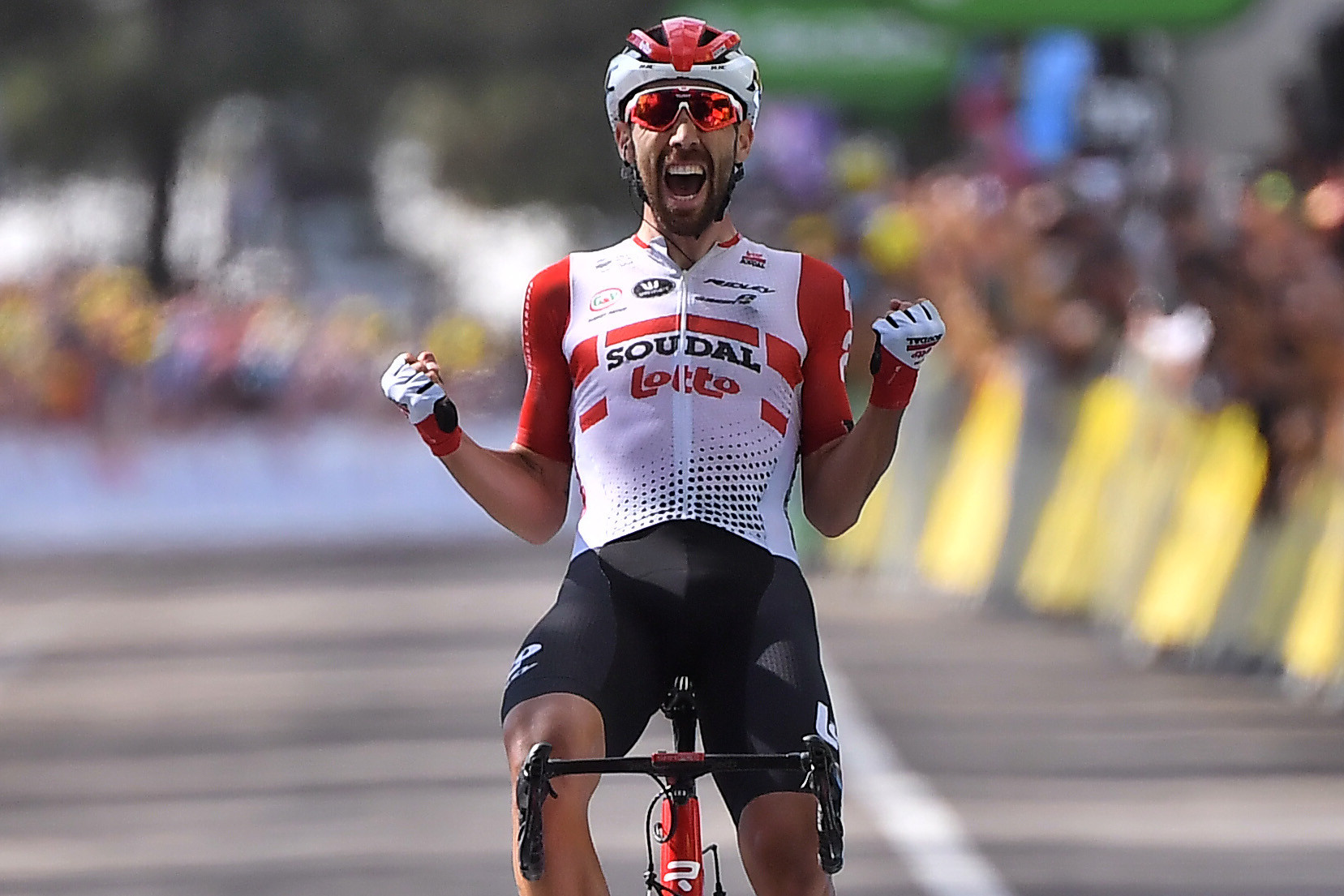
Perhaps the best example of this came on stage eight of the Tour, a hilly parcours taking in 200km from Macon to Saint Etienne. Eventual winner Thomas De Gendt took a shade over five hours to reach the finish line, having originally led a four-man breakaway group from the off before eventually grinding down his fellow escapees to take victory.

Back in the main pack, surprise race leader Julian Alaphillipe, who would go on to make headlines for his swash-buckling defence of the yellow jersey, re-claimed the overall lead of the race after attacking the main group of favourites in the final kilometres, joined by fellow Frenchman Thibaut Pinot, who effectively staked his claim for the overall win.

Coming right at the end of a long day where, to the uninitiated, nothing much was happening, this moment of action created a frantic, pulsating finish to the stage, as heroic breakaway artist De Gendt dug deep to claim the day’s win and hold off the two home heroes. Watching the gap ebb away on the TV broadcast was unmissable viewing, with multiple questions to be answered before the day was out – would De Gendt claim the deserved win? Would Alaphillipe re-capture the overall lead? Did this mean that Pinot was the most likely to claim overall victory in the remaining stages of the race?

As it turned out, this was just a skirmish in an ultimately classic war – further highlighting the difficulty of condensing three week’s action into a single package and the joy of following the theatre throughout its entirety.

There is a lot to be said for the accessibility of taking sport’s best bits and presenting them in a way that appeals to a wider demographic. Expecting everyone to want to sit down and commit to hours and hours in front of a TV screen or in a crowd might be a thing of the past, creating an understandable fear of declining audiences and reduced advertising revenues as a result.

However, protecting the extended formats of sporting occasions remains essential to maintaining their significance, and hopefully 2019’s rise of the longer occasions will go someway towards stemming the tide of further T20-ising among sport administrators and marketers.