Everything Still to Play For in Dramatic Third Tier Finale

Plymouth play host to MK Dons in a final-day fixture with many issues left to be settled and multiple potential outcomes.

As League One enters its final week, it is not exaggerative to say that this season has been like no other. While it looks as though Wigan Athletic should secure the title and climb to the Championship, a host of permutations, some more likely than others, mean they could still finish outside the top two and miss automatic promotion all together, while four sides competing for three play-off berths are separated by just one point point and only two goal difference.

Normally it would seem hyperbolic to suggest, but it is practically impossible to predict what might happen.

The Latics could have secured promotion at home to Plymouth Argyle on Saturday, but were held to a draw that saw the visitors reach 80 points, a figure they share with Sunderland and Wycombe Wanderers, which would normally be comfortably enough to secure a top-six finish and a place in the play-offs.

However, with Sheffield Wednesday currently seventh on 79 points – and with two games remaining – it is not inconceivable that a side could muster 83 points this campaign and not make the play-offs, something which has never been seen before at this level.

In fact, the last time a team secured 80 points and missed the end-of-season promotion fixtures was 2002/3, when Tranmere Rovers were the unlucky outfit. That season was dominated by Wigan, who amassed 100 points to top the division – this time around, they could reach 95 if they win their final two fixtures. That said, in 2009/10 Southampton were docked 10 points for financial irregularities; had that deduction not happened, Huddersfield Town would have finished seventh despite having 80 points.

While Wigan look certain to secure their place in the Championship next season, the second automatic spot remains up for grabs. Rotherham, who have been there or thereabouts all season, currently occupy second place but are level on points with MK Dons. Both teams have stumbled in recent weeks, but while Rotherham overcame Oxford this Saturday, the Dons claimed a vital win at home to Morecambe. The Millers travel to Sunderland on Tuesday evening in a huge game that could have significant impact on all the clubs involved in the run-in.

A win for Rotherham at the Stadium of Light would see them as-good-as promoted going into their final day fixture at Gillingham with a three point lead over the Dons and a goal difference advantage worth a point, especially with the MK side travelling to Plymouth, where their hosts have enjoyed excellent home form this season.

One potential reason for the near-unprecedented high points tallies at the top of the table could be the low accumulations at the bottom; going into the final week, Gillingham have 40 points from 45 games while Fleetwood – currently one position outside the drop zone – have 40 from 44.

With tough fixtures remaining – the aforementioned Rotherham for the Gills, Wednesday and Bolton for Fleetwood – it remains possible that 40 points could be enough to beat the drop, which would be a first for the third tier (the lowest previously recorded as Oxford United’s 45 in 1999/2000).

Even though this has been a wildly unpredictable division, it’s possible to identify a big and possibly growing gap between the teams at the top and those at the bottom. It’s long been thought that the gulf between Premier League and Championship is creating yo-yo teams like Fulham and Norwich, but something similar is developing between tiers two and three – should Rotherham secure promotion, it would be their third in five seasons, while Peterborough, Barnsley and Charlton Athletic, to name just a few, have all suffered relegations from the Championship in recent seasons within a year or two of winning promotion.

Before the start of this season, there were eleven or possibly twelve sides with legitimate ambitions for promotion from League One and maybe a couple more with hopes of making the play-offs. While some of those pre-season contenders have struggled – namely Ipswich Town and Charlton, who go into the final game of the campaign 11th and 12th respectively. Whoever misses out on promotion this year can bank on those two clubs, plus a number of others, regrouping and challenging next time around.

That Plymouth Argyle go into the final game with their play-off destiny in their own hands shouldn’t be overlooked as an outstanding achievement. 2020/21 saw the Pilgrims finish 18th after a terrible second half of the season, which led some pundits to predict a potential relegation battle.

After some smart recruitment in the summer, particularly bring in a completely new three-man defence in Dan Scarr, Macauley Gillesphey and James Wilson, Argyle went on an incredible run at the start of the campaign, losing just one of their first seventeen games. That sequence saw Ryan Lowe’s team hold on to first place in the table all the way up to Christmas, an achievement that saw the manager eventually catch the attention of Championship club Preston North End.

Following Lowe’s departure to Deepdale in December, Argyle moved quickly to appoint his assistant – Steven Schumacher – as his replacement, a smart move which has seen the Greens remain stable and adapt quickly, playing attractive football and ultimately earning the new boss the League One Manager of the Month award for March.

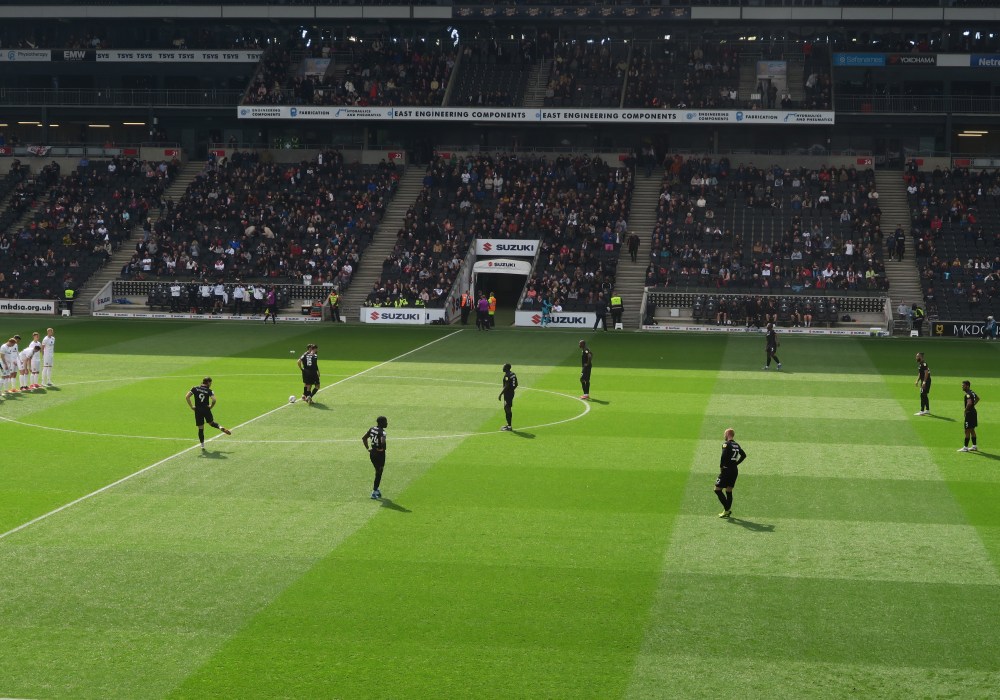
Waiting for the teams to arrive before kick off between Wycombe Wanderers and Plymouth Argyle on Good Friday, 15th April

A tough string of fixtures towards the end of the season has seen Argyle struggle in recent weeks, particularly a demoralising 2-0 defeat at fellow play-off contenders Wycombe Wanderers, but they will know that a positive result on the final day will give them a great chance of securing an unexpected top-six spot.

Saturday’s visitors to Devon, MK Dons, would have been among most people’s expected candidates for promotion before a ball was kicked this season. A mid-table finish in 2020/21 came after an excellent finish to the campaign under hot managerial prospect Russell Martin, who joined the Dons in 2019 and established a successful, possession-heavy approach.

After a big-spending summer, Martin walked out on the Dons on the eve of the new season, leaving the club in the lurch to join Championship outfit Swansea City. Despite being rocked by Martin’s departure, the Dons made a smart managerial appointment, hiring the previously unknown Liam Manning. Since his arrival, the Dons have steadily grown into promotion contenders despite needing to replace a number of important loan players and midfield star Matt O’Riley in the January window, something which could easily have de-stabilised the squad and undermined their campaign.

Although they too have stuttered in recent weeks, losing back-to-back games against Sheffield Wednesday and Oxford United, Manning’s Dons have really found their groove since Christmas, with the defeat against the Owls ending a run of 15 games unbeaten and being only their second loss since 11th December.

By the time these two sides meet next Saturday, some of the remaining issues could be all but settled, which could totally change the complexion of this fixture.

Whatever happens between now and then, both clubs have overcome adversity and unexpected challenges throughout the campaign and although their end-of-season emotions could swing wildly from delight to despair, they should both be extremely proud.

At the Wheel

Argyle’s full-circle journey that sees a winning run ended by Charlton before returning the favour at Home Park

The real beauty of following a football team outside the Premier League is the sheer unpredictability of the story that makes up the season. More generally, it’s the possibility of a wide range of outcomes that makes pretty much all sports so engaging and enthralling. This League One campaign for my team, Plymouth Argyle, has so far been much better than almost anyone would have predicted, with the team recovering from defeat on the first day of the season to embark on a 16-match unbeaten run.

That streak of results came to a shuddering halt on Saturday 20th November away to Charlton Athletic, which just happened to be my second Argyle match of the season, with my attendance seemingly predicating an outcome that was completely foreseeable.

That’s always the issue with any sequence of results, especially one so positive and so long – eventually it has to come to an end. Argyle defied all the odds to be in the position they were going into this game, while the hosts themselves were recovering from a shocking start that cost manager Nigel Adkins his job, meaning the Addicks were being marshalled on a temporary basis by former player Johnnie Jackson. Under his stewardship, Charlton have improved hugely – they were terrible when I saw them lose 2-1 at MK Dons in August – and they undoubtedly deserved this 2-0 win at the Valley.

Moments before kick off at the Valley; 26,000 fans in attendance, including 3,000 visitors

Being a supporter in exile – or ‘up the line’ as it was always known in he Westcountry – adds a layer of detachment from the team that can make it hard to keep up. One of the really great things about supporting a team is the immersion it brings, especially in a one-club community where there are no local rivalries to contend with. When I was young, I remember my parents receiving local newspapers – Western Morning News and Evening Herald – where Argyle were the entire focus of local sports coverage, with match reviews, previews, transfer rumours and conjecture around matches meaning it was easy to keep up to date and feel part of the journey.

Being 250 miles away makes that more tricky, although the wealth of online media makes that easier, even if club-controlled content is, at the very least, polished.

After that phenomenal string of results came to an end in South London, there was an instant demonstration of the importance of momentum in sport with Argyle losing their following two league games against sides chasing promotion as both Wycombe and Wigan came away from Home Park with all three points.

Form and momentum in sport can be so important, but also so fragile. One minute you can be flying and everything feels easy, happening almost naturally with the minimum of effort. That positive sensation can be incredibly difficult to maintain and often there can be little or no way to identify what makes everything click for so long.

On the flip side, that momentum can switch almost instantly and those games where a win was snatched or a draw somehow claimed against the odds become so much harder to find and all of a sudden, it can feel like trying to turn the tide of defeats. It must be incredibly difficult for people in sport to handle momentum in this way – how do you maintain the positive outcomes when you know they can’t last forever and how do you arrest the slide before it becomes insurmountable?

After a brief break to win at Rochdale in the FA Cup, Argyle’s next league game was a trip to somewhere far more familiar to me, MK Dons at stadiumMK.

The day before the trip to Milton Keynes, Argyle took perhaps a more significant blow to their ambitions than a couple of disappointing recent results with news emerging that manager Ryan Lowe would be leaving to join Preston North End. Ryan is a Liverpudlian through-and-through and the vast majority of his career prior to taking the Argyle hotseat has been in and around the north west of England. His previous job saw him take Bury to promotion from League Two with a side playing expansive, attacking football, something he has successfully transplanted to Plymouth, only for the club to succumb to years of appalling mismanagement and ultimately going out of business.

Argyle Twitter went into something approaching meltdown on the day the rumours of Lowe’s departure began to surface, with fans showing their displeasure by giving oxygen to all manner of salacious rumours. Fans are always very quick to turn on players and managers who they feel have wronged their club and this was the case, with many appearing to cite Lowe’s reluctance to relocate to Devon as a sign of him never really committing to the role.

I think it’s important at this point to remember that football people are people too – when Lowe and his managerial team lost their jobs as a result of Bury’s collapse, they would have been in a position of needing to take up a new gig to protect their careers, reputations and to keep a roof over their families’ heads. As a man in his early 40s, Lowe has a settled family in the north west and moving them to a new city, hundreds of miles from home, potentially taking children out of schools and expecting them to settle instantly is, at best, unlikely.

Instead, and as is common in football, he would have taken temporary accommodation in Plymouth, either a long-term stay in a hotel or by renting an apartment, working at training during the week, leading the team into matches and maybe getting home to see his family when the schedule allows.

Add to that the additional restrictions created by the last 18 months in a global pandemic and trying to maintain a connection to his family would have been more difficult than ever.

With this in mind, when he was presented with the chance to return home with a club a division higher (at the moment), it’s hardly a surprise that Lowe took the chance to move to Preston. Even if Argyle are capable of winning promotion to the Championship, Devon will always be a long way from home and that separation will continue to put strain on a man, his family and their happiness.

I don’t blame him at all for making the switch, even with Argyle enjoying a fantastic first half of the season, as it’s impossible to know when the next chance might be. In addition, the ‘life expectancy’ of a manager in the Football League is incredibly short – what would have happened to Lowe if the team’s form had taken a dip, as it did last season, and all of a sudden his job is at risk?

Stepping into the manager’s shoes for the team’s trip to Milton Keynes was his own assistant, Steven Schumacher, making for a sensible appointment that guarantees stability while also providing him with an opportunity to step up and take charge of a team for the first time. Schumacher has been instrumental in establishing the team’s style of play and he will know the characters that make up the dressing room, having worked with them since the start – it strikes me as a situation that works for everyone, especially with Argyle pocketing compensation for Lowe’s departure.

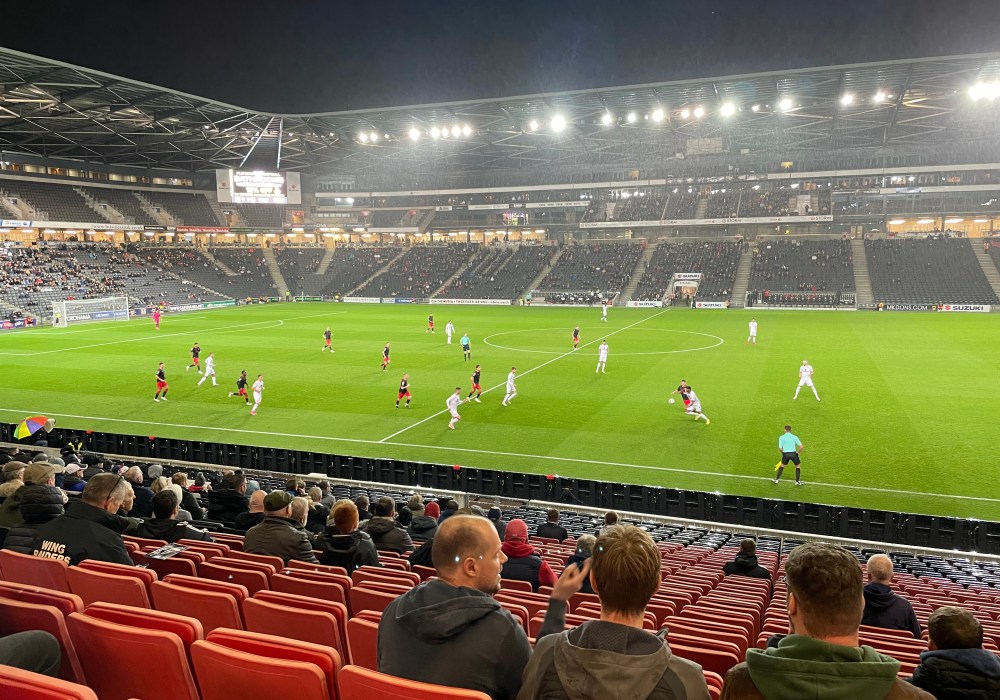
I was able to switch my season ticket seat at stadiumMK for a spot in the away end, creating an unfamiliar feeling to somewhere I know so well – I was there when it was a big concrete whole in the ground and again when it first welcomed football as well as attending some great moments in my time working for the Dons. Taking a seat in the away section for this game was a first for me and it was an interesting change of perspective.

The game itself, which was live on Sky on a Wednesday evening, was actually pretty terrible. The hosts capitalised on a couple of mistakes in Argyle’s defence to take the lead after 20 minutes and then seemingly tried to remove any life from the encounter by reducing the match’s tempo to practically zero.

Argyle made changes after the break and took the game by the scruff of the neck – in particular, the introduction of midfield playmaker Danny Mayor changed the game, and it was no surprise when he was involved in the equaliser, scored by Conor Grant, with about 25 minutes to go. Both sides went on to strike the woodwork before the end, but with 45 minutes of dominance each, a draw was probably the fair result.

The equaliser gave rise to Argyle’s fans celebrating their new manager’s reign with chants of ‘Schuey’s at the wheel’ and ‘Shoes off if you love Schuey’. I was far too cold to be exposing my feet to the concrete steps, but it was a bizarre sight to see so many young lads waving their footwear behind the goal.

Shoes off if you love Schuey: Argyle fans celebrate their new gaffer by raising their footwear

Seeing stadiumMK as a visitor was an eye-opening experience; it is a fantastic stadium, no doubt, and while it is easy to criticise the club for lacking the support to generate the atmosphere it deserves, games there do lack the intensity of a large crowd, with such a huge percentage of the ground sitting empty and large gaps between fans as a result. It’s great for social distancing, but it  does nothing for bringing supporters together and creating the sense of community and togetherness that fosters support and emotion.

Whether or not MK will ever truly have a team befitting of this wonderful stadium remains to be seen. I hope it does, but my personal experiences from this season have left me feeling indifferent towards the team, primarily because the matchday experience lacks much of the edge and energy that makes going to football such a great event.

Argyle’s next away day probably provided the exact opposite atmosphere with the prospect of English football’s longest trip by way of a trek to Sunderland. I had considered making this journey myself as the Black Cats’ Stadium of Light home is a ground I’ve yet to visit – however, I was left feeling inadequate after deciding it was a trip too far for me after learning that over 1,000 away fans did make the trip. Perhaps next season, depending on the two clubs’ respective outcomes this campaign, when I’ll have the majority of my Saturdays back after not renewing my season ticket at stadiumMK.

It’s incredible to think that so many fans made that trip and it must have been heartbreaking to see Argyle go two down in the first 13 minutes, but these things can happen and they so often do. In the end, Argyle claimed a goal in the second half to lose 2-1, meaning that their 16-game unbeaten run was instantly followed by four defeats in five in the league, including a draw and a defeat for the new manager.

But football has a strange habit of weird sequences and symmetries; almost exactly a month after seeing their bubble burst on a Saturday afternoon in South London, Argyle would welcome Charlton to Plymouth for the return fixture and the first for Jackson since being confirmed as the Addicks’ full-time manager.

After a start which saw the visitors come close to scoring twice in the first 20 minutes, Argyle took the lead in first half stoppage time through Kieran Agard and after the interval they created the better chances, deservedly claiming the win despite being unable to double their lead.  I would’ve loved to have been there for this clash – Schumacher’s first home game in charge and a worrying dip in form turned around just in time for the busy festive period (Covid cancellations allowing), but unfortunately that’s the nature of being an up-the-line fan.

Even though I’ve only seen Argyle in action three times so far this season and I was really apprehensive about how I’d take to following them again after so long, I’ve absolutely loved the experience so far. While Premier League clubs seem to be more detached from their fanbases and communities than ever, becoming essentially the content generation departments of corporate investment growth conglomerates, it’s been fantastic to re-connect with the club that fostered my original love for going to matches and actually watching football.

And while it’s obviously easier to become attached to a winning team, it’s not as straightforward as that – seeing the team encounter and overcome the challenges that are inevitable in the course of a season are what makes football – and, more broadly, sport – so enduringly engaging. You hope it will go well, you expect that it won’t and whichever way it goes, you just have to roll with it.

When things are going well, you have to make sure you ride the wave and remember the good times, because when the coin is flipped and you’re on the end of a sticky patch, the memories of the good times can keep you going.

Embracing the Rain While the Champions League Comes Calling

In celebration of being a part of the action by attending in person instead of taking in a game on the box

The near instant transition from summer to autumn confirms that the football season is firmly up and running, to the point that looking at league tables is now valid. With that in mind, it’s both surprising and encouraging to see my two League One sides, Plymouth Argyle and MK Dons, threatening the upper reaches of the table.

Before the start of the campaign, both teams had reason to be negative about the months ahead, with Argyle’s form last season suggesting a possible relegation battle while the Dons headed into the unknown having lost their manager just days before their first game.

Instead, both sides have won more games than they’ve lost, picking up 19 points from their first ten games and defying expectations.

While Argyle can be seen as the division’s real surprise package so far, rubbing shoulders with the likes of Sunderland, Wigan Athletic and Wycombe Wanderers, the Dons are perhaps the league’s entertainers, scoring 20 goals and conceding 13 in their opening encounters.

The most recent fixture at stadiummk saw Fleetwood Town visiting; a side who have struggled so far this season, picking up only ten points from their first nine games.

Taking place on a Tuesday night, the game represented an example of a lower league club’s worst nightmare – direct competition with a televised Champions League matchday, the focus of which was a clash between Manchester City and Lionel Messi’s Paris Saint-Germain, a game which many believe could be a pre-cursor to the ultimate winner of that competition.

Attracting fans to a stadium for live action when a big game is on the box is a tough challenge – made even more difficult by torrential rain in Milton Keynes with casual punters dissuaded from parting with their cash in favour of kicking back to see how that PSG front line is actually working together.

Before the start of the season, my knowledge of my local team and its players was practically zero. After a few games, however, I already feel more in tune with who the team’s leaders are, who the potential match winners are and who could be concerned about their place in the side.

Meanwhile, my connection to my ‘big’ side, Tottenham, continues to wane – and not just because the club seems to be constantly searching for a new crisis, ready to lurch from the current one with spectacular drama and embarrassment. That’s not solely down to the side’s steady drift down the Premier League table, but also because, in my opinion, actually going to matches is a big part of the experience of following a club.

There’s so much more to attending games than simply the game or the action, much of which revolves around the social experience and sharing it with other people, even if they are total strangers.

On this particular occasion, those of us who eschewed the televised action in favour of the real world were treated to a proper game between two sides who really went for it. Despite their lowly position in the table, Fleetwood played on the front foot and looked to get bodies forward, which hasn’t always been the case for some of the Dons’ opponents so far this season.

It made for an entertaining game, not just because of the 3-3 scoreline, but because both teams looked like they wanted to attack and create chances. So far this season, I’ve been really impressed with the standard of football on show from almost every side. In particular, my previous visit saw Portsmouth as the visitors for an evenly-matched, entertaining game, which ultimately resulted in a 2-1 win for the Dons.

I don’t come at this from a particularly technical point of view – I’m not a coach or an expert in tactics by any means – so I’m just a punter with no horse in the race, but still the experience of going to matches again has been well worth the investment in my season ticket. Thinking back a few years ago, football at this level was not always a great spectacle; most sides seemed happy to be solid and hard to beat, aiming to maybe nick a goal with a set piece, but sies playing in that manner seem to be the exception rather than the rule.

While I still wouldn’t class myself as a Dons fan, there’s no substitute for actually attending a match; watching games, highlights and YouTube clips from afar is not the same as actually feeling it when the action takes place in front of you. Even on a rainy night in a quarter-filled stadium, you’re essentially part of the game rather than simply observing it on the box.

It’s essentially a case of an active experience in contrast to a passive one – when watching football on telly, it’s easy to drift in and out of attention. You pick up your phone and briefly scroll the socials, maybe like a few cat videos and then return to the game when Gary Neville’s commentary reaches fever pitch. When you’re actually in attendance, you’re far more immersed in the occasion, observing the actions of the players in any given situation and taking in the reactions of the crowd.

This is even further amplified when the result really matters – nothing beats the feeling of a last-gasp equaliser or that moment of brilliance that turns a game in your team’s favour. While my match-going experiences so far this season have been limited to attending as a neutral bystander, I can’t wait to get behind Argyle when I can. My first planned trip to see the Greens in action was at Wimbledon a couple of weeks ago, but all tickets were sold to season ticket holders before general sale, showing the popularity of following the team on the road. It’s now looking like my first Argyle game of the season might be Oxford away on 16th October.

Back at stadiummk, the crowd of 6,600 (including probably 100 visiting fans) were treated to an absolute cracker of a game, which ultimately resulted in a share of the spoils thanks to a late equaliser from the away side. Dons were dragged through the game by an excellent performance from Scott Twine, who sealed a brilliant hat trick with a direct free kick that smashed the crossbar, bounced down onto the line and into the roof of the net.

It must have been a great night out for the away fans who made the trip; the journey is a shade under 200 miles as the crow flies, making it a late night on Tuesday. Those who did make the trek certainly looked like they were enjoying themselves and they would definitely have gone away happy, having claimed a richly deserved point with an 88th minute equaliser.

While City were being put to the sword by Messi, Neymar and pals, I never once regretted my choice to go out and watch the game as opposed to staying in for a different one. It was cold, it threw it down with rain and there were no petrostates inflating the wage bill, but it was real, it mattered and I felt like a part of it.