Glory on the Roubaix Cobbles Confirms Deignan’s Place Among the Very Best

By claiming victory on the first ever Paris-Roubaix Femmes, Britain’s Lizzie Deignan added another historical page to her incredible career story thanks to one of 2021’s stand-out sporting performances.

Paris-Roubaix is arguably the jewel in cycling’s one-day race crown; it features unrivalled spectacle with the mud or dust (depending on the weather), the brutal cobbled roads and the iconic finish in the Roubaix velodrome.

2021’s edition of the race was its 118th, showing the incredible longevity and tradition that this runs through the soul of this event, one in which is held in the greatest of esteem. Which begs the question – why did it take so long for there to be a female version?

After pandemic postponements in 2020 and spring 2021, Saturday 2nd October saw professional female cyclists finally given the opportunity to tackle the race known as the Hell of the North, breaking down yet another anachronistic barrier perpetuated by sporting patriarchy.

Recent editions of the Women’s Tour, Giro Rosa and Ronde van Vlaanderen have shown that female cycling is, in its own way, equal to or greater than its more established male equivalent in regards to action, excitement and certainly unpredictability. In many ways, as women’s cycling continues to develop in terms of professionalism and organisation, it avoids much of the structure and regimentation that makes male cycling often predictable.

As an event, Paris-Roubaix is best known for the cobbled roads and tracks which make it the ultimate test of strength and endurance. Being the first female edition of the race would add to the element of unknown, as even though the riders and their teams could have carried out plenty of preparatory training rides to understand the characteristics of the surface, there’s no substitute for actually riding in race conditions and handling the fatigue that comes from this kind of situation.

While the topography of this part of France may lack the long, torturous mountain passes of the Alps or the leg-burning gradients of neighbouring Flanders, there is nothing quite like the draining effect of riding through wind, rain and mud combined with the repeated efforts of surfing the cobbles, where each contact with the ground feels like being punched through your front wheel.

This first edition of Paris-Roubaix for female riders would always hold a place in the record books, with whoever won forever being the first winner, but that it should be Britain’s Lizzie Deignan who stood head and shoulders above the other 128 riders was testament to her steel and resolve to continue what has already been a glittering career.

With a total of 17 cobbled sectors on the menu for the riders, it must have come as a surprise to the vast majority of the incredibly strong field, featuring star names such as Marianne Vos, Chantal van den Broek-Blaak, Kasia Niewiadoma, Annemiek van Vleuten, Lotte Kopecky and Lisa Brennauer, when Deignan launched her attack, solo, with over 80km to go and not a single cobblestone traversed.

Moves of this nature are often doomed to failure, with the chasing riders able to work together in order to either prevent a significant lead being built or to allow the breakaway enough licence to accrue a margin, yet never being in danger of losing the race altogether. For a rider to win by way of a long range solo attack is surely among the most revered of sporting successes; the ultimate demonstration of courage, commitment and determination by effectively taking on and beating everyone else. One versus 128.

However, perhaps because of the course or maybe the wet and muddy conditions which saw many riders hit the deck and either lose time, motivation or both, Deignan was able to steadily build and hold a lead of over two minutes, while the field behind her whittled down to just a select few.

Into the final 20km, with the riders’ bike handling skills under stress being increasingly tested, it was perhaps the greatest competitor of them all, Vos, who struck out to try and reel in Deignan, both to eviscerate the remaining chasers but also to make what she hoped would be the winning move.

The race became a classic cat-and-mouse chase, with the Dutch superstar gradually eating into the British former World Champion’s cushion. It was impossible not to keep one eye on the clock, counting down the remaining KMs while also taking in the suffering of both riders, digging increasingly deeper to either hold on or break through. This was attack versus defence in cycling form; a nervy head-to-head, yet one where the two opponents were roughly a kilometre apart and unable to look each other in the eye.

Moments like this are among those which make road racing such a captivating sport. In a race which takes roughly three hours, it’s these periods of action where the outcome is completely in the balance that make this kind of endurance event enduring. Both riders on the rivet, giving everything to try and win the race, to take a unique place in the sport’s history, knowing that the tiniest lack of concentration or something totally out of their control, could derail their effort and hand victory to their rival.

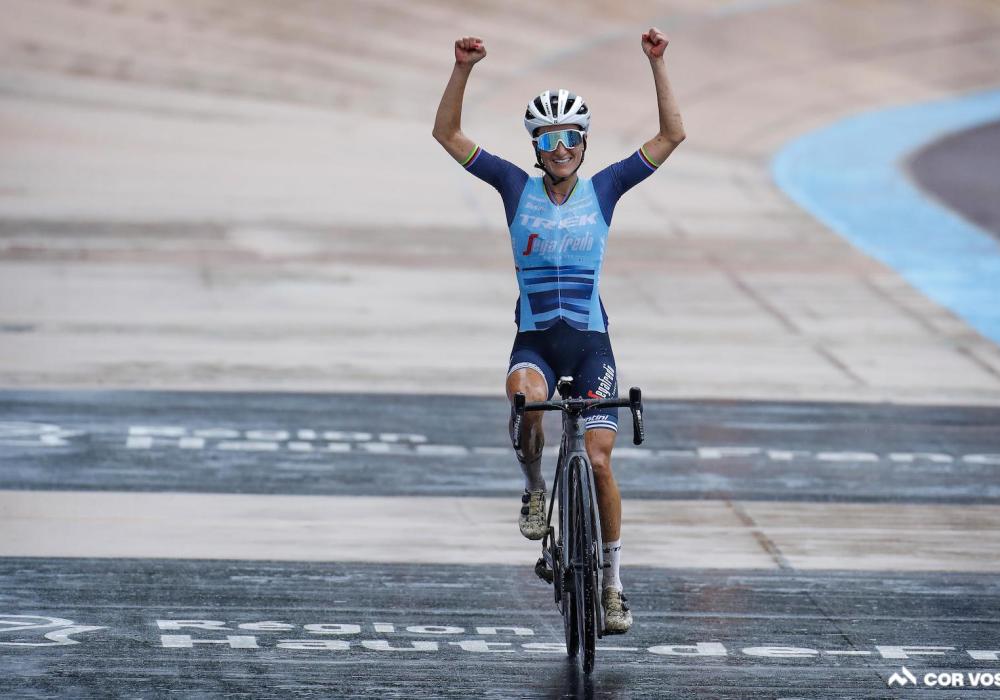
Deignan dug in, keeping Vos at arm’s length and reached the velodrome on her own, able to enjoy the final KM as a victory lap-and-a-bit. Crossing the line and raising her arms in victory gave perhaps the final insight into the effort it took to win this race, known as the Queen of the Classics, showing blood running from open blisters on her hands, worn down by the vibrations through her handlebars. Despite this, her grip never faltered, either on the bars or on the race, as she deservedly became the first ever winner of the Paris-Roubaix femmes.

This was a performance of the ages, one initiated with bravery and audacity but maintained through guts and a refusal to give in. It was fitting of the occasion and history it would create that the inaugural women’s Paris-Roubaix should end this way, with the riders spent physically, faces covered in mud and a field split to pieces, adding to the gravity and spectacle of the event.

Long may Lizzie’s win be remembered and celebrated as a landmark in cycling and female sport.

The Boss: Why One Rider Must Surely Be Seen as the Best

Last weekend’s World Cyclocross Championship was billed as being a clash between two of the sport’s greats, with Belgium’s Wout van Aert and Mathieu van der Poel of the Netherlands going head-to-head on Ostend.

As these two continue their rivalry on the road in addition to their history through the mud, they are increasingly becoming the Federer/Nadal or the Hunt/Lauda of their sport; two geniuses seemingly driving the other to greater and greater heights, something that we as fans can look forward to for years to come.

While the race itself ended as something of an anticlimax as a result of van Aert’s puncture and subsequent deflation, there was another great to be celebrated over the weekend, with arguably the greatest of all time also taking on the dunes, waves and man-made bridges of the World Champs course.

After all, how many cyclists possess a palmares that includes winning the Giro d’Italia on three occasions, three road world titles, seven world cyclocross wins, victory at the Ronde van Vlaanderen and multiple successes at Flèche Wallone as well as their national championships, in both the time trial and road race. Not forgetting Olympic gold medals and a list of further one-day classics as long as your seat post.

Worked who that might be yet? How about if you add in four wins in the Trofeo Binda and one Women’s Tour in 2014? And she’s only 33 years old.

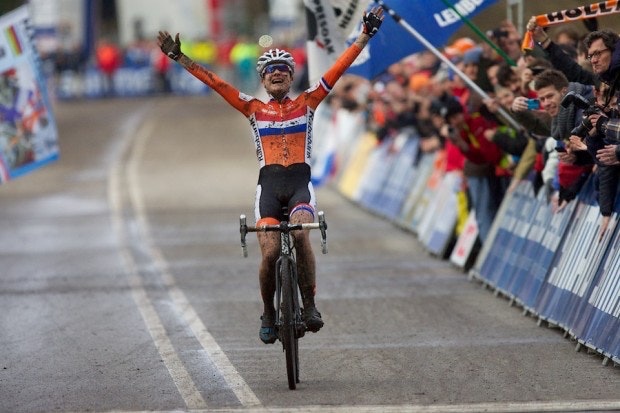
Marianne Vos wins the 2014 Cyclocross World Championships – her sixth consecutive crown.

Marianne Vos has to be considered among the greatest cyclists ever. Few athletes have enjoyed the kind of longevity she has endured and continued to claim the highest honours across a variety of disciplines – in addition to the above wins, she has also won World Championships and Olympic gold on the track and she has a history of winning mountain bike races too.

In all honesty, comparing cyclists of different eras is wholly pointless as the sport changes so much from one generation to another as to make those comparisons pointless. This is even more true when it comes to comparing men and women; the worlds in which the two sports exist are so vastly different, with resources, support and coverage being just the clearest contributing factors.

If you’re hoping for a straight-up Vos vs Merckx battle to the death, then this article may be disappointing.

After a change of teams this winter, Vos joins the Dutch Jumbo-Visma squad, making their first forays into women’s cycling after out-Skying Team Ineos over the last couple years in the men’s peloton. This will be Vos’s 17th as a professional as a result, in an elite career stretching back to 2002 when she was just 15 years old. Two years after first making an impression on the Dutch cyclocross scene, she won her first international race in 2004, followed quickly by the junior world championships, indicating the precocious talent she was developing.

Having won the senior world cyclocross title in 2005, her breakthrough season was perhaps more arguably 2006, when, still aged just 19, she retained her world XC crown and then followed it up with a series of successes on the road, leading to claiming the rainbow jersey from a stacked field in Salzburg, Austria. That success was then backed up by overall victory in the Women’s World Cup in 2007, second place in that year’s world champs and then two track gold medals in the 2008 Beijing Olympics.

For a rider to be as consistent as Vos across all the different disciplines is incredible. As she continued to dominate her sport through and beyond another Olympic cycle, including winning the 2012 gold medal on the road from Britain’s home favourite Lizzie Deignan, Vos also won the 2014 Giro d’Italia Femminile and the first edition of La Course, having been instrumental in bringing about the creation of a race in France from the organisers of the men’s Tour.

However, as she continued to rack up the victories, it was clear it would take something huge to halt her ascent, something which arguably came to pass in 2015, where a combination of injuries and overtraining forced the Dutch superstar to take an extended break from the sport.

In recent years, there have been several high profile cases of riders taking time away from competition to evaluate their continued commitment and determine whether or not racing remains a high enough priority to justify the sacrifice and the suffering. The latest example being Vos’s fellow Dutch rider and briefly team mate, Tom Dumoulin, who last month announced that he will be taking a hiatus of unspecified length.

Speaking in October 2015, Vos made it clear that taking time away was the right thing to do, even if it went against every instinct she had grown to rely on. She said: “Rest is currently the best way to return as soon as possible on the bike; that’s the hardest race of my career because I have always achieved results by working hard.” To recognise the signs of overtraining and take steps to address that issue goes against the common characteristics of almost any elite athlete, most of which are used to going further and further to achieve their goals.

However, Vos deserves huge credit for the way she approached her condition, recognising that she couldn’t power through and take her usual winning approach to crushing her opposition, due mainly to the unknown and unpredictable nature of recovering from overtraining. “The only thing against it that helps is complete rest. I then, with the doctors, took up to three months to fully rest.

“Overload is difficult to gauge and for me it’s also unclear. It would have been easier if I had a broken leg. That is easy to explain. I do not feel bad, but I simply do not recover from great efforts… It’s frustrating when you want to perform well and you find you are unable to pick up your level.”

As this kind of career break becomes increasingly prevalent, it only serves to highlight the commitment and resolve that someone like Vos must have needed to return from her own time away when she resumed road racing in 2016. By this time, she surely had done everything she could in the sport and on our return the landscape of competition had changed with compatriots Anna van der Breggen and Annemiek van Vleuten now the dominant forces in the peloton, seemingly sharing the big victories between themselves.

It’s at this point that Vos should be recognised for persisting with her return despite not enjoying the ascendency as she did previously. Surely it would have been easy, perhaps natural, at this time to see that her place at the pinnacle was no longer assured, something which would almost certainly have diluted the enjoyment for many others in her position.

However, Vos was seemingly determined to prove that her joy from cycling went deeper than domination, as she has slotted back in amongst the group, taking opportunities to claim wins as and when they arrive, including two European Championships, another La Course and that fourth Trofeo Binda.

No-one doubts that it’s tough at the top of any sport, but being so clearly better than your competition must make the relationship between the work needed and the success enjoyed more straightforward to comprehend. When you know how it feels to win and you understand the pathway to success, it surely makes the sacrifice needed more bearable.

The reverse of this must also be the case when a true great sees their place in the sport’s order upset by newcomers. The temptation for Vos to walk away from her sport completely after her recuperative period must have been vast, but seemingly not as great as the desire to continue competing and, ultimately, winning.

That level of dedication, to come back after physical and mental fatigue and still be among the regular winners after such a long and celebrated career, demonstrates why Vos must surely be recognised as the campianissimo of the sport – the very, very best.