Sweet like chocolate: Swiss-style Champions League league phase nears conclusion but what have we learned?

Ahead of next week’s fixtures in the catchily-titled Champions League League Phase, we find ourselves five-eighths of the way through the new “Swiss-style” model, making now as good a time as any to review its impact so far.

Prior to the new format being rolled out this season, there was much consternation and gnashing of teeth about what it might bring: the huge new table, more fixtures and almost certainly heavier defeats for the European game’s “lesser” lights.

As it turns out, that hasn’t really been the case. There have been some hefty drubbings dished out, such as Bayern Munich’s 9-2 win over Dinamo Zagreb on matchday one or Borussia Dortmund crushing Celtic 7-1 on matchday two, but on the whole, there have actually been more surprise scorelines than might have been expected.

Results such as Monaco beating Barcelona 2-1 (although Barça’s recent travails made that one not a huge shock), Lille claiming the scalps of both Madrid sides on consecutive matchdays or Sporting overcoming the loss of head coach Ruben Amorim to beat Manchester City 4-1 on matchday four.

It is still hard to predict the final outcomes of the 36-team super-table, but it is clear that some clubs have struggled to meet their historical best – specifically Manchester City, Real Madrid and PSG, with the Parisians looking to be in the most peril.

However, with three games still to play, it is still hard to see all three clubs not making their way through to the knockout stage, even if they find themselves in the play-off stage rather than leapfrogging straight to the final 16.

PSG look at most risk, but with games to come against RB Leipzig, who are set to be the League Phase’s biggest casualties, Manchester City and Stuttgart, who have also underperformed, seven more points looks plausible, which would mean 11 for the final standings and probably a play off spot.

Meanwhile, for Madrid and Manchester City, the competition’s last two winners, of course, a further five points should do the job. Madrid do have to face Italian league leaders Atalanta in their next fixture, but with points already in the bag and games against RB Salzburg and Brest, currently defying expectations in 11th spot, they should be ok. Same goes for City, who despite a terrible run of form domestically should still progress comfortably – they have 8 points to their name and games coming up against Juventus, PSG and Club Brugge.

So while Liverpool, with five wins from five, peer down from the top of Mount League Phase, what does this all tell us? Well, not much more than the previous format, in all honesty.

We’re still most likely to see the “biggest” clubs in the knockout phase, despite the odd travail and  blooded nose along the way. Even if there is a surprise elimination at this stage, that happened in the past too – just last year, we all chuckled heartily at the ongoing malaise at Old Trafford as Manchester United came last in their group. Milan, Newcastle and Sevilla were also among the list of clubs from the big five leagues that failed to make the knockout stages.

If anything, the new format has killed off the previous format’s most egregious failing – that which saw group stage failures rewarded with a parachute into the knockout stages of the Europa League. This at least makes the second and third tier competitions ‘cleaner’ – no last-minute super club additions to swoop in and steal the silverware. Or Sevilla, just for a change.

There is also the argument that more teams in this pre-knockout phase has meant more opportunities for “smaller clubs”, with teams such as Dinamo Zagreb, Club Brugge and – with apologies for highlighting Scottish football’s place in the world – Celtic in with a chance of making it through. However, getting to the play-off round is in effect the same as making the final 32 (ie, a play-off to reach the round of 16), so all the new format is doing is eliminating an extra four teams, which at the moment are likely to be Young Boys, Slovan Bratislava, RB Leipzig (all on zero points) and Bologna (one point).

Should those faltering big clubs make the play-off round, they will then face a two-legged tie against one of the other teams outside the top eight. This play-off is seeded, with the teams from 9-16 drawn against opponents from 17-24, so based on current standings Madrid could face Milan, Benfica or Bayern – or they could be paired with Lille or Brest, who have already sprung surprises in this competition.

This kind of proves the point that this complicated league phase has changed nothing – the competition only really gets going when it reaches the knockout phase, bringing with it the element of unexpected clashes that really matter, with no safety net for underperforming losers.

Instead, all we have really seen from the bloated group stage is more ultimately meaningless encounters between the biggest and richest. So far we have seen Inter beat Arsenal, Barcelona beat Bayern heavily and Liverpool win at Milan, but so what? None if it matters at this stage.

It’s all just the biggest clubs swelling their already stuffed coffers with more cash. More matches as content and more eyeballs and flashy social media highlight reels.

Any stories that have been created so far have centred around negative narratives associated with the names we already know – Mpabbé’s struggles in Madrid, Guardiola’s head-scratching at underperforming City or Slot’s machines taking the table by strorm. There has been practically zero spotlight for Monaco, riding high in 8th, or Brest punching well above their weight. It would have been fantastic to learn more about clubs making headlines like this, but there’s no oxygen for them among all the noise of the big boys chasing clicks.

No one is suggesting that the previous format was loved and created endless classic clashes – the truth instead was a bundle of dead rubbers towards the end of the group stage and maybe one or two games that really mattered. But at least it was over sooner – this seemingly endless League Phase will still be live in the last week of January, meaning extra complication as the transfer window creeps towards slamming shut.

The previous format felt like what it was: a preliminary series of fixtures that ultimately weeded out the sides expected to be eliminated while also creating revenue and security for the biggest clubs. By contrast, the new format does this too, but with less clarity, more meaningless games and with greater threat to the rest of football, portending towards the inevitable European Super League, where inconsequential mid-table clashes between Atleti and Juventus will be the norm while also further distorting domestic leagues by channeling funds to only one club from countries like Denmark, Belgium or Slovakia.

Knockout football always was and always will be the great leveller in football; any team can beat any other on the right day and in the right circumstances, even over two legs. Minimising that format in favour of an expanded league system reduces the risk, creating more opportunities for recovery. And the bigger the league, the more fixtures it creates, the greater the safety net. It only serves to close the shop further, reinforce the exterior window and stretch the arm at which the rest of football is held at bay.

The biggest clashes on famous nights in European competitions always felt so important because they happened so rarely – supply and demand exists in football as in economics, so scarcity increases value. Just spamming the fixture list with more games between the biggest names only makes those encounters less significant in the long run.

No doubt this format will appeal to many fans by creating more fixtures between the biggest clubs, but you really can have too much of a good thing. A dash of syrup in your coffee can add an extra sweet hit, but if you’re already serving yours with multiple spoons of sugar, swirly cream and and a chocolate flake, then you’re probably only heading towards diabetes.
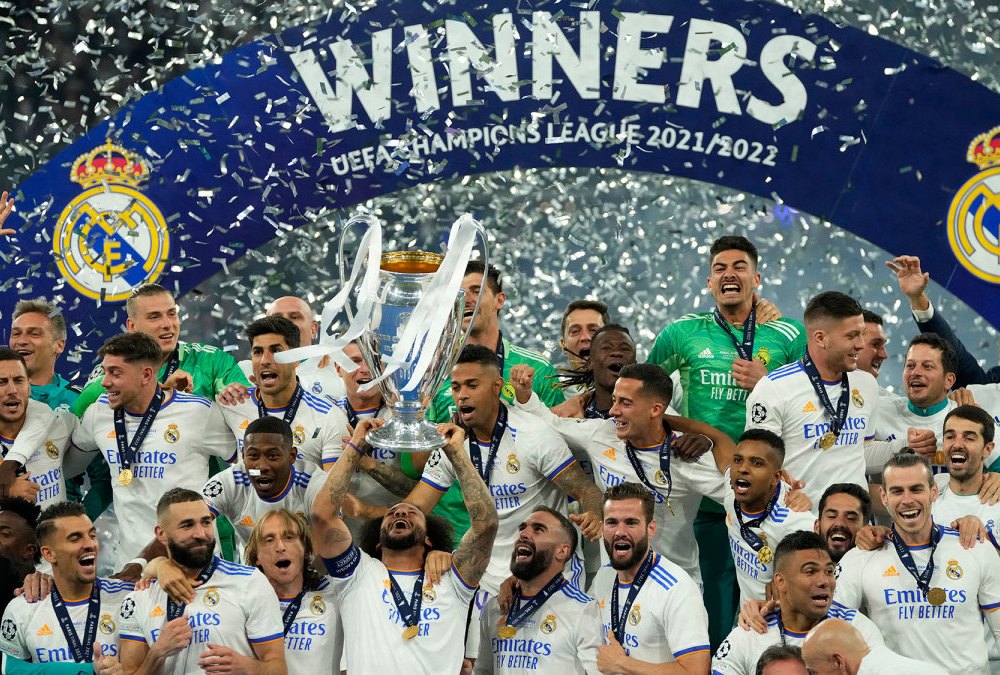
Real Reign Supreme: Europe’s Most Elite Club Stay On Top

When Vinícius Junior found himself in space to find the net with what turned out to be Real Madrid’s sole shot on target in the entire Champions League final on Saturday evening in Paris, it felt strangely inevitable yet also something of a surprise.

That moment in itself was essentially a condensed version of Real’s entire campaign – while it seems far-fetched to view the competition’s most successful side in history, now having won European club football’s highest honour 14 times, as something of an underdog, that is kind of true.

Perhaps a more fitting characterisation would be of old-money establishment putting the new-money upstarts in their place, with a run to the final that included victories against Paris St Germain and Manchester City either side of eliminating sanction-stricken Chelsea. In all three of those two-legged ties, this Real side, packed with ageing superstars seemingly playing on beyond their best, somehow found a way to get past their opponents when it seemed impossible.

In each of those knockout ties, Real were seemingly dead and buried, from turning the PSG tie around in the last 30 minutes, through taking the Chelsea quarter final to extra time and on to that incredible stoppage time flurry against City when 3 goals in the 90th minute turned a 3-5 deficit into a 6-5 win on aggregate. That this team keeps finding paths to victory in all those circumstances speaks volumes for the mentality of their players and coach, Carlo Ancelotti.

Once again, in this final against Liverpool, defeat looked most likely but thanks to a combination of an outstanding goalkeeping performance from Thibaut Courtois and a collective determination to keep soaking up pressure, this team kept Jurgen Klopp’s Reds at bay before exploiting one of few potential gaps in Liverpool’s defence – namely the possibility of finding space behind star wing-back Trent Alexander-Arnold – to score the game’s only goal with half an hour still to play.

Coming in to the match, a Liverpool win looked the most likely outcome; Klopp has assembled a fantastic team built on hard work, collective excellence over individual brilliance and the forcing of errors through intensity. The creative genius of Alexander-Arnold, the explosive pace and goalscoring feats of Mohamed Salah and the silky-smooth assurance in defence of Virgil van Dijk – there’s no doubting that this side is among the very best – which also shows just how good the current Manchester City side is to shade them in the Premier League title race.

However, there’s just something about this Real team – whether it be the experience of Toni Kroos, Luka Modric and Casemiro in midfield, the explosive talent of Vinícius out wide or the scruff-of-neck number 9 play of Karim Benzema, they just keep finding a way to navigate through almost any situation to victory.

Surely much of the praise deserves to go to Ancelotti; this time last year, the Italian had led Everton to an un-noteworthy 10th place in the Premier League, raising questions about his future and perhaps signalling the end of his time at the top table of coaching. When he resigned from his post at Goodison Park to return to the Santiago Bernabeu, many eyebrows were raised, with few expecting him to succeed in the shadow of Zinedine Zidane, despite his second spell in charge of the club having failed to live up to the success of his first, when they claimed a hat-trick of Champions League wins.

This latest success makes Ancelotti the first coach to win the Champions League on four occasions – twice with Real and a further twice with AC Milan. In addition, his record of having won domestic league titles in Italy, England, France, Spain and Germany demonstrates his ability to adapt and develop a winning formula wherever his travels take him. In a footballing world of philosophies and blueprints, where winning isn’t always enough and defining a whole new way of playing the game seems to be desired, Ancelotti’s style seems to be a far more basic one: just win. With style, if you can.

That has been exactly what Real have brought to this year’s Champions League campaign – when the odds have been against them, they’ve managed to stay in games and force their way back into contention, maximising their steadfast belief that they would ultimately come out on top. Benzema in particular has stood out in this team, free at least from his role as Ronaldo’s wingman; his first-leg hat-trick at Stamford Bridge was the highest of highlights, but Modric and Kroos are equally as essential to Real’s success with their unwavering consistency and ability avert danger by shifting the play from one area of the pitch to another under pressure. As a midfield pairing, their understanding of the space they occupy and how to find more elsewhere without sacrificing possession is unrivalled, helping Real avoid the unforced errors that Liverpool impress upon most.

Perhaps on another day, Liverpool might have scored from at least one of their first half opportunities and put this game to bed. Had that have been the case, however, this season’s form suggests that Real would probably still have clung on in this final and again managed to snatch an unlikely victory. As it was, the longer this game went without a goal, the more visibly Liverpool became frustrated and the more a Real win looked on the cards.

When Federico Valverde’s cross found its way to the net via Vinícius’s well-timed run and finish, it felt beyond one of those entirely predictable moments that turn games and more akin to the exertion of will by an empirical force. That sense of the established power ruling through tradition and entitlement, manifested in this case through unwavering confidence in their ability come out on top. They just know that they will ultimately win, so they do.

As a result of their historical success in the European Cup and Champions League, no other club is as closely tied to the competition than Real. This in itself is hugely ironic when you consider the role played by the club and their president, Florentino Perez, in trying to kill UEFA and its flagship tournament by forming and flogging the European Super League fiasco a little over 12 months ago.

So after all, despite that attempt at a coup de t’at last spring, European football’s most haughty member of the establishment were able to flex their muscle on the field when it mattered most and keep their hands on the sport’s biggest prize, which does make it difficult to totally commit to their underdog, against-the-odds journey to lifting the trophy.

Just when you think this team, this club and perhaps even this category of super club – lacking the bottomless pit of petrodollars of their rivals – has done all it can and reached the end of the road, they somehow find a way to stay in the game, stay in the competition and stay relevant in the sport. The bloodline continues, the monarch refuses to die and the Champions League’s kings just keep on winning.

PSG Eventually Overcome Atalanta Despite the Heavy Weight of History

On what was essentially opening night for the compacted Champions League, which sees this year’s edition minimised into a tiny tournament in Portugal, there was no lack of drama and excitement in the first quarter final, between minnows Atalanta and money bags Paris Saint-Germain.

Much had been written in the build-up to the game about the gaping difference between the two sides’ playing budgets and the fairytale that has seen the side from Bergamo in Northern Italy, where the Coronavirus crisis really kicked off on March, scrap and battle their way to the quarter-finals. In particular, this is a team making its debut in Europe’s elite competition and which began that campaign by losing their first three fixtures in the group stage. For them to even reach the final eight is a fantastic story and a testament to a team that embodies the concept of ‘more than the sum of their parts’.

And yet, when it came to the crunch, there was something achingly inevitable about the outcome of this fixture – a 2-1 win for the Parisians – despite ultimately needing to make use of every available minute beyond the scheduled ninety.

That the eventual heroes for PSG were not the hugely price-tagged Neymar or Kylian Mbappe but defensive midfield lump Marquinhos and former Stoke City plodder Eric Maxim Choupo-Moting demonstrates perhaps the desperation that had set in among the Paris side, throwing everything at Atalanta in search of a late reprise.

When Mario Pasilic opened the scoring for the underdogs midway through the first half, it was no less than their play to that point deserved. All eleven players appear committed to the high-pressure, high-intensity approach deployed by head coach Gian Piero Gasperini and it is easy to see why they have attracted so many admirers along the way so far. Playing with ambition and imagination in the final third, they created a number of good chances before eventually taking the lead, despite the best opportunity falling to PSG’s Neymar, who completely fluffed his own lines, scuffing wide in a one-on-one situation with Atalanta’s stand-in ‘keeper, Marco Sportiello.

With 2018 World Cup star Mbappe rated as only 80% match fit and therefore starting on the bench, PSG relied heavily on the Brazilian Neymar from the outset. That reliance is almost certainly their Achilles heal, placing what must be a mass of pressure on the shoulders of one player. It was almost like watching the Brazil side that Neymar nearly carried to World Cup glory in 2014, when the South American nation hosted the tournament and ultimately crumbled in the semi-final against Germany, having lost their talisman to injury in the quarters.

Throughout that competition, Neymar was the standout star in a fairly average team that was nowhere near the level of quality demanded by fervent home support. It must be incredibly tough to carry that kind of expectation and deliver consistently, regardless of how many zeroes appear on your payslip.

Throughout this game, Neymar appeared to be living his own personal nightmare – he was regularly appearing in the right places, creating opportunities for himself and others, yet nothing clicked, everything seemed forced and unnatural.

It is easy to dislike this PSG side, for their petro-funded assembly of global talent, their classless baiting of Borussia Dortmund earlier in the competition and for their boringly relentless success in their domestic league.

However, much as we all chuckle when this year’s edition of the PSG Champions League catastrophe plays out in front of us, it’s easy to forget, that these are humans, young men too. After their 6-1 collapse to Barcelona and last year’s humbling at home against a supposedly crisis-ridden Manchester United, there must always be a nagging element of doubt in the minds of these players as to whether things will actually ever go their way.

In the build up to what seems like every PSG tie, there grows an air of ‘Good versus Evil’ about proceedings, with the Paris side being pitched as the bad guys because of their Qatari owners and the funds sloshing around in their budgets. But maybe it’s worth remembering that these are essentially just men, footballers, lads too – when they grew up kicking a ball around on an estate or a beach somewhere, it’s almost certain that they dreamt of scoring goals, winning medals and celebrating with fans, not becoming a collection of Bond-style footballing henchmen, taking up arms against the next plucky underdog story to come their way.

While it would certainly have been an incredible story for Atalanta to become the first Champions League debutants to reach the semi-finals in 14 years, as with almost every football narrative, there are two sides to every story. When Neymar sliced that incredible pass through the tiring Atalanta defence last night to find Mbappe and provide him with the space to lay the winning goal on a plate for Choupo-Moting, there must have been a huge sense of relief for all involved.

Ever since he first appeared as an angular teenager with incredible skills, Neymar has been burdened by the lineage that he represents in Brazilian football – Pele, Romario, Ronaldo et al. The weight of that history alone would be huge to contend and perform with, but this is a player who has also traversed the demands of a spell at Barcelona in the shadow of Leo Messi and then onto his own stage in Paris, where every performance comes with a golden asterisk.

When Neymar and PSG falter, the footballing world smiles, points and laughs. When they succeed, it is shrugged off as only being an inevitable result of the expenditure.

Love or hate Neymar and his band of well-paid men, maybe sometimes it’s ok for them to have their own moment of celebration, overcoming the frustration of a night where it seemed like they might play forever and never score.

After all, if the bad guys always lost, we’d eventually get tired of the good sides winning and would crave the rise of the character villain, the spirited anti-football or the guy who pokes authority in the eye. And we don’t need another Mourinho.