Pidcock Powers to CX Title and Signals Superhuman Season

On the back of claiming the Cross World Championships, could cycling’s latest superstar now target the biggest one-day races on the road?

When Tom Pidcock crossed the line first in Fayetteville, Arkansas on Sunday to become the men’s world cyclocross champion, he confirmed his status as cycling’s latest superhero – and not just for the way he celebrated his victory.

By adding the rainbow stripes of world champion to his Olympic mountain biking gold, Pidcock has demonstrated superbly the talent he possess across multiple disciplines. A small, punchy rider who packs power beyond his frame, Pidcock has the potential to achieve just about anything in the sport.

Road cycling has already seen numerous elite talents cross over from CX in recent years, with Mathieu van der Poel and Wout van Aert being the standout names, but Pidcock has everything in his locker to compete with the titans of the sport for years to come.

And while MvdP and WvA may have been AWOL from Sunday’s race, Pidcock’s victory still came against a top-class field, all of whom were crushed by the Briton, unable to handle the ferocity of his attack with six laps remaining, and able only to follow his growing dust cloud carry away the top spot on the podium.

A prodigious talent from an early age, the 22-year-old from Leeds won the junior editions of world championships in cyclocross and road time trial as well as Paris-Roubaix, demonstrating his talent for the cobbles, something he may be hoping to repeat this spring.

He is now expected to line up in all the big one-day races in Belgium, Italy and the Netherlands in the first half of 2022, before featuring in Team Ineos’s eight-man squad for the Giro d’Italia in May for his first three-week Grand Tour.
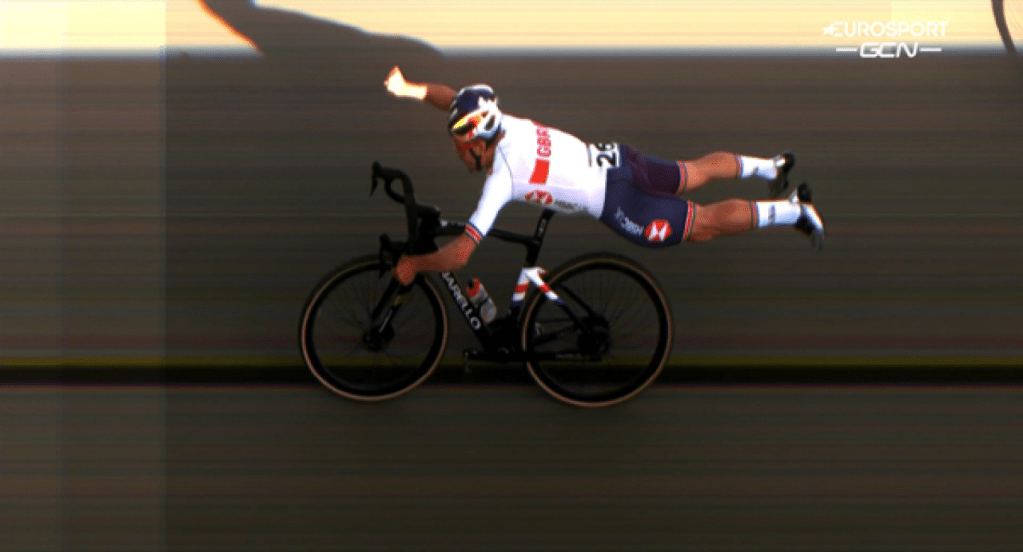
Tom Pidcock crosses the line in style to win the Cyclocross World Championship at Fayetteville, Arkansas last weekend

Going into that hectic spring classics campaign, Pidcock will be confident of going head-to-head with the sport’s established big names, with van den Poel and van Aert joined by the likes of road World Champion Julian Alaphilippe, 2021 Tour of Flanders winner Kasper Asgreen and a man seeking to rediscover his mercurial best, Peter Sagan.

However, with just one win in the pro road ranks to his name, for Pidcock to instantly succeed in the biggest races would still be a surprise to many.

In a potentially strange twist of fate, a horrific crash and subsequent injuries suffered by Pidcock’s Ineos team-mate, Egan Bernal, could ultimately provide the Briton with a boost to his chances of springtime success.

While Pidcock was crushing his CX foes in Arkansas, 2,500 miles away in Bogotá, Colombia, Bernal was recovering from a shocking accident during a training ride that left him in need of multiple surgeries to his spine and, at one point, given a chance of less than 5% of recovering full mobility.

Clearly the priority for Bernal is making a full recovery from his injuries, which also include a broken thighbone and kneecap, before attention turns to his future cycling career. In the short term, his season is essentially over, meaning that Team Ineos will need to pivot their approach to the campaign.

Since arriving on the World Tour scene in 2010 as Team Sky, the outfit led by Sir Dave Brailsford have enjoyed massive success in the sport’s 21-stage Grand Tours, spearheaded by Tour de France wins for Bradley Wiggins, Chris Froome and Geraint Thomas as well as further success for Froome at the Vuelta a España and Giro d’Italia, where Tao Geoghan-Hart and Bernal have also taken the top step of the podium in 2020 and 2021 respectively.

However, in the big one-day races, the sport’s Monuments, Sky/Ineos have struggled to repeat that kind of success, with only two wins coming their way to date with victories for Wout Poels at Liège–Bastogne–Liège in 2016 and for Michał Kwiatkowski in 2017’s Milan-Sanremo.

Arguably, the team’s focus on winning the biggest stage races, including multiple training camps each season at altitude and ensuring their Grand Tour teams are packed with incredibly talented riders in service of their selected leaders, has potentially diminished their chances of winning more Monuments.

There have still been huge one-day wins for the team – particularly Kwiatkowski, with wins at E3 Harelbeke and Strade Bianche in addition to finishing first in Sanremo – but a squad of their depth and talent could and should have secured more consistent successes to their collective name.
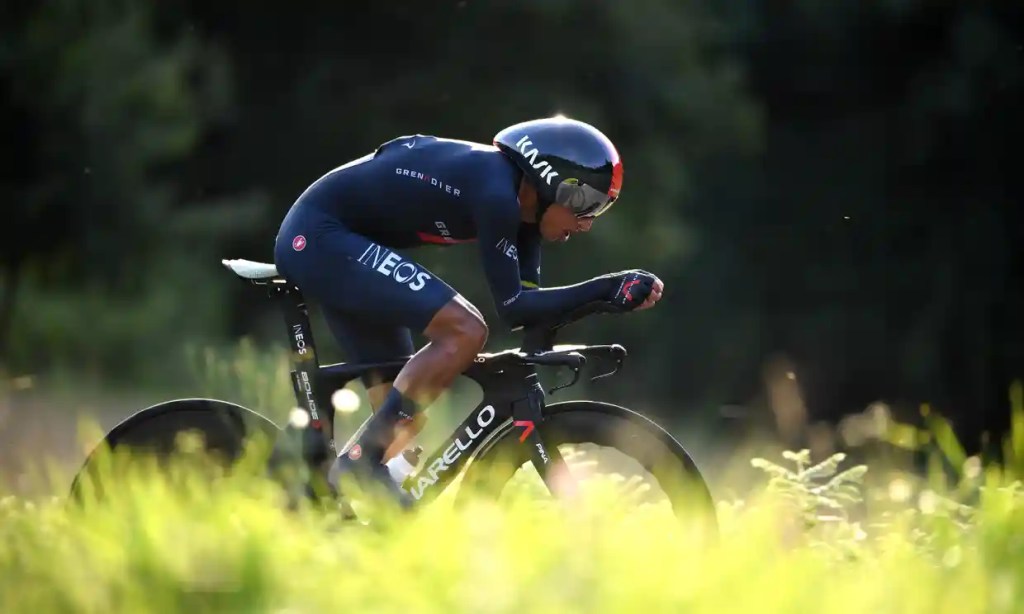
Team Ineos rider Egan Bernal, who suffered a horrific crash during training in Colombia recently

Bernal’s injuries leave the team’s plans for the coming campaign in tatters, with no obvious replacement for the Colombian in terms of climbing ability or General Classification talent – while they might expect Thomas or Richard Carapaz to be able to step up, they surely are some distance from being able to challenge current double Tour de France winner Tadej Pogacar.

Which presents something of an opportunity for the squad to take a different approach and re-focus elsewhere in the season. When Geoghan-Hart won the Giro in 2020, it came as a surprise, clinched as it was on the final stage time trial into Milan. After the dust had settled and the Maglia Rosa awarded, Ineos boss Brailsford reflected on the way that race was won and how it could herald a new, attacking style of cycling for the team: “We’ve done the train. We’ve done the defensive style of riding and we’ve won a lot doing that,” he said, to velonews.com.

“But it’s not much fun, really, compared to this. What we’ve done here, the two Giros we’ve won. First with Froomey’s win on stage 19 [i.e. back in 2018] and the way all of the guys raced here, well, at the end of the day, the sport is about racing.

“It’s about emotion and the exhilaration of racing. And that’s what we want to be now.”

That new approach, taking races by the scruff of the neck, has yet to be seen unequivocally, despite Bernal’s success in the 2021 Giro where the Colombian was never really threatened after taking the pink jersey on stage nine and ultimately winning by a margin of 1’29” from Damiano Caruso.

With Bernal yet to begin his rehabilitation and recovery from breaking as many as 20 bones in his crash, Ineos could completely shift their approach to the 2022 season, throwing additional resource behind a committed bid for wins in Flanders or Roubaix.

Riders such as Kwiatkowski, Luke Rowe and Dylan van Baarle are outstanding competitors with immense pedigree, but who are often saved for deluxe domestique duties with training plans designed to peak around the Tour de France in July. Allowing them to ride off the leash could be a major headache for perennial classics big boys, Quick-Step Alpha Vinyl.

Combined with up-and-coming superstars like Pidcock, Italian powerhouse Filippo Ganna and reigning track Omnium world champion, Ethan Hayter, Ineos have the basis for team that could rival the best in the world.

While van der Pool continues to nurse a back injury from last season and van Aert potentially targets goals as far ahead as the Tour’s Green Jersey classification, this year could be the perfect opportunity for Pidcock to step into the vacuum created and grasp the opportunity it creates.

Targeting the sport’s biggest single-day events wouldn’t be easy as anything can happen on a single day, but with the way he demolished the opposition in Arkansas, cycling’s newest Man of Steel has proved that he has what it takes in the biggest races on the biggest stages.
Glory on the Roubaix Cobbles Confirms Deignan’s Place Among the Very Best

By claiming victory on the first ever Paris-Roubaix Femmes, Britain’s Lizzie Deignan added another historical page to her incredible career story thanks to one of 2021’s stand-out sporting performances.

Paris-Roubaix is arguably the jewel in cycling’s one-day race crown; it features unrivalled spectacle with the mud or dust (depending on the weather), the brutal cobbled roads and the iconic finish in the Roubaix velodrome.

2021’s edition of the race was its 118th, showing the incredible longevity and tradition that this runs through the soul of this event, one in which is held in the greatest of esteem. Which begs the question – why did it take so long for there to be a female version?

After pandemic postponements in 2020 and spring 2021, Saturday 2nd October saw professional female cyclists finally given the opportunity to tackle the race known as the Hell of the North, breaking down yet another anachronistic barrier perpetuated by sporting patriarchy.

Recent editions of the Women’s Tour, Giro Rosa and Ronde van Vlaanderen have shown that female cycling is, in its own way, equal to or greater than its more established male equivalent in regards to action, excitement and certainly unpredictability. In many ways, as women’s cycling continues to develop in terms of professionalism and organisation, it avoids much of the structure and regimentation that makes male cycling often predictable.

As an event, Paris-Roubaix is best known for the cobbled roads and tracks which make it the ultimate test of strength and endurance. Being the first female edition of the race would add to the element of unknown, as even though the riders and their teams could have carried out plenty of preparatory training rides to understand the characteristics of the surface, there’s no substitute for actually riding in race conditions and handling the fatigue that comes from this kind of situation.

While the topography of this part of France may lack the long, torturous mountain passes of the Alps or the leg-burning gradients of neighbouring Flanders, there is nothing quite like the draining effect of riding through wind, rain and mud combined with the repeated efforts of surfing the cobbles, where each contact with the ground feels like being punched through your front wheel.

This first edition of Paris-Roubaix for female riders would always hold a place in the record books, with whoever won forever being the first winner, but that it should be Britain’s Lizzie Deignan who stood head and shoulders above the other 128 riders was testament to her steel and resolve to continue what has already been a glittering career.

With a total of 17 cobbled sectors on the menu for the riders, it must have come as a surprise to the vast majority of the incredibly strong field, featuring star names such as Marianne Vos, Chantal van den Broek-Blaak, Kasia Niewiadoma, Annemiek van Vleuten, Lotte Kopecky and Lisa Brennauer, when Deignan launched her attack, solo, with over 80km to go and not a single cobblestone traversed.

Moves of this nature are often doomed to failure, with the chasing riders able to work together in order to either prevent a significant lead being built or to allow the breakaway enough licence to accrue a margin, yet never being in danger of losing the race altogether. For a rider to win by way of a long range solo attack is surely among the most revered of sporting successes; the ultimate demonstration of courage, commitment and determination by effectively taking on and beating everyone else. One versus 128.

However, perhaps because of the course or maybe the wet and muddy conditions which saw many riders hit the deck and either lose time, motivation or both, Deignan was able to steadily build and hold a lead of over two minutes, while the field behind her whittled down to just a select few.

Into the final 20km, with the riders’ bike handling skills under stress being increasingly tested, it was perhaps the greatest competitor of them all, Vos, who struck out to try and reel in Deignan, both to eviscerate the remaining chasers but also to make what she hoped would be the winning move.

The race became a classic cat-and-mouse chase, with the Dutch superstar gradually eating into the British former World Champion’s cushion. It was impossible not to keep one eye on the clock, counting down the remaining KMs while also taking in the suffering of both riders, digging increasingly deeper to either hold on or break through. This was attack versus defence in cycling form; a nervy head-to-head, yet one where the two opponents were roughly a kilometre apart and unable to look each other in the eye.

Moments like this are among those which make road racing such a captivating sport. In a race which takes roughly three hours, it’s these periods of action where the outcome is completely in the balance that make this kind of endurance event enduring. Both riders on the rivet, giving everything to try and win the race, to take a unique place in the sport’s history, knowing that the tiniest lack of concentration or something totally out of their control, could derail their effort and hand victory to their rival.

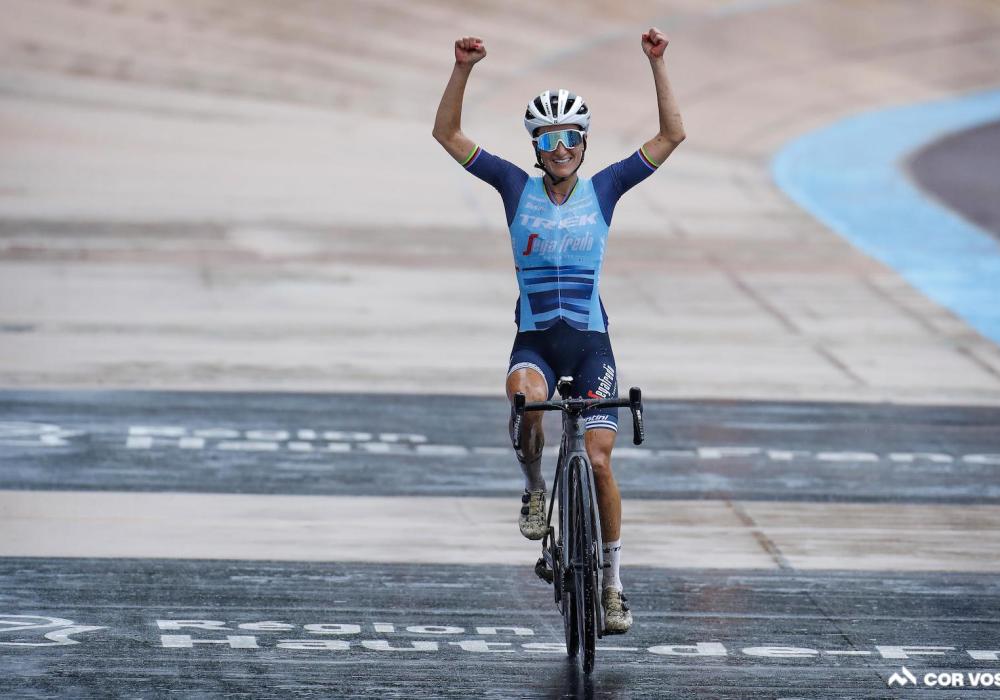
Deignan dug in, keeping Vos at arm’s length and reached the velodrome on her own, able to enjoy the final KM as a victory lap-and-a-bit. Crossing the line and raising her arms in victory gave perhaps the final insight into the effort it took to win this race, known as the Queen of the Classics, showing blood running from open blisters on her hands, worn down by the vibrations through her handlebars. Despite this, her grip never faltered, either on the bars or on the race, as she deservedly became the first ever winner of the Paris-Roubaix femmes.

This was a performance of the ages, one initiated with bravery and audacity but maintained through guts and a refusal to give in. It was fitting of the occasion and history it would create that the inaugural women’s Paris-Roubaix should end this way, with the riders spent physically, faces covered in mud and a field split to pieces, adding to the gravity and spectacle of the event.

Long may Lizzie’s win be remembered and celebrated as a landmark in cycling and female sport.

Can Two of Cycling’s Recent Greats Still Mix it with the Golden Generation?

Men’s pro cycling appears to be entering into a golden age, with Mathieu van der Poel and Wout van Aert crossing over from cyclocross to compete head-to-head with the likes of Julian Alaphilippe, Tadej Pogacar and Primoz Roglic – not to mention other up-and-coming talents like Marc Hirschi, Filippo Ganna and other more specialists riders in the sprint and general classifications.

Cycling’s current talent pool is undoubtedly in a rich vein, making for spectacular competition. Already this season, some of the racing on show at Tirreno-Adriatico and Strade Bianche in particular was incredible, with van der Poel, van Aert and Pogacar all going at it hammer and tongs.

Straight away, the fact that a Tour de France winner like Pogacar is even racing with a burgeoning classics maestro like van der Poel is itself eye-catching, but to see another XC convert in van Aert beating the sprinters in a sprint stage, climbing with the climbers, then out-muscling the Time Trial specialists in a TT speaks volumes for his cross-the-board potential.

Watching races which feature three, four or five of these characters almost guarantees a spectacle to remember. Thinking back a year or so, Alaphilippe’s dashing style and panache made him an instantly lovable character; his time in yellow during the 2019 Tour de France was incapsulating and his attempt to hold the jersey was more than just a romantic ideal; when he won the time trial in Pau, it seemed like he genuinely could go all the way to Paris and break the long-standing drought for French riders in the Tour.

To draw a parallel with another sport, cycling seems to be at the start of a period similar to that still being enjoyed by tennis, where the giants of Roger Federer, Rafa Nadal and Novak Djokovic (and Andy Murray) have shared and dominated the headlines for nigh on twenty years.

However, to continue that reference, before Federer became the world’s preeminent Grand Slam collector, the tennis scene was dominated by Pete Sampras and, to a lesser extent, Andre Agassi, with their rivalry and contrast making for fascinating viewing at times.

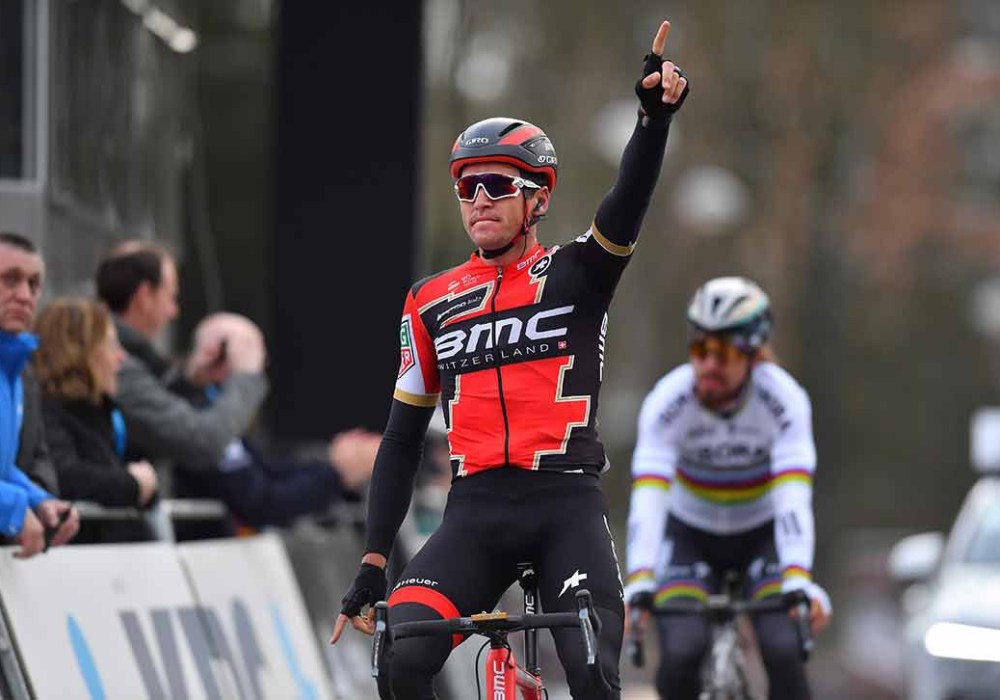
Cycling has it’s own Sampras & Agassi – the men who shone for a while and are now in danger of being forgotten in the shadow of the current behemoths: Peter Sagan and Greg van Avermaet.

In the case of Sagan in particular, it seems incredible to be thinking of him almost as being yesterday’s man, but the numbers don’t lie – the man who won three consecutive world championships in 2015, 16 and 17 has won just one race since 2019 – a stage of the Giro d’Italia – and while there are mitigating circumstances, such as injuries and his recent run-in with Covid, he has been conspicuous by his absence from race podiums.

There’s no doubt that Sagan will always have star quality and races do certainly miss his attacking flair and sheer strength of character at the sharp end of proceedings. At the peak of his powers, Sagan is a formidable foe, which may well be one of the reasons his win rate has slumped.

At the heigh of his form, if the Slovakian was on a race start list, it almost felt like it was him versus the peloton. Often you might see a break go up the road followed by a frustrated Sagan attempting to organise the chase, only to be greeted by reluctant opponents, many of whom knowing that helping him bridge a gap would only result in his victory and their defeat. When at his best, Sagan has that versatile strength which makes him almost as good as the best sprinters and right up there with the strongest puncheurs. When given the opportunity, he is a tough man to beat.

In that spell between 2015 and 2018, Sagan was almost untouchable; his approach to races changed the way other teams and riders raced, forcing pre-made plans to be thrown out of the window. While others relied on structured team tactics and lead-outs, he would ride completely off-script, surfing from wheel to wheel in search of the best position in a sprint or attacking at will with an almost playful attitude.

Beyond just his racing style, Sagan once threatened to be cycling’s breakout, cross-sport superstar – the finish line celebrations, the video of him and his wife miming to Grease, the slightly bizarre post-race interviews – in general, his Sagan-ness, which made him a hugely likeable character in a sport mainly dominated by efficient and slightly predictable robots. He was different, eye-catching and vivacious.

Sagan’s nearest rival at the time was undoubtedly van Avermaet, the reigning Olympic road race champion who now seems to have been wearing that golden helmet since the mid-70s. A true Flandrien tough guy, van Avermaet is always there-or-thereabouts in the big races, but definitely lacks the palmares that his ability deserves. True, that Olympic Gold is backed up by a Roubaix cobble, two Omloop wins and success at E3-Harelbeke but without Sagan, van Avermaet would most likely have many more wins to show for his efforts.

Without a win to his name since 2019, van Avermaet is now 35 and the emergence of cycling’s new superstars makes any further major victories unlikely, but he is a steely character who always shows willing to dig in and make a fight of a race.

Occasionally the victim of unfortunate accidents and injuries, such as the 2016 Tour of Flanders where a crash in the final 15kms saw him break a collarbone, van Avermaet always comes back when you think he might be beaten. He’s tough to shake off and refuses to give in.

Having moved to join the AG2R Citroen team this winter, he has a contract that takes him up to the end of the 2023 season, so there’s still time for him to add to his haul. In particular, it would be fitting to see him win on the home roads of Flanders, going beyond his two second places and one third.

With each passing week it seems like another star is born in the men’s peloton, while the likes of van Aert and van der Poel also appear to grow stronger – even Alaphilippe appears to be losing ground to the two XC titans. That makes it increasingly unlikely that we’ll see Sagan or van Avermaet add to their medal collections, but the prospect of seeing even more potential winners in any given race is a tantalising one.

Races right now seem more unpredictable than for years, especially with van der Poel’s penchant for long range or even whimsical attacks. The addition of an on-song Sagan or an unshakable van Avermaet would add an extra dimension to an already complicated race equation, which would only further increase the excitement and action for us as spectators.

Hopefully cycling’s growing golden era still has time and space for two of the sport’s finest recent champions as the whole picture would undoubtedly be richer for their presence.