After such a long time away from being a match-going supporter, was it slightly ambitious to think it would all just be like it was?
Twelve years is a surprisingly long time. That’s how long it had been since I last saw the team I watched most growing up, Plymouth Argyle, in actual live action. There’s numerous reasons for that, central to which was geography but equally important was an overall waning of interest in football and, therefore, a reduced willingness to part with cash for the experience.
The last Argyle game I saw was a Championship fixture in September 2009 at Peterborough, with Plymouth manager Paul Sturrock in his second spell at the club leading the Greens to a 2-1 win thanks to goals from Jamie Mackie and Rory Fallon. It was Argyle’s first win of the 2009/10 season and ultimately both sides would be relegated to League 1.
Fast forward to October 2021 and so much has changed for me – house purchases, changes of career, weight loss, marathons and loads of other memories wiped out by late nights and their supporting substances. In that time, I’d almost totally lost interest and energy for football – no longer a game or the never-ending soap opera it once was, now more of a corporate content factory where victory in the transfer window and social media bear pit trumps actual form on the pitch. Announce Icardi! Take the ratio, admin.
At the height of the pandemic-enforced global lockdown, many of us fell back on nostalgia to replace the hope vacuum created by an uncertain future. I spent a lot of time thinking about my favourite football memories and why they particularly stuck in my mind. Almost exclusively, my personal highlights revolved around watching matches in the flesh and sharing that experience, with friends, family and total strangers. Having televised games on wall-to-wall during lockdown was fine, but watching a series of ghost games played out in front of empty stadiums with canned audio only underscored what was missing, both from matchdays but also my own existence.
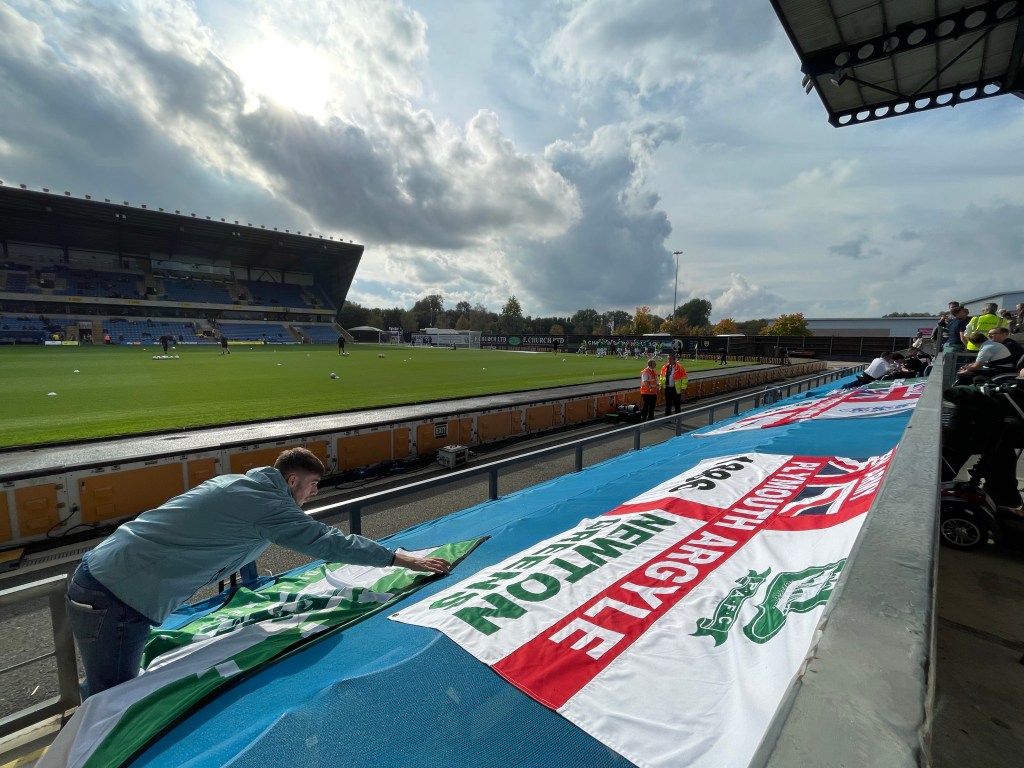
An Argyle fan places a flag in position before kick off at the Kassam Stadium
So far this season, I’ve enjoyed going to watch matches again, taking in games at stadiumMK as a season ticket holder at MK Dons. However, the ambition this year was always to re-connect with Argyle and try to see them in action whenever their away fixtures brought them close to my Buckinghamshire home. The first such match, after having failed to get a ticket within the sold-out allocation at Wimbledon, was a trip to Oxford United’s Kassam Stadium.
It was hard to know how the game would go as a lapsed, exiled fan – I don’t have a Westcountry accent so I would probably stand out a mile. I also don’t have the knowledge of the team that more committed supporters build up over years of comings and goings, so what if I seem like some kind of bandwagon jumper, especially seeing as the team are, at time of writing, top of League 1, having enjoyed a fantastic start. What might happen if I was seen as some kind of imposter, taking up the place of a proper fan among the 1,800 away fans?
I was apprehensive, nervous really, about trying to be a fan again, which is crazy really – I’m a middle-aged man who has been to hundreds of games in my time at all kinds of levels. But wanting to be a part of something, a community, and to share that experience creates a huge fear of rejection and humiliation.
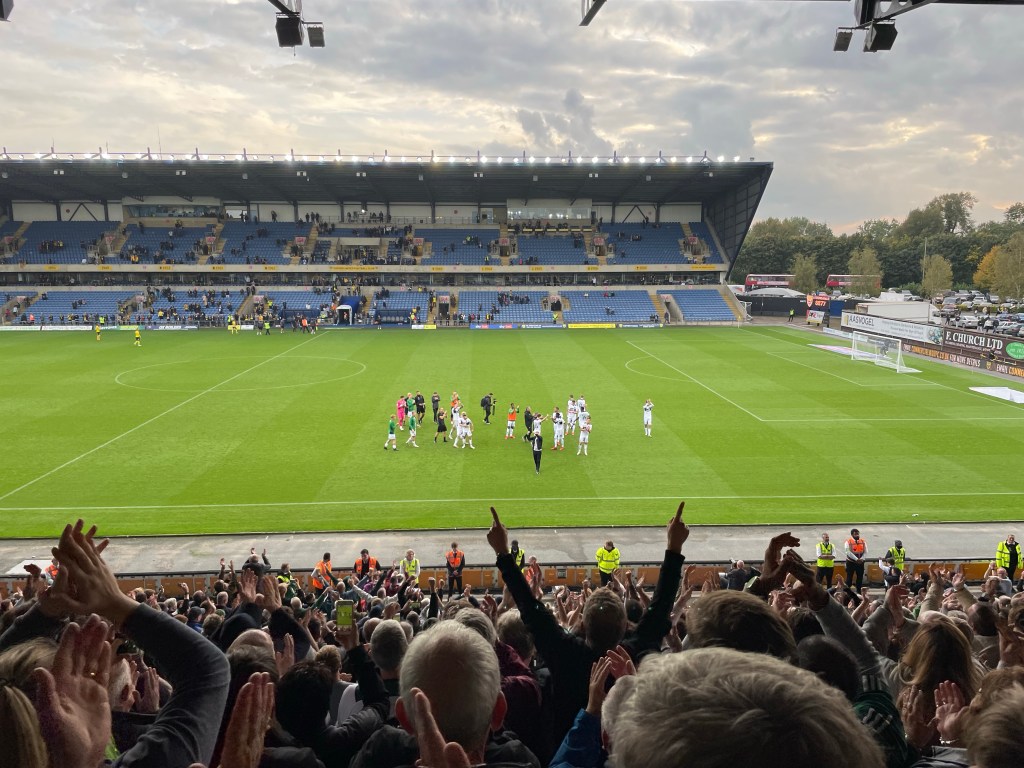
Very soon it became clear that those fears were irrational and unnecessary. The game itself was a rollercoaster and was perfect for this return to being a fan – Argyle were behind early, then equalised quickly and went in at half time 2-1 up. Oxford then wasted a series of chances after the interval, but Plymouth weathered the storm and eventually doubled the lead in the closing stages.
Argyle fans and players celebrate the 3-1 win at Oxford
All the emotions of supporting a team came flooding back – the disappointment of conceding early, the relief of an unexpected equaliser and the joy of seeing a game turned on its head. Then the nerves of seeing your team pushed back, waiting for the inevitable levelling of the scores and ultimately the surreal sealing of the win with the third goal. The pantomime jeering of an opposition player with the temerity to celebrate his goal and the hero-worshipping of a midfielder from Guinea-Bissau who was born the year I took my GCSEs (Panutche Camara, scorer of two goals against Oxford, in case you were wondering).
I’d expected to be something of a detached observer, quietly taking in the game and making astute observations (not that I normally do this anyway, but still). Instead, I found myself completely unbridled, on my feet from the early exchanges and joining in all the songs as best I can – it always did feel odd to me to proclaim Plymuff Argo as the greatest team the world has ever seen, not because they’re not excellent, but because my Home Counties diction struggles with the colloquialism.
Argyle’s fans are terrific. I was sat in the quieter of the three blocks, but the noisy and boisterous support on either side was infectious and it felt totally normal to be sharing the game with the elderly couple on my left and the guy on the right who was enjoying a day out with his boy seeing as his under 11s game had been played the night before.
I’d worried before the game that I wasn’t a fan any more, that I was too aloof and too distant from actual supporters to be able to enjoy the experience, but I couldn’t have been more wrong. My whole desire to get back in touch with football fandom was fuelled by nostalgia – powerful memories from my youth, shared with friends, strangers and, particularly, my parents. Football may have totally changed in those times, but it’s also exactly the same, depending where you look.
Above all else, it was a sense of normality and regularity that I took from the game – no questions about the bigger picture, the future of the sport or the potential damage being done by financial disparity and European Super Leagues. No concerns over foreign ownership, petrostate transfer budgets or games being moved to fit TV schedules – just a football match, three points and then onto the next one.
It was simple, uncomplicated and energising. I’d expected to feel like a fish out of water and for the game itself to be relatively low standard – that couldn’t have been further from the truth. Because I felt invested in the outcome, it was exciting, enjoyable and it felt like it mattered, which is something I’d really missed from my match going hiatus.
Prior to the start of the season, Argyle were expected by many to struggle, maybe even candidates for relegation after a terrible finish to the last campaign. The fact that they are currently top of the table, admittedly having played more games than those around them, just shows the unpredictable nature of football outside the ‘big six’ Premier League bubble.
Whether or not Plymouth stay in the race for promotion is unlikely but also irrelevant – just that there is the opportunity to do so is what makes the sport exciting.
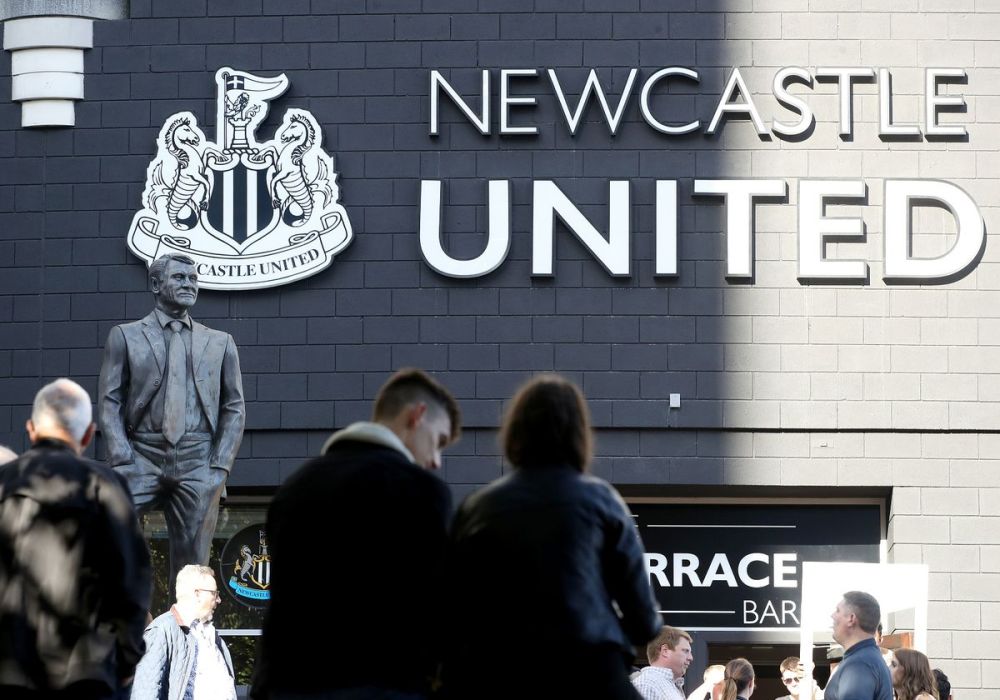
Newcastle takeover heralds bright future for club’s supporters, but what does it say for the game as a whole?
After 18 long months, finally, they can dare to dream. The deal to pass ownership of one of England’s most storied football clubs, Newcastle United, into the hands of an investment vehicle that is in no way connected to the ruling monarchy of Saudi Arabia (despite being chaired by the nation’s Crown Prince), is finally complete.
Since the club was purchased in 2007 by Mike Ashley, more Clown Prince than Crown, and his Sports Direct empire, the Magpies have unquestionably regressed. The team that were known in the mid-90s as football’s entertainers, attacking with cavalier style under Kevin Keegan and boasting stars such as David Ginola, Tino Aspilla and Alan Shearer, have become an average-at-best outfit with Premier League survival their only ambition every season.
It is no wonder that the supporters want – need – something to feel excited about.
The glory days, 1997, when Newcastle were the last team to beat Barcelona (speaking of clubs in decline) at the Nou Camp in the Champions League prior to this season
As a city and wider region, Newcastle has suffered in a similar way to many other northern towns and cities under generations of British governments. The decline of traditional industries means that there are fewer and fewer things to unite ordinary, working class people like the mines once did, fuelling feelings of neglect and amplifying the importance of the long-standing community institutions which remain.
Clubs mean so much more to their fans and the residents of their locale than simply who wins a match each week. As a one-club city, this is even more the case for somewhere like Newcastle, where the football club goes a long way to putting the place and the people on the map.
While the club has essentially become the Premier League version of Slazenger or Lonsdale, it is not just the team which has suffered from financial malnutrition. Reports suggest that the club’s training ground, stadium and entire infrastructure are decaying at a visible rate, adding to the sense that Ashley and his Sport Direct goons couldn’t give a massive mug of tea for their footballing investment.
It is easy to see why Newcastle’s fans are excited about the takeover led by Saudi Arabia’s sovereign wealth fund, the Public Investment Fund (PIF). The promise of Manchester City-style investment, not just in eye-catching signings to lift the team up the league but also in the entire region, are hard to resist. Under the stewardship of Adu Dhabi’s own investment fund, Abu Dhabi United Group, City have developed an entire campus based around the Etihad Stadium which rivals the best facilities in the world, while the team has become one of the best in Europe, based on a similar model to Barcelona (no coincidence when the club’s Chief Executive and First Team Coach are former Barça employees).
Manchester City are lauded for creating a successful, stylish team while there is recognition for ADUG that it has all been done ‘the right way’, investing significant amounts of money not just in the playing staff but also the entire environment, regenerating the area and bringing hope to the region.
But that’s exactly how sportwashing works.
Much of the conversation around PIF’s takeover of Newcastle United has centred around the Saudi government’s approach to human rights, their enforcement of laws preventing homosexuality and the murder of critical journalist Jamal Khashoggi. Many of the same question marks around human rights and tolerance exist in relation to Abu Dhabi and also Qatar, the de facto owners of arch villains Paris St Germain and hosts of the 2022 World Cup.
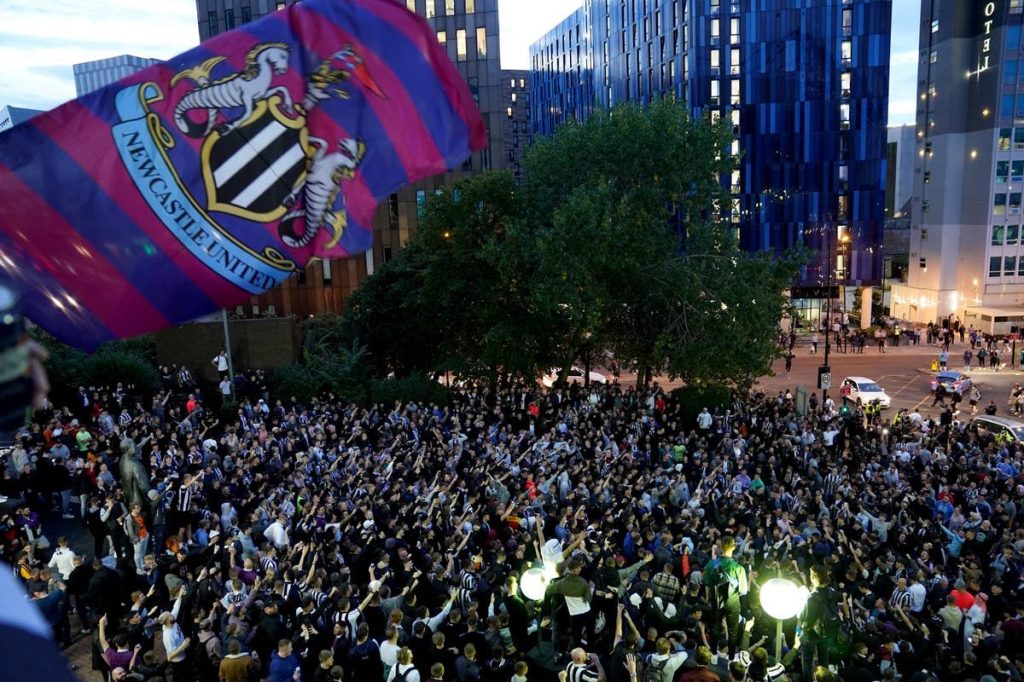
Newcastle fans celebrate the news of their club’s takeover by the Saudi-backed Public Investment Fund
So what makes this acquisition less palatable than those? Well, nothing actually – they are all clear and obvious attempts to brush over any negative views attached to those regimes and present their rulers and their nations in a more positive light.
A quick scroll through the social media cess pits shows that the general response to any negativity around PIF’s takeover of the Magpies is a universal demonstration of whataboutery; a sense that any questioning of the takeover is some kind of conspiracy against Newcastle as city by the metropolitan elite or an attempt to protect the footballing hegemony of the big six/four (delete as applicable).
While those big clubs would go to any length to protect their status – see ‘European Super League’ – the fact that it takes an investment from a questionable (at best) sovereign state to provide football fans with any hope for the future is a damning statement about the game itself.
It has always been true that money talks in football. The Premier League points tally at the end of the season nearly always matches the wage bill table, with the biggest spenders occupying the top places and the strugglers paying out the least.
But the gulf between the haves and the have nots continues to grow at an unsustainable pace in terms of maintaining viable competition. It is now impossible for fans outside the top six to conceive of breaching the upper echelons without the levels of investment being speculated upon for Newcastle. Despite the massive monies being poured into clubs from huge TV deals, the financial inertia around the biggest clubs means there is zero chance of anyone making it big.
Admittedly, Leicester City have bucked this trend in recent years, winning the FA Cup last season and the Premier League itself five years earlier – but their story is the exception rather than the rule (and their owner, Aiyawatt Srivaddhanaprabha, son of Vichai Srivaddhanaprabha and heir to the King Power estate, is hardly short of a few quid). Everton, meanwhile, since receiving investment in 2016 from Farhad Moshiri, whose estimated net worth is greater than Liverpool’s owner John W. Henry, have spent over £500million on transfers alone in that time but have yet to finish in the top six (they are currently fifth).
Football at the highest level no longer belongs to the fans or the people – it hasn’t done for years. It is now a profit and PR vehicle for wealthy owners, distant investors and giant corporations, which includes the bodies who supposedly run and police the sport.
Questioning Newcastle fans for being excited about their new owners is neither fair nor worthwhile and it misses the real point. it is not their fault that PIF’s connection to the Saudi state makes their club the latest sportswashing weapon and it is hard to begrudge them a moment of hope after years of neglect.
But that owning a club, a social institution and community pillar, like Newcastle United can only be achieved by such an organisation speaks volumes about the state of the game. After the European Super League fiasco earlier this year, football media was awash with positivity about fan ownership and the game returning the people; it is clear that this is as far away now as it has ever been at the highest level.
Asking whether Newcastle should be taken over essentially by the Saudi state or attempting to block the acquisition is essentially pointless and it would do nothing to address the real issues which the deal exposes.
The purchase of Newcastle United raises huge questions about ownership of clubs and the use of football for soft power sportswashing, many of which have already been asked of the game’s major stakeholders, investors and powerbrokers. At the same time, it does herald the end of a bleak period for the club, one that no fans would ever wish to endure – but it highlights the parlous state of the game’s governance when it requires turning a blind eye to all manner of actions and behaviours in order to gain hope from an acquisition effectively funded by a secretive petrostate with a painfully opaque agenda.
In celebration of being a part of the action by attending in person instead of taking in a game on the box
The near instant transition from summer to autumn confirms that the football season is firmly up and running, to the point that looking at league tables is now valid. With that in mind, it’s both surprising and encouraging to see my two League One sides, Plymouth Argyle and MK Dons, threatening the upper reaches of the table.
Before the start of the campaign, both teams had reason to be negative about the months ahead, with Argyle’s form last season suggesting a possible relegation battle while the Dons headed into the unknown having lost their manager just days before their first game.
Instead, both sides have won more games than they’ve lost, picking up 19 points from their first ten games and defying expectations.
While Argyle can be seen as the division’s real surprise package so far, rubbing shoulders with the likes of Sunderland, Wigan Athletic and Wycombe Wanderers, the Dons are perhaps the league’s entertainers, scoring 20 goals and conceding 13 in their opening encounters.
The most recent fixture at stadiummk saw Fleetwood Town visiting; a side who have struggled so far this season, picking up only ten points from their first nine games.
Taking place on a Tuesday night, the game represented an example of a lower league club’s worst nightmare – direct competition with a televised Champions League matchday, the focus of which was a clash between Manchester City and Lionel Messi’s Paris Saint-Germain, a game which many believe could be a pre-cursor to the ultimate winner of that competition.
Attracting fans to a stadium for live action when a big game is on the box is a tough challenge – made even more difficult by torrential rain in Milton Keynes with casual punters dissuaded from parting with their cash in favour of kicking back to see how that PSG front line is actually working together.
Before the start of the season, my knowledge of my local team and its players was practically zero. After a few games, however, I already feel more in tune with who the team’s leaders are, who the potential match winners are and who could be concerned about their place in the side.
Meanwhile, my connection to my ‘big’ side, Tottenham, continues to wane – and not just because the club seems to be constantly searching for a new crisis, ready to lurch from the current one with spectacular drama and embarrassment. That’s not solely down to the side’s steady drift down the Premier League table, but also because, in my opinion, actually going to matches is a big part of the experience of following a club.
There’s so much more to attending games than simply the game or the action, much of which revolves around the social experience and sharing it with other people, even if they are total strangers.
On this particular occasion, those of us who eschewed the televised action in favour of the real world were treated to a proper game between two sides who really went for it. Despite their lowly position in the table, Fleetwood played on the front foot and looked to get bodies forward, which hasn’t always been the case for some of the Dons’ opponents so far this season.
It made for an entertaining game, not just because of the 3-3 scoreline, but because both teams looked like they wanted to attack and create chances. So far this season, I’ve been really impressed with the standard of football on show from almost every side. In particular, my previous visit saw Portsmouth as the visitors for an evenly-matched, entertaining game, which ultimately resulted in a 2-1 win for the Dons.
I don’t come at this from a particularly technical point of view – I’m not a coach or an expert in tactics by any means – so I’m just a punter with no horse in the race, but still the experience of going to matches again has been well worth the investment in my season ticket. Thinking back a few years ago, football at this level was not always a great spectacle; most sides seemed happy to be solid and hard to beat, aiming to maybe nick a goal with a set piece, but sies playing in that manner seem to be the exception rather than the rule.
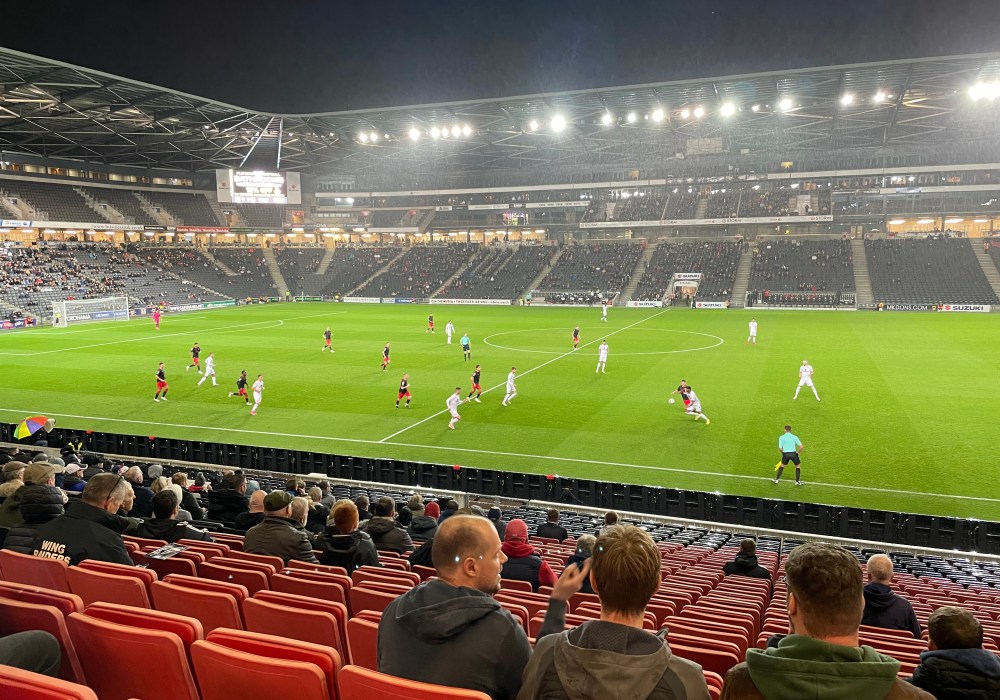
While I still wouldn’t class myself as a Dons fan, there’s no substitute for actually attending a match; watching games, highlights and YouTube clips from afar is not the same as actually feeling it when the action takes place in front of you. Even on a rainy night in a quarter-filled stadium, you’re essentially part of the game rather than simply observing it on the box.
It’s essentially a case of an active experience in contrast to a passive one – when watching football on telly, it’s easy to drift in and out of attention. You pick up your phone and briefly scroll the socials, maybe like a few cat videos and then return to the game when Gary Neville’s commentary reaches fever pitch. When you’re actually in attendance, you’re far more immersed in the occasion, observing the actions of the players in any given situation and taking in the reactions of the crowd.
This is even further amplified when the result really matters – nothing beats the feeling of a last-gasp equaliser or that moment of brilliance that turns a game in your team’s favour. While my match-going experiences so far this season have been limited to attending as a neutral bystander, I can’t wait to get behind Argyle when I can. My first planned trip to see the Greens in action was at Wimbledon a couple of weeks ago, but all tickets were sold to season ticket holders before general sale, showing the popularity of following the team on the road. It’s now looking like my first Argyle game of the season might be Oxford away on 16th October.
Back at stadiummk, the crowd of 6,600 (including probably 100 visiting fans) were treated to an absolute cracker of a game, which ultimately resulted in a share of the spoils thanks to a late equaliser from the away side. Dons were dragged through the game by an excellent performance from Scott Twine, who sealed a brilliant hat trick with a direct free kick that smashed the crossbar, bounced down onto the line and into the roof of the net.
It must have been a great night out for the away fans who made the trip; the journey is a shade under 200 miles as the crow flies, making it a late night on Tuesday. Those who did make the trek certainly looked like they were enjoying themselves and they would definitely have gone away happy, having claimed a richly deserved point with an 88th minute equaliser.
While City were being put to the sword by Messi, Neymar and pals, I never once regretted my choice to go out and watch the game as opposed to staying in for a different one. It was cold, it threw it down with rain and there were no petrostates inflating the wage bill, but it was real, it mattered and I felt like a part of it.
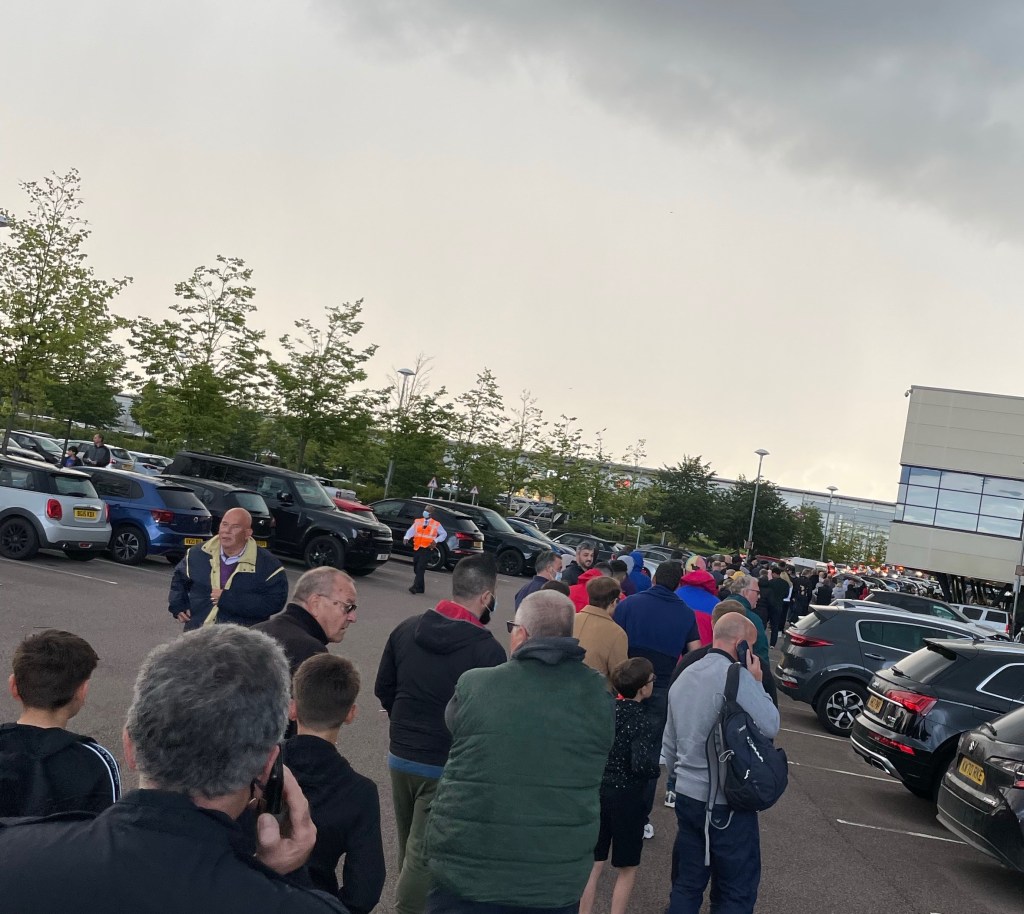
Standing in a queue and waiting in a car park to finally return to a stadium and catch a game. In a strange way, it felt kind of apt – I don’t know exactly how long it’s been since I last went to the match, least of all as a punter, but it’s definitely in the realm of years rather than months. In itself, that seems extremely sad; the boy from the middle of nowhere with the insatiable appetite for football, a passion so great that he studied the sport at university and toured the south of the country in search of a career, bouncing from club to club like an unsure golfer.
So why now after so long away? If the truth be told, I totally lost my love and interest in football. One of the dangers of turning your passion into your paycheque is that you close off what you do to escape from the real world. Working in football became a real grind; watching matches lost its sparkle, especially when fans become customers and the attendance is more important than the result.
After so long away from it, much of my interest returned during the pandemic, partly because, in all honesty, there wasn’t much else to focus on. I stopped going to games because time is precious and I wanted to waste mine doing other things. Over the years I continued following my big team – Spurs – and enjoyed seeing them improve massively from where they were when I was young. That bubble kind of burst, however, when they appointed a manager who ‘guarantees trophies’ but in a style totally at odds with the club’s tradition and with a management approach based on avoiding blame, singling out individuals and generally protecting his own reputation. The trophies never arrived so Mourinho had to go.
That appointment typified priorities of the biggest clubs – instant success is more important that traditions or values, because neither of those bring in the money. Being in the Champions League is all important now to the clubs with the biggest outlays in order to preserve their status at the top table and prevent anyone else from stealing their slice of the pie.
With that in mind, it was never a huge surprise when the European Super League was announced earlier in 2021; owning a football club is an expensive business, so protecting your investment to guarantee a future profit needs a secure stream of income in the short term. That kind of steady revenue is totally at odds with the competitive nature of sport where risk is inherent – a poor run of form here or a bad string of injuries there and all of a sudden that Champions League spot becomes Thursday night trips to far flung Eastern Europe and a greatly diminished tv revenue.
Queueing the rain at stadiumMK to watch Dons vs Spurs in pre-season. I eventually made it into the ground 10 minutes after kick off to see Spurs comfortably win 3-1 – it was only after I got home later that evening that I learned Dons had missed a penalty in the first five minutes.
Front the point of view of the ESL club owners, it makes sense – protect your income, massively reduce the chance of seeing that income fall into the hands of someone else and watch your investment steadily grow.
At the time, I remember reading something that likened the ‘big six’ English clubs to being like the ‘big four’ supermarkets – greedily gobbling up the little businesses by hoovering up their customers while also expanding into new markets, leaving behind their traditional fanbases, laughably referred to as ‘legacy fans’. In this sense, fans like me are no more than customers – years of supporting the club that my dad did means nothing.
This makes it difficult to love your club. There’s something unique about going to football; admittedly a lot of what makes it great also makes it repulsive to many – the passion and tribalism that creates an indescribable bond spills over all too easily into pathetic scraps on the street and juvenile ‘banter’ in the stadium.
There’s a couple of old cliches that try to explain what it’s like supporting a football club: that it’s either a religion where everyone gathers to worship and pray or it’s like being part of a family except that everyone wants much the same thing. You can add in a couple of extra layers to both those ideas by including the shared experience of going to a match and the sense of community created by following a single entity that represents your town, city or borough.
All of which is lost when football becomes purely a made-for-TV exercise.
Watching games on television during the height of pandemic lockdown did make for an excellent distraction: something to focus on other than the rising death toll, something that really wasn’t important in the grand scheme of things. But after months of games in front of empty stadiums, it probably struck home to the big club bigwigs that those pesky legacy fans really aren’t that important to the whole business anyway, so why bother considering them in the next evolution of investment protection?
The biggest clubs in Europe are now essentially vehicles either for state-funded soft power PR campaigns or investment arms for (predominantly) US capitalists. In essence, the name of the club, its geographical location and the community links that infers are now irrelevant – these clubs are realistically franchises that could play their games anywhere in the world so long as it suits the broadest TV viewing market.
Complaining about this feels a little like ‘Old man shouts at clouds’ and it will take an unimaginable shift in the way the game is run to turn this particular tanker. This summer’s transfer splurge by Paris Saint-Germain (Owned by the Qatari state), only highlights this by taking star players, for ‘free’, from Barcelona, Real Madrid, AC Milan and Liverpool, plus a big-money transfer from a powerless Inter Milan, in a real demonstration of strength.
The state of the game at the highest point got me thinking about what it was I really enjoyed and loved about football. It was never about the biggest names, the transfer gossip or the endless debates on telly (who remembers Andy Gray and the Boot Room off the mid 90s?). For me, despite being a Spurs fan, it was never about going to watch them play – my parents retired to Cornwall when I was five years old, so I grew up around 250 miles from Tottenham and my supporting experience was limited to watching frequent disappointments on Sky.
Instead, my live football fix was formed at my local league club – Plymouth Argyle. When we first moved to the south west, Argyle were an old Division Two (now Championship) club. I remember going to my first game – I’d fallen in love with football, like so many people my age, during Italia ‘90, seeing England get the semi-finals, Gazza’s tears, Lineker’s goals and all that. It was a great time. Over the summer, I joined a local football club (not easy to find in deepest, darkest rugby country) and I wanted to consume every possible aspect of the game possible.
We were encouraged to take in a game at Argyle’s ground, Home Park, during the pre-season to 1990/91 and a friend of ours got hold of a pair of tickets for a friendly with Wimbledon – the Crazy Gang! Just two years on from the greatest FA Cup upset of all time, beating Liverpool 1-0 in the final at Wembley, the Dons would be bringing the likes of Vinny Jones, John Fashanu and Dennis Wise to Plymouth for a warm-up match before the new campaign. It promised to be a great introduction to live match action.
The game finished goal-less and and my Dad vowed never to return to Home Park. He broke that vow 18 months later to accompany me on a trip with my football club to see Argyle play Newcastle United in a league match just before Christmas. That game was also dire, with both sides setting up either side of the halfway line and launching long balls at each other until eventually the visitors broke the lines and stole the win with a goal from Gavin Peacock. It was more like trench warfare than football and the old man renewed his vow to avoid visits to Argyle, a promise he would keep this time for over a decade – and I don’t blame him; it was awful.
Plymouth Argyle’s Home Park: AKA the ‘Theatre of Greens’. The tight turnstiles, the wooden seats, the pasties. Brilliant.
However, and somewhat bizarrely, I was hooked. Most Saturdays for me meant either playing football myself or, as I grew up being a swimmer, taking part in competitions up and down the westcountry – it should be noted that I was never any good at swimming, but my mum was the coach, so I had limited choice. Even as Argyle slid down the leagues into what was originally Division Four, but was at the time known as Division Three (It’s now called League Two), the experience of going to games was addictive. I grew attached to Argyle as my ‘little club’ and the fortunes of the team and players became as much a part of my fandom as those of Spurs.
Going to matches as a teenager would be restricted to once a month initially, but as I got a bit older I could get to a few more of the bigger matches. In particular, after multiple seasons of decline, Argyle found themselves in the bottom division of elite football, but with an up-and-coming, energetic manager in charge: Neil Warnock. I didn’t really understand what good or bad football was at the time, but Warnock turned the ship at Home Park and the team were on the up. Games were exciting with the team playing fast, attacking football and winning games.
The 1995/96 season would end with Argyle being promoted via the play-offs. I couldn’t attend the final itself but the semi-final second leg remains to this day one of my all-time favourite moments watching football.
Argyle were pitched against Colchester United (more about them another time, probably). Play-off semi-finals are played over two legs, home and away with the winner on aggregate progressing to a winner-takes-promotion final at Wembley. After losing the first leg 1-0 at Colchester’s ground, Argyle knew that they would need to win at home to make it through.
I was stood on the terrace behind the goal – the Devonport End – where all the songs and the noise originated from. As a 15 year old who had never really belonged in any group or felt part of anything before, it was amazing – singing, shouting, swearing – it was liberating and exhilarating.
Argyle were fantastic that day – they raced into a two-goal lead on the night, making the aggregate score 2-1, only to be pegged back to 2-2 with the visitors scoring in the second half. If the game finished that way, it would go to a nervy period of extra-time and potentially a penalty shoot-out.
Into the final five minutes and the action was taking place way down the other end of the pitch. Even 25 years later, I can vividly remember thinking that momentum was going against Argyle and that they had no chance of making it through. Then from nowhere, a cross in from the right hand side found Plymouth’s diminutive left-back, Paul Williams, in space at the back post. His diving header was awkward, but effective, finding the net and giving the hosts a lead they would hold to book their berth in the final.
The stadium erupted – Home Park at the time was a ramshackle collection of terraces, stands and uncovered sections. For a club that normally had attendances of around 5,000, to be part of a 19,000 crowd felt like the biggest barrage of noise, celebration and joy imaginable. Everyone streamed onto the pitch, singing sings of salutation for the players, the manager and even the chairman.
It was an evening that had everything – at its best, football has that ability to ebb and flow between failure and success, with the ultimate outcome in the balance. The best matches are never the 5-0 thrashings, but the ones where your side appears to have thrown it away but somehow manages to steal victory.
There would be times in life where I would attend Argyle games more regularly, especially in my early twenties and with my mum. We formed a really close bond by attending games together (she was originally a fan of Crystal Palace), and some of those games, afternoons and moments before she died in 2004 are among my most treasured memories.
So that’s how I came to find myself stood in a queue in the rain in Milton Keynes in 2021. Because while I know I cannot repeat that sense of belonging and that attachment which grew in my teenage self, I want at least some of the experience to be refreshed.
After deciding that I wanted to get back into watching games live, I thought long and hard about what it was I got out of going to watch games and why it was something I cared about. I could go and watch my big club, especially now they’re in a new, huge stadium – I have been to see Spurs play in the flesh, many times, and have experienced some fantastic atmospheres and occasions at White Hart Lane, but, if the truth be told, I do feel a bit like a tourist when I’ve been there because I don’t go regularly enough – I couldn’t afford the cost or the time.
The commercialisation of top-level football makes following a big club even less attractive – there’s so much discussion and promotion of Premier League football that it feels like a never-ending soap opera; it doesn’t feel real or genuine as the superstars are so vast.
I mulled over some options for securing my football fix: living in MK means there are a number of different options within an hour or so but my instant reaction to paying £25 to watch Northampton or Luton play is that it’s too expensive – not because of the sheer cost, but because I don’t care how they do. Part of the joy of the experience is in the emotions created by the outcome so attending every game as a neutral will always leave something of a hollow feeling.
On the flip side of that, stumping up to watch a Premier League team is an expensive hobby – the cheapest season tickets at Spurs cost more than £900 and a single Matchday, including ticket, travel and food, will set you back around £100. For that kind of investment, its understandable that you want to feel entertained, see attractive football and, ultimately, a positive result – none of these things are guaranteed in sport.
I decided that now was the time to rekindle my love for my small club – Plymouth Argyle at a time when clubs outside the Premier League need all the support they can get. To re-visit the supermarkets analogy, there has been a real energy in the last 18 months to shop local where possible and I feel that supporting your local or lower league club is the football equivalent of this.
It’s not feasible for me to make the 500-mile round trip to Devon every other weekend, but I did consider a season ticket at one point to put something into the club and to show my support. Instead, I’ve opted to use my central location to get to as many away games as I can – there are roughly seven or eight fixtures within a reasonable journey from where I live, including a few that I haven’t been to before. I can’t wait to follow the club’s progress, even if they are among the favourites to be relegated from League One.
Meanwhile, in my research for match options, I came across this season’s promotion from my new(ish) local club, Milton Keynes Dons. The reason I live in MK is that I came here to work for the club and enjoyed seven amazing years doing just that (again, probably more on that another time). After having had no fans in the ground in the last 18 months, you can now buy a season ticket at stadiumMK for £230, which equates to a tenner a game and is much less than during ‘normal’ times.
In my opinion, the club should be applauded for this step and I want to show support for this initiative, so in addition to watching my team on the road throughout the season, I’m now a season ticket holder at stadiumMK – I think League One is going to be really exciting this season with a lot of teams realistically in with a chance of promotion. While I do have a strong affiliation to the Dons after my time on the staff, I’m still of a mindset that I’m going there to watch games involving two teams, not supporting one or the other (except when Argyle visit, of course).
The irony of this situation is not lost on me – I feel totally disenfranchised by my big club and a desire to watch ‘real’ football in person, so part of my solution is to watch the original Franchise Football Club. Much has been written on the story of Wimbledon, MK Dons and everything in between, so there’s no need to add to it here.
In the course of planning this article, I’ve read much about the Dons for this season and they’ve put together an interesting team, looking to play attractive football. However, on the eve of the campaign, their promising young manager, Russell Martin, was spirited away to Championship club Swansea, sending the club into turmoil, which could affect their fortunes through the year – time will tell.
So this marks the start of something, although what that might be is unknown, which is kind of the point. I have no idea what experiences, positive or negative, might be waiting out there or what characters might be encountered along the way.
As football clubs welcome fans back after 18 months away, my social media timelines have been buzzing with positivity and happiness for supporters to be reunited with their heroes, their friends and even their families. It’s been great to see and after my own hiatus stretching back further, it feels even better to be a part of it again.
On what was essentially opening night for the compacted Champions League, which sees this year’s edition minimised into a tiny tournament in Portugal, there was no lack of drama and excitement in the first quarter final, between minnows Atalanta and money bags Paris Saint-Germain.
Much had been written in the build-up to the game about the gaping difference between the two sides’ playing budgets and the fairytale that has seen the side from Bergamo in Northern Italy, where the Coronavirus crisis really kicked off on March, scrap and battle their way to the quarter-finals. In particular, this is a team making its debut in Europe’s elite competition and which began that campaign by losing their first three fixtures in the group stage. For them to even reach the final eight is a fantastic story and a testament to a team that embodies the concept of ‘more than the sum of their parts’.
And yet, when it came to the crunch, there was something achingly inevitable about the outcome of this fixture – a 2-1 win for the Parisians – despite ultimately needing to make use of every available minute beyond the scheduled ninety.
That the eventual heroes for PSG were not the hugely price-tagged Neymar or Kylian Mbappe but defensive midfield lump Marquinhos and former Stoke City plodder Eric Maxim Choupo-Moting demonstrates perhaps the desperation that had set in among the Paris side, throwing everything at Atalanta in search of a late reprise.
When Mario Pasilic opened the scoring for the underdogs midway through the first half, it was no less than their play to that point deserved. All eleven players appear committed to the high-pressure, high-intensity approach deployed by head coach Gian Piero Gasperini and it is easy to see why they have attracted so many admirers along the way so far. Playing with ambition and imagination in the final third, they created a number of good chances before eventually taking the lead, despite the best opportunity falling to PSG’s Neymar, who completely fluffed his own lines, scuffing wide in a one-on-one situation with Atalanta’s stand-in ‘keeper, Marco Sportiello.
With 2018 World Cup star Mbappe rated as only 80% match fit and therefore starting on the bench, PSG relied heavily on the Brazilian Neymar from the outset. That reliance is almost certainly their Achilles heal, placing what must be a mass of pressure on the shoulders of one player. It was almost like watching the Brazil side that Neymar nearly carried to World Cup glory in 2014, when the South American nation hosted the tournament and ultimately crumbled in the semi-final against Germany, having lost their talisman to injury in the quarters.
Throughout that competition, Neymar was the standout star in a fairly average team that was nowhere near the level of quality demanded by fervent home support. It must be incredibly tough to carry that kind of expectation and deliver consistently, regardless of how many zeroes appear on your payslip.
Throughout this game, Neymar appeared to be living his own personal nightmare – he was regularly appearing in the right places, creating opportunities for himself and others, yet nothing clicked, everything seemed forced and unnatural.
It is easy to dislike this PSG side, for their petro-funded assembly of global talent, their classless baiting of Borussia Dortmund earlier in the competition and for their boringly relentless success in their domestic league.
However, much as we all chuckle when this year’s edition of the PSG Champions League catastrophe plays out in front of us, it’s easy to forget, that these are humans, young men too. After their 6-1 collapse to Barcelona and last year’s humbling at home against a supposedly crisis-ridden Manchester United, there must always be a nagging element of doubt in the minds of these players as to whether things will actually ever go their way.
In the build up to what seems like every PSG tie, there grows an air of ‘Good versus Evil’ about proceedings, with the Paris side being pitched as the bad guys because of their Qatari owners and the funds sloshing around in their budgets. But maybe it’s worth remembering that these are essentially just men, footballers, lads too – when they grew up kicking a ball around on an estate or a beach somewhere, it’s almost certain that they dreamt of scoring goals, winning medals and celebrating with fans, not becoming a collection of Bond-style footballing henchmen, taking up arms against the next plucky underdog story to come their way.
While it would certainly have been an incredible story for Atalanta to become the first Champions League debutants to reach the semi-finals in 14 years, as with almost every football narrative, there are two sides to every story. When Neymar sliced that incredible pass through the tiring Atalanta defence last night to find Mbappe and provide him with the space to lay the winning goal on a plate for Choupo-Moting, there must have been a huge sense of relief for all involved.
Ever since he first appeared as an angular teenager with incredible skills, Neymar has been burdened by the lineage that he represents in Brazilian football – Pele, Romario, Ronaldo et al. The weight of that history alone would be huge to contend and perform with, but this is a player who has also traversed the demands of a spell at Barcelona in the shadow of Leo Messi and then onto his own stage in Paris, where every performance comes with a golden asterisk.
When Neymar and PSG falter, the footballing world smiles, points and laughs. When they succeed, it is shrugged off as only being an inevitable result of the expenditure.
Love or hate Neymar and his band of well-paid men, maybe sometimes it’s ok for them to have their own moment of celebration, overcoming the frustration of a night where it seemed like they might play forever and never score.
After all, if the bad guys always lost, we’d eventually get tired of the good sides winning and would crave the rise of the character villain, the spirited anti-football or the guy who pokes authority in the eye. And we don’t need another Mourinho.
It almost seems too great an understatement to describe the season just passed as being ‘strange’. It’s probably fair to say that not many pundits would have predicated a football campaign derailed for three months due to a global pandemic, so kudos for 2019/20 for claiming that particular slice of uniqueness.
Whether football’s return in July after the Covid-19 hiatus was due to financial or sporting reasons, it was probably only right for Liverpool to be crowned champions in as-near-as-possible the ‘normal’ way. Jurgen Klopp’s team has no obvious flaws, even accounting for the fact that their nominal number 9, Roberto Firmino, only found the net at Anfield for the first time in the final fixture.
Liverpool demonstrate modern football perfectly – pressing high and with immense tenacity, combined with rapid attacks on the break and flexible attacking options all over the pitch – the way they have reinvented the full-back role to being the instigation of most opportunities is perhaps most impressive.
Amidst the unprecedented this season, it was either re-assuring or depressing that the Premier League campaign ultimately finished with a top four comprised of Liverpool, Manchester City, Chelsea and Manchester United. That’s not to say that Frank Lampard and Ole Gunnar Solskjaer don’t deserve credit for the way their respective Chelsea and Manchester United sides ultimately secured their places in next season’s Champions League.
In particular, the signing of Portuguese midfielder Bruno Fernandes reinvigorated the previously directionless United, bringing even acceptable performances from Paul Pogba, proving that he can do it on a sunny Saturday afternoon in July after all.
As a result of finishing in the top four, both United and Chelsea have already started making moves on the transfer market. By adding Timo Werner and Hakim Ziyech to Lampard’s squad from RB Leipzig and Ajax respectively, Chelsea will be exciting to watch in 2020/21, as much for their thrust and flair in attack opposite the continued comedy that is their back four. While their next steps in the transfer market really should identify a commanding centre back to build their defence around – think Virgil van Dijk at Liverpool – they instead look set to sign another forward player in the Bundesliga starlet Kai Havertz. Here’s a hint for next season’s fantasy league: don’t buy Chelsea ‘keeper Kepa (but then you probably already knew that).
Elsewhere in the league, it was ultimately disappointing to see three pretenders to the Champions League places slip by the wayside after Project Restart. Going into the break, Leicester, Wolves and Sheffield United all looked primed to upset the traditional order. In particular, Wolves have been a breath of fresh air to the division, offering pace and power in attack (step forward Adama Traore), but also genuine class in Ruben Neves and Raul Jimenez. If they can add a couple more players in the same bracket and hold on to Nino Esposito Santo in the manager’s dugout, they could be a real force next season and maybe even finish sixth.
The fact that finishing in the top half-dozen is now effectively the promised land for many clubs is what makes this season’s completion somewhat disappointing. At different times throughout the campaign, Chelsea, Manchester United and Tottenham were all viewed through a prism of crisis, whether that be relying on the kids, harking back to the past or paying the price for a lack of investment. Yet they all still finished in the top six, begging the question – what does it take for the English Premier League to actually get shaken up?
Credit to Leicester, it was only the final day that they slipped from the top four to finish fifth, but that coveted Champions League berth was well within their grasp before the lockdown, so to see it pass through their fingers must have been heartbreaking for the team led by Brendon Rogers.
Away from the top table, it was hard not to feel sorry for Bournemouth, although they paid the price in their relegation for a series of transfers that failed to work out, leaving manager Eddie Howe relying on many of the same players who brought the south coast club up through the leagues. In their five years in the Premier League, they have been entertaining to watch, scoring many and conceding just slightly less – this year, that high-risk strategy proved to be their undoing as the goals dried up. After a couple of days of reflection it was hardly surprising to learn that Howe and Bournemouth have parted ways, and huge question marks now reside over whether or not the Cherries have the resources to compete in the Championship.
There must surely be less sympathy, however, for fellow trapdoor tumblers Watford, who started the season in the steady hands of Java Gracia, replaced him earlier than they could have with former boss Quique Sanchez Flores (who was decent first time around), then showed him the same door after just 12 games before eventually settling on the imposing, alleged wolf-wrestler Nigel Pearson. Admittedly the Hornets improved under Pearson and looked like they would actually beat the drop, only to shoot themselves in the foot by firing the former Leicester boss with just two games ago. Whether or not the rumours of a post-game bust up involving Pearson and his own players are true or not, this proved to be a spin too far for the Vicarage Road revolving door and relegation was no less than the club’s owners deserve.
While Watford and Bournemouth failed to beat the drop, seeing a clubs the size of Aston Villa secure a second season in the top flight is a definite positive. It’s hard to dislike talisman Jack Grealish, with his pristine hairstyle contrasting perfectly against his minimal, almost casual socks and therefore tiny shinpads. Grealish is something of a throwback footballer, willing to take risks in the final third – or the first third, for that matter – and play with his heart. While others would have long flown the nest of their boyhood club in search of a chunkier pay packet, Grealish remains, shining bright in a fairly unbalanced team – Tyrone Mings and John McGinn are both excellent, while many others at Villa Park are not – and ultimately playing a key role in keeping the Birmingham club up on the final day.
Grealish’s excellent strike in front of West Ham’s most lively crowd of the season (lol) confirmed his undoubted quality when it counts, even if his enthusiasm for doing his bit defensively might also have contributed to the Hammers’ equaliser moments later, deflecting the ball into the net beyond the hapless Pepe Reina.
Even allowing for his lockdown discrepancy and his previous penchant for nitrous oxide, the Premier League is far better for characters like Grealish, who we are often told do not exist in the modern game – mainly by the same agencies who love to question their commitment when seeing lads on their holidays in Ibiza. Drinking a beer. Whatever next.
Villa’s survival came down to goal difference on the final day thanks to the point secured at the London Stadium, not, entirely, as some have suggested, the draw claimed on the first day of Project Restart against Sheffield United. On that day at Villa Park, football’s goal-line decision system, Hawk-Eye, ended up looking more like dork eye, somehow failing to signal a clear goal for the Blades when the ball crossed the line in the arms of the Villains’ keeper Orjan Nyland. Yes, that proved to be a crucial point for Dean Smith’s Villa side, but it’s not the reason Bournemouth went down, so no legal proceedings please.
This is probably a good point to mention VAR and it’s arrival upon the Premier League this season. Scrap that – there’s never a good point to mention VAR.
So it was Villa up, Cherries and Hornets down and everyone else pretty much where you expected they would be, highlighting the predictability within the chaos and uncertainty created by months in lockdown at the hands of the coronavirus: Liverpool champions, City win one cup final and Arsenal the other.
Late in the evening on Tuesday 27th August, it finally happened: after months of threats, possible breakthroughs and false dawns, the English Football League (EFL) were finally forced to expel one of its member clubs, Bury FC.
This was a truly sad end to a long and drawn out saga, the culmination of a series of events that has seen this historic club, founded in 1885, cast from the league setup after 125 years of membership and into almost-certain liquidation. Just a few months ago, in April, the club’s fans, players and staff were celebrating the momentous achievement of promotion from the league’s lowest tier, League 2, to the third rung of the English football ladder, League 1.
However, that promotion itself came in the face of a growing crisis at the club with players and staff reporting unpaid wages dating back to February and the club’s owner buckling under the weight of mounting debts, many of which were leveraged against the club and its assets to meet spiralling interest payments and ongoing commitments.
How the club got into this position is one matter for debate. Punching above its financial weight with player wages reportedly in the same ballpark as clubs two divisions higher, it was evident that this was likely to end in tears, but when that actually happens it’s always the fans that feel the effects worse.
While the club’s owner, whose actions seem to have stymied any potential sale and therefore made survival even more unlikely, will ultimately walk away from the ashes of the team’s Gigg Lane home, it is the supporters who will suffer from the club’s demise the most.
Going to the match is something of a British institution; generations of men, women, boys and girls taking the trip on a Saturday afternoon to follow their team, come rain, wind or shine. Family outings, meeting up with the lads, taking the boy to his first games – all rites of passage for football supporters up and down the country.
That sense of community and importance to the local area is even greater for the nation’s provincial clubs; away from the bright lights of the Premier League, it is our smaller clubs where fans gather, fall in love with their club and build tight-knit networks around their Saturday ritual. You get to know the people who sit around your season ticket seat and share the highs and lows of supporting your team. In many ways, being a fan of a lower league side is much like being a member of a family – there’s a firm sense of togetherness, empathy and loyalty towards the group, looking out for each other and with a much deeper sense of belonging than can be found in many of the global corporation-esque super clubs.
You are an important part of your club and it is an important part of you.
That in itself is the real tragedy in this loss – and it feels like a bereavement: here we have not just the closing of a business, but the cessation of an entity which provides thousands of people with something and somewhere to aspirate their emotions, ambitions and, in many cases, their actual reason for being.
It sounds dramatic to pitch it in those terms, but to many of the supporters of football clubs, it truly is their religion – to have that stripped from their psyche will leave a massive hole.
Apportioning blame in this situation certainly won’t bring the club back but working out how this has been allowed to happen may provide some clues as to how it can be avoided in the future. We live in a world where there are Premier League players sitting inactive on benches earning weekly wages that would keep many a club afloat, but it can’t be their responsibility to fund their colleagues and, ultimately, rivals. They are only being paid what someone is prepared and able to pay them.
The disparity between the top-flight ‘haves’ and the lower league ‘have nots’ continues to grow at an alarming rate, something which feeds the desire to chase success and reach the pot of gold at the end of the footballing rainbow. Achieving promotion to the Premier League can take a club from a position of keeping its head barely above water to profitable sustainability – just ask a recent riser like Bournemouth – but it’s a precarious position that can be taken away just as quickly – see Bolton Wanderers, Portsmouth, Leeds United et al.
Facilitating this kind of survival tightrope is at the heart of the issue. Achieving success and climbing the leagues is so incredibly valuable that clubs – and their owners – will take all kinds of risks in their pursuit of victory at the expense of simple business logic. In what other industry would senior management even consider paying out more that they make?
Unfortunately there can only be a limited number of winners in any season, so for every side that climbs a ladder, there are plenty more who slide down a snake, whether that be in terms of their league status or their ability to balance the books.
In that respect, the EFL have taken a lot of the stick for the demise of Bury with questions over their Fit and Proper Persons test for club owners and the level of control they wield over members’ financial actions. There is only so much that the central body of what is effectively a members’ club can do to police its constituents, but perhaps it is time for firmer governance and greater restriction over finances – even if this threatens to reduce competitivity with Premier League clubs and their fiscal muscle.
In an ideal world, the game’s wealth would be shared far more evenly – does Mesut Özil really need his £350,000 a week and do Manchester United have to spend £98 million on Paul Pogba? If he didn’t and they didn’t, the game at the highest level would hardly wither and die, but without more evenly distributed funds, the chasm that already exists will only expand over time. Eventually that could see more clubs disappear from the system, and there’s even some logic behind an argument to reduce the number of professional clubs in the English game to reduce the financial land-grab that currently exists in the lower leagues.
However, in both these situations, it’s impossible to force the toothpaste back into the tube – Premier League owners, players and agents are hardly likely to donate their earnings for ‘the good of the game’, while asking lower league clubs to become semi-professional or amateur setups would never be a move that could be supported politically by all.
Which kind of leaves us at something of an impasse; with so many stakeholders – Premier League, Football League, Football Association, and the growing power of clubs and players – there exists a huge power vacuum at the top of the game. Who actually runs football in the UK and what are their motives?
There is no single entity or governing body that has the authority to step in and make rulings with the long-term sustainability of the game and its incredibly loyal followers at heart – each organisation with any power has its own agenda, which in turn is dictated by the motivations of its own stakeholders. For instance, the Premier League has to pander to the whims of its clubs, who continue to carry the threat of banding together with Europe’s elite outfits to form a European super league, so anything that could threaten their dominance or profitability is certain to fall on deaf ears.
By its very nature, football is a competitive business – winning, losing, promotion, relegation – but it’s time for that level of tribalism to be diluted for the greater good. Without a more balanced sharing of the game’s eye-watering incomes and a will to create an even playing field, we could well see a wave of clubs going under and eventually drowning beneath unsurmountable debt and over-commitment.
Hoorah! Football is back after what feels like a lifetime – or at least a couple of weeks – with the return of the Premier League. There were ominously large victories for Manchester City and Liverpool on the opening weekend, suggesting that we might, at best, be in for another two-horse title race, but we should probably expect another significant gap to the rest.
Leading that chasing pack is likely again to be Tottenham, who belatedly sparked into life in their opening clash, eventually out-muscling newly promoted Aston Villa to claim a 3-1 win. The Villains, returning to the top flight after three seasons in the Championship, showed plenty of promise in their own performance, led by an outstanding display from central defender Tyrone Mings and an early smash-and-grab goal from John McGinn that threatened to claim all three points until deep into the second half.
Until that point, Spurs had been, at best, blunt in attack, creating few chances despite dominating possession and territory – a situation that threatened to perpetuate the theory that star striker Harry Kane struggles to find the net in the month of August.
With the England captain Kane being less supported, more swamped by the likes of Erik Lamela and Lucas Moura, Spurs looked bereft of ideas, struggling to create space and restricted to half-chances falling the way of Moussa Sissoko, whose finishing continues to display all the confidence of someone who scores roughly every two-and-bit years.
However, that all changed with the introduction of Spurs’ Danish midfield schemer, Christian Eriksen, who has been the subject of a number of transfer rumours since making clear his desire to seek a new challenge away from North London, back in June.
That declaration of intent was typical of Eriksen – understated, relatively classy but with clear intent that he was destined for more. This is a player that deserves to win titles, trophies and to be considered among the elite.
That said, finding a landing spot for a player in this market is more complicated than it sounds; despite being in the final year of his contract, Eriksen is still viewed by Tottenham’s chairman, Daniel Levy, as being of great value, understandably, with a transfer fee in the region of £65m thought to be needed to capture his signature.
Talk of a switch to Manchester United has never really taken off this summer and with the Premier League transfer window now closed, that route seems to be a dead end. In any case, Eriksen’s desired destination is thought to be Real Madrid, who have spent significantly this summer with returning coach Zinedine Zidane thought to be trying to show a lively dressing room – and boardroom – who’s boss.
With the Madrid club in mind, continental clubs can play a waiting game with players heading towards the end of their contracts, choosing to eschew hefty transfer sums payable to the selling club and instead agree a pre-contract arrangement from 1st January, allowing them to siphon more cash into the star’s pocket as a result of the Bosman ruling.
All of which leaves Spurs with a headache. On Saturday, they were stodgy, narrow and predictable until Eriksen’s arrival. After his return to the side they came to life, opening up the play and creating a number of clear-cut opportunities, leading to a debut goal for Tanguy Ndombele – who looks like he has the attributes to be a key player for Spurs – and two strikes for Kane, laying to rest the August curse nonsense.
While Eriksen might not have been directly involved in all three goals, his influence was all over them, accepting the ball in tight areas, spotting passes that other players miss and moving the play rapidly from non-threatening positions into advanced parts of the pitch to stretch a well-organised defence to breaking point.
It’s possible to suggest that, despite playing less than half of the game, this was a man-of-the-match performance from the Dane, unlocking the Villa defence and, ultimately, being central to Spurs claiming the win.
Which only further underlines his value to the team – more effective than his midfield colleagues despite being given less than half the opportunity, Eriksen is the heartbeat of this side. If this game was, intentionally or otherwise, a chance for Spurs to test life after Christian, then it was not a pleasant experience. Admittedly, they do have a number of new and returning stars to bolster their attacking options – Heung-Min Son has one game left on his suspension while Dele Alli continues his comeback from injury and Giovani Lo Celso arrives from Betis with great promise – but it’s hard to imagine any of them having the same game-turning impact that Eriksen demonstrated here.
Spurs are left with few potential outcomes: they either have to find a buyer for Eriksen before the transfer window closes on the continent at the end of August, which looks unlikely given that any potential move would have to work for all parties, or allow him to run down his current deal and potentially move for free. The third – and probably least likely solution – would be for Eriksen to backtrack and sign a new deal with the club. One possibility in this respect would be for Spurs to insert a release clause that would see Eriksen move if a certain fee was triggered, although finding the right level for all involved could be tricky.
Levy has demonstrated in the past that he drives a hard bargain and generally sees the club come out on top – take the moves to Madrid of Luka Modric and Gareth Bale as examples. Conjuring up a solution that works for Spurs on this occasion would rank highly in Levy’s achievements to date, otherwise this could be the first in a number of costly departures that could see the likes of Toby Alderweireld, Jan Vertonghan and even manager Mauricio Pochettino following Eriksen out of the door.





 sixteeneightyone