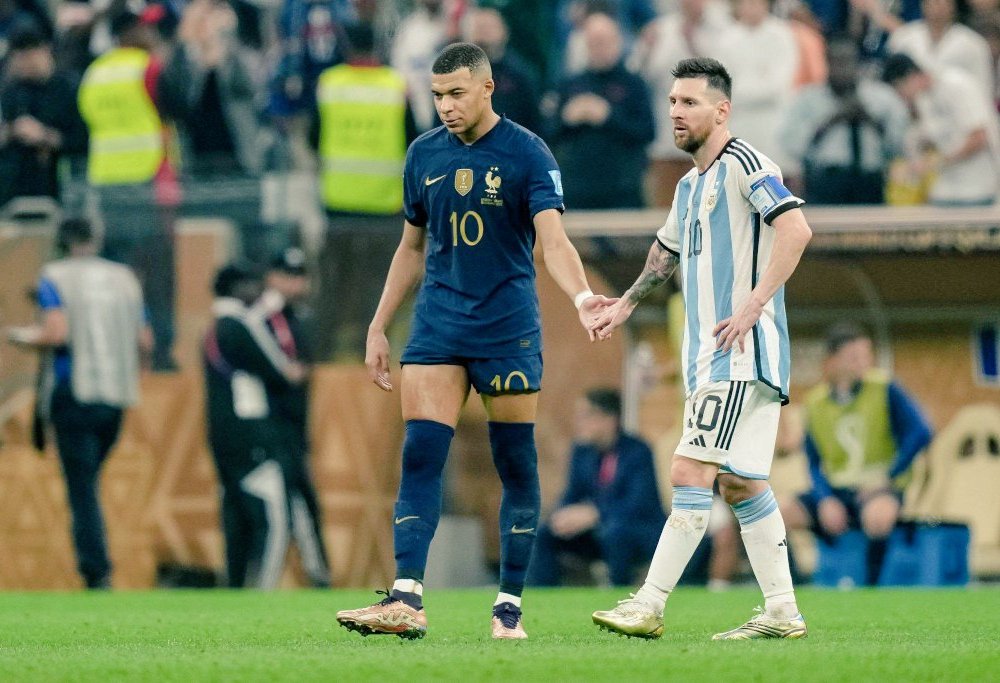
Argentina’s win in Qatar was the perfect way to complete their captain’s career, but the match itself showed that the game’s next great is very much already here.
Lionel Messi, cloaked in the ceremonial Bisht placed on his shoulders by the Emir of the host country, Qatar, collected football’s most iconic trophy and made his way across the temporary platform created for the tournament’s final moment.
As he raised the World Cup, surrounded by his Argentina team-mates, showered in confetti and set against a backdrop of fireworks, arguably the game’s greatest ever player could finally say he had done it all; he has collected all the infinity stones, discovered all the rings of power and even answered the art and literature question to complete a full set of cheeses.
He has done it all and in some style.
While the man once known as ‘The Flea’ may not have been as central a figure in this particular game as he has on so many occasions in the past, he is still the man for the big moments, including all three of Argentina’s goals in this final. It was his penalty that opened the scoring, his neat pass round the corner that sent Alexis Mac Allister in behind France’s defence to create the second and then his sense of presence to be in the right place, at the right time to convert Lautaro Martínez’s rebound and give his side the lead in extra time.
Throughout the tournament, he was the man who gave his side something extra, whether that be on the ball, such as his evisceration of Croatia’s rising star defender Joško Gvardiol in the semi final or in leading his side in the face of adversity, like losing their opening match or seeming to grab defeat from the jaws of victory in the quarter finals against the Netherlands.
But despite being the ultimate victor, Messi certainly couldn’t claim to be the only star of this World Cup final. While his Argentina squad were celebrating their success, France’s leading man, Kylian Mbappé was already looking ahead to a joyous bounceback in four years’ time – or in his own words, tweeted after the match: “Nous reviendrons.” We will return.
For the first seventy minutes of this match, there was only likely to be one winner. Argentina hardly put a foot wrong in the first half and were excellent value for their 2-0 lead at the break, while France looked completely absent and seemingly sunk without a trace, making two substitutions before the interval.
Changing shape might not have had the immediate impact that French coach Didier Deschamps may have hoped for, but eventually the tide turned, powered by 120 inspirational seconds from Mbappé, first scoring from the penalty spot, before finding the net with an outstanding volley to set up a dramatic final 10 minutes.
At this point, the momentum was all with the French, whose changes saw them pack the field with powerful and pacy forwards, stretching the tiring Argentines with every attack – that they were able to resist the French offensive and re-take the lead in extra time is testament to their own collective will and a demonstration of the see-saw nature of this clash.
In converting his second penalty of the night and levelling the game at three apiece, Mbappé became only the second man in the history of the game to score a hat-trick in a World Cup final, in addition to claiming the tournament’s golden boot. He went on to score his third penalty kick of the evening in the shoot-out, but it still wasn’t enough to overturn Argentina.
The way France’s talisman showed up in this game just when he was needed speaks volumes – given the circus that surrounded his hotly-tipped summer move to Real Madrid, which ultimately never happened, there has been growing criticism of Mbappé’s character and his role at PSG, with many casting him as de facto sporting director, influencing the club’s transfer policy and tactical approach to suit his own game. It could have been easy for him to sulk out the closing minutes of this final, throw away his runners-up medal and move on, but, thankfully for those of us in search of a dramatic twist or turn, that wasn’t to be the case.
It’s easy to forget that at 24 years old, this is the PSG forward’s second World Cup final, having effectively announced himself on the global stage in Russia four years ago, scoring the crucial fourth goal against Croatia – a strike which made him only the second male teenager to score in the game’s showpiece clash, an accolade shared with football’s original great, Pelé. That said, his goal in the 2018 final came a full year after completing a move from Monaco to the Paris club in a deal that eventually would be worth €180 million, so this was hardly an unknown hero enjoying a moment in the sun.
In that tournament, his pace and direct running struck fear into the hearts of opponents, most memorably against this year’s vanquishers, Argentina, in the round of 16, when his searing break through the heart of the opponents’ defence saw him eventually hauled down for a penalty that set the tone for the encounter. He would go on to find the net twice afternoon, both with neat finishes, to show his coolness in front of goal to match the physical prowess.
Having been pictured returning to training with his club earlier than instructed, it is clear that he means business and is ready to get straight back into action, hoping to add to his 19 goals so far this season. At club level, the aim for Mbappé and his PSG team-mates must surely be the much-coveted Champions League title, an aim which has thus eluded the club owned by the Qatari state, who have backed them to the hilt financially. With 147 goals from 197 appearances, he is well-set to become one of the game’s all-time greats and to amass an incredible collection of silverware.
From an international perspective, a winter World Cup means that the next major tournament, the European Championship, is now just 18 months away. Qualification for the tournament finals in Germany begin in earnest in March with France early favourites, giving Mbappé and co. plenty to focus on.
Looking ahead to 2026’s finals in North America, should he and France successfully go one step further and win the whole thing, Mbappé could become only the second man in history to feature in three World Cup finals and the first to play in three consecutively. Obviously much can change in the space of three and half years, but he is, without doubt, the focal point of France’s entire team structure and it’s hard to envisage his nation lining up in Canada, USA & Mexico without his name among their ranks.
Coming into Qatar, Deschamps, who has yet to confirm whether or not he will continue in charge of the World Cup runners-up, saw his squad suffer injuries to a number of key players, including stars like Paul Pogba and Karim Benzema. In a way, the injury to Real Madrid forward Benzema – who currently holds the Ballon d’Or as the world’s best player – coming as it did right on the eve of the tournament, may actually have helped les Bleus in the short term, removing any potential doubts over who might be this team’s leader and totem.
Surrounded by emerging talents such as Eduardo Camavinga, Randal Kolo Muani and Aurélien Tchouaméni, as well as experienced support like Antoine Griezmann and Raphaël Varane, Mbappé was the stand out, world class figure in an already-strong squad that looks well-set for the future.
While we should certainly be celebrating the incredible career and talent of Messi, whose crowning glory ensures he receives the adulation that comes with adding the World Cup to his personal palmarés, this final may come to be remembered as a passing of the baton and a shift from one generation to the next.
We already knew that Mbappé had everything to be the best in the world; his performance in defeat in Qatar just confirmed that he could bring it to the surface when it matters most.
 sixteeneightyone