
Adding Arsenal’s experienced attacker looks a risky move for the cash-strapped Catalans, who now look overstocked with forwards.
There’s an old saying that when a salesperson is struggling to get deals over the line, rather than cut back and let clients see that they are working hard to make ends meet, they should instead turn up to appointments with a flash new car and a sharp suit.
Barcelona appear to trying to live out this metaphor in a footballing sense, attempting to show the world that the financial challenges they have faced recently are no longer an issue; the enforced departure of the club’s greatest ever player, Leo Messi, just a fading memory.
Or as club President Joan Laporta explained it early in January after completing the €55m signing of Ferran Torres from Manchester City: “We’re definitely recovering our status. Everybody in the world should get ready, as we are back as big players in the market.”
But are they really back? Or is this just a show of strength and security that lacks the substance?
The Catalans’ winter transfer window opened with the signing of Torres to universal questioning about how they could afford such a deal with reported debts over €1bn and it closed with the recruitment of former Arsenal captain Pierre-Emerick Aubameyang, a capture which could be extremely exciting but does raise a few eyebrows.
Aubameyang has plummeted from favour at the Emirates, where disciplinary issues have seen him stripped of the captaincy and booted from the first team squad by increasingly tough Head Coach, Mikel Arteta.
That it has come to this for the French-born Gabonese striker is a huge fall from grace, with Arsenal cancelling his contract on deadline day to pave the way for a move to Barça yet continuing to pay a percentage of his wages, showing their willingness to get him off the books.
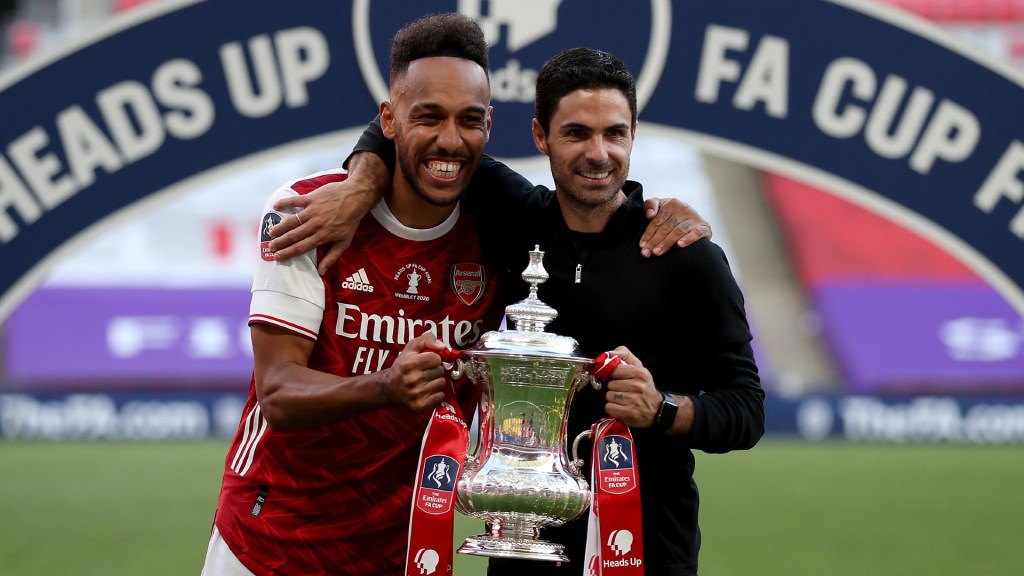
Rewind to 2019 and Aubameyang was a hot property, sharing the Premier League’s golden boot with Mo Salah and Sadio Mané. A year later, he was rewarded for a dazzling display in the FA Cup final against Manchester City with a bumper new contract in order to ward off the circling vultures.
With hindsight, that new deal resulted in something more akin to an albatross around the club’s neck, with performances rarely matching the reported £350,000 a week wage and Arsenal finding themselves increasingly finding themselves in a deja vu situation after the painful saga that was the disposal of Mesut Özil.
In that sense, Aubameyang’s move seems to suit the Gunners; theirs is slimmed-down, youthful squad built around the emerging talents of Bukayo Saka, Emile Smith-Rowe, Martin Ødegaard and Gabriel Martinelli; they are happy to take risks in attack and to counter with pace, making them engaging to watch and a genuine contender for a top four finish.
To achieve his approach, Arteta demands commitment and dedication, something that has been questioned before with Aubameyang before the final rupture in the camel’s spine when he failed to return on time in December from an authorised trip to France ahead of the cub’s clash with Southampton. The fall-out from that incident saw him lose the armband, his place in the squad and, finally, his manager’s support, making the ultimate departure inevitable.
However, there have to be questions about Barça’s decision to move for the 32-year-old at this time. Reports suggest that he has signed a contract until 2025, at which point he will be 36, but with a mutual break clause in summer 2023, which suggests that the Catalans may be spreading the cost of his contract over a longer period of time to essentially defer the impact on their budget – something that have also done with a new deal for French defender Samuel Umtiti.
Arriving as he did at the last minute of the window’s final day, Aubameyang’s move rounded off a busy month for Barça, who in addition to signing the former Arsenal man and Spanish international Torres, made moves for Wolves winger Adam Traore. This leaves the Blaugrana with something of a top-heavy squad – while Sergio Agüero’s enforced retirement has stripped them of his certain goals, this is a roster that already includes top class youngsters like Ansu Fati, recent recruits such as Memphis Depay and Luuk de Jong, plus the likes of Martin Braithwaite, who bailed Barça out of a hole when he joined a little under two years’ ago.
And then there’s Ousmane Dembélé – frequently injured, but mercurially talented and seemingly cast out for refusing to take a pay cut.
It’s hard to imagine how Barça can possibly accommodate all these forwards on a consistent basis, especially as they all seem to be suited to the styles of different coaches, having chopped and changed in the dugout in recent years – Xavi is the club’s fourth full-time coach since January 2020.
That instability is reflected in the club’s transfer strategy. This is a club that found itself like a kid in a sweetshop with a month’s pocket money when golden boy Neymar abdicated his status as heir to Messi’s throne and joined Paris St Germain, who met his €222m release clause in 2017 to make him the poster boy for the Qatar revolution.
That left Barça scrambling to replace the Brazilian, leading to a series of panic buys – Dembélé from Dortmund, Philippe Coutinho from Liverpool and Antoine Griezmann from Atlético Madrid all arriving for over €100m each. While all have shown flashes of the brilliance that dictated their transfer fees, none have been an unqualified success – Coutinho and Griezmann are both currently out on loan, while Dembélé looks to be running down his contract ahead of a lucrative ‘free’ transfer in the summer.
Those moves – and subsequent huge pay rises for established squad members – has left Barcelona spiralling financially; once a club that guaranteed success, in a certain style and based around promoting the very best academy prospects (they do have a very good crop coming through, it should be noted); they are currently a patchwork of players acquired under different coaches and regimes for what they can afford or account for creatively.
While Aubameyang’s form has taken a dip in recent seasons, finding the net on just 14 Premier League occasions in the last season-and-a-half, signing a player of his undoubted talent at a reduced salary and with no transfer fee is, on the surface, a smart move, but how exactly will Head Coach Xavi incorporate his particular role in the club’s system?
Barça is probably the most ideological football club there is, with the team’s possession-based style central to everything. For players to succeed at Camp Nou, the must be outstanding with the ball at their feet, operating in tight spaces and making perfect decisions.
Obviously Aubameyang is a smart, gifted footballer, but his game has always thrived with space in front of him to run into, darting onto angled balls between full back and centre half to spring a defence and finish regularly. Up against deep, packed defences who are happy to operate a low block, this kind of space is rare – will Xavi bend his style to suit Aubameyang or can the forward adapt to the Barça way?
 sixteeneightyone