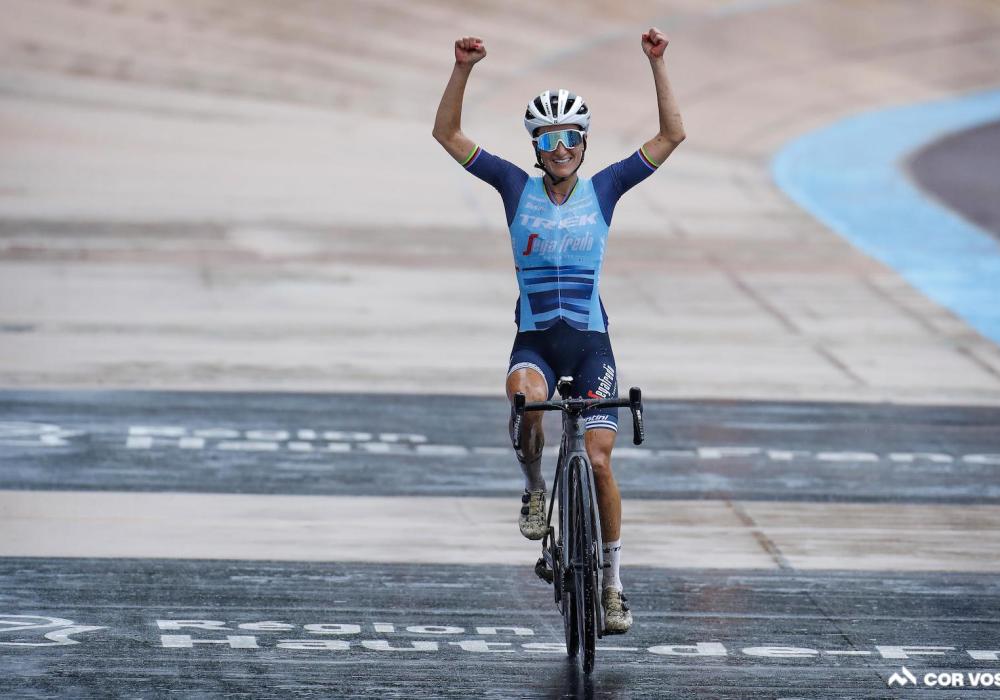
By claiming victory on the first ever Paris-Roubaix Femmes, Britain’s Lizzie Deignan added another historical page to her incredible career story thanks to one of 2021’s stand-out sporting performances.
Paris-Roubaix is arguably the jewel in cycling’s one-day race crown; it features unrivalled spectacle with the mud or dust (depending on the weather), the brutal cobbled roads and the iconic finish in the Roubaix velodrome.
2021’s edition of the race was its 118th, showing the incredible longevity and tradition that this runs through the soul of this event, one in which is held in the greatest of esteem. Which begs the question – why did it take so long for there to be a female version?
After pandemic postponements in 2020 and spring 2021, Saturday 2nd October saw professional female cyclists finally given the opportunity to tackle the race known as the Hell of the North, breaking down yet another anachronistic barrier perpetuated by sporting patriarchy.
Recent editions of the Women’s Tour, Giro Rosa and Ronde van Vlaanderen have shown that female cycling is, in its own way, equal to or greater than its more established male equivalent in regards to action, excitement and certainly unpredictability. In many ways, as women’s cycling continues to develop in terms of professionalism and organisation, it avoids much of the structure and regimentation that makes male cycling often predictable.
As an event, Paris-Roubaix is best known for the cobbled roads and tracks which make it the ultimate test of strength and endurance. Being the first female edition of the race would add to the element of unknown, as even though the riders and their teams could have carried out plenty of preparatory training rides to understand the characteristics of the surface, there’s no substitute for actually riding in race conditions and handling the fatigue that comes from this kind of situation.
While the topography of this part of France may lack the long, torturous mountain passes of the Alps or the leg-burning gradients of neighbouring Flanders, there is nothing quite like the draining effect of riding through wind, rain and mud combined with the repeated efforts of surfing the cobbles, where each contact with the ground feels like being punched through your front wheel.
This first edition of Paris-Roubaix for female riders would always hold a place in the record books, with whoever won forever being the first winner, but that it should be Britain’s Lizzie Deignan who stood head and shoulders above the other 128 riders was testament to her steel and resolve to continue what has already been a glittering career.
With a total of 17 cobbled sectors on the menu for the riders, it must have come as a surprise to the vast majority of the incredibly strong field, featuring star names such as Marianne Vos, Chantal van den Broek-Blaak, Kasia Niewiadoma, Annemiek van Vleuten, Lotte Kopecky and Lisa Brennauer, when Deignan launched her attack, solo, with over 80km to go and not a single cobblestone traversed.
Moves of this nature are often doomed to failure, with the chasing riders able to work together in order to either prevent a significant lead being built or to allow the breakaway enough licence to accrue a margin, yet never being in danger of losing the race altogether. For a rider to win by way of a long range solo attack is surely among the most revered of sporting successes; the ultimate demonstration of courage, commitment and determination by effectively taking on and beating everyone else. One versus 128.
However, perhaps because of the course or maybe the wet and muddy conditions which saw many riders hit the deck and either lose time, motivation or both, Deignan was able to steadily build and hold a lead of over two minutes, while the field behind her whittled down to just a select few.
Into the final 20km, with the riders’ bike handling skills under stress being increasingly tested, it was perhaps the greatest competitor of them all, Vos, who struck out to try and reel in Deignan, both to eviscerate the remaining chasers but also to make what she hoped would be the winning move.
The race became a classic cat-and-mouse chase, with the Dutch superstar gradually eating into the British former World Champion’s cushion. It was impossible not to keep one eye on the clock, counting down the remaining KMs while also taking in the suffering of both riders, digging increasingly deeper to either hold on or break through. This was attack versus defence in cycling form; a nervy head-to-head, yet one where the two opponents were roughly a kilometre apart and unable to look each other in the eye.
Moments like this are among those which make road racing such a captivating sport. In a race which takes roughly three hours, it’s these periods of action where the outcome is completely in the balance that make this kind of endurance event enduring. Both riders on the rivet, giving everything to try and win the race, to take a unique place in the sport’s history, knowing that the tiniest lack of concentration or something totally out of their control, could derail their effort and hand victory to their rival.
Deignan dug in, keeping Vos at arm’s length and reached the velodrome on her own, able to enjoy the final KM as a victory lap-and-a-bit. Crossing the line and raising her arms in victory gave perhaps the final insight into the effort it took to win this race, known as the Queen of the Classics, showing blood running from open blisters on her hands, worn down by the vibrations through her handlebars. Despite this, her grip never faltered, either on the bars or on the race, as she deservedly became the first ever winner of the Paris-Roubaix femmes.
This was a performance of the ages, one initiated with bravery and audacity but maintained through guts and a refusal to give in. It was fitting of the occasion and history it would create that the inaugural women’s Paris-Roubaix should end this way, with the riders spent physically, faces covered in mud and a field split to pieces, adding to the gravity and spectacle of the event.
Long may Lizzie’s win be remembered and celebrated as a landmark in cycling and female sport.
 sixteeneightyone