
Standing in a queue and waiting in a car park to finally return to a stadium and catch a game. In a strange way, it felt kind of apt – I don’t know exactly how long it’s been since I last went to the match, least of all as a punter, but it’s definitely in the realm of years rather than months. In itself, that seems extremely sad; the boy from the middle of nowhere with the insatiable appetite for football, a passion so great that he studied the sport at university and toured the south of the country in search of a career, bouncing from club to club like an unsure golfer.
So why now after so long away? If the truth be told, I totally lost my love and interest in football. One of the dangers of turning your passion into your paycheque is that you close off what you do to escape from the real world. Working in football became a real grind; watching matches lost its sparkle, especially when fans become customers and the attendance is more important than the result.
After so long away from it, much of my interest returned during the pandemic, partly because, in all honesty, there wasn’t much else to focus on. I stopped going to games because time is precious and I wanted to waste mine doing other things. Over the years I continued following my big team – Spurs – and enjoyed seeing them improve massively from where they were when I was young. That bubble kind of burst, however, when they appointed a manager who ‘guarantees trophies’ but in a style totally at odds with the club’s tradition and with a management approach based on avoiding blame, singling out individuals and generally protecting his own reputation. The trophies never arrived so Mourinho had to go.
That appointment typified priorities of the biggest clubs – instant success is more important that traditions or values, because neither of those bring in the money. Being in the Champions League is all important now to the clubs with the biggest outlays in order to preserve their status at the top table and prevent anyone else from stealing their slice of the pie.
With that in mind, it was never a huge surprise when the European Super League was announced earlier in 2021; owning a football club is an expensive business, so protecting your investment to guarantee a future profit needs a secure stream of income in the short term. That kind of steady revenue is totally at odds with the competitive nature of sport where risk is inherent – a poor run of form here or a bad string of injuries there and all of a sudden that Champions League spot becomes Thursday night trips to far flung Eastern Europe and a greatly diminished tv revenue.
Front the point of view of the ESL club owners, it makes sense – protect your income, massively reduce the chance of seeing that income fall into the hands of someone else and watch your investment steadily grow.
At the time, I remember reading something that likened the ‘big six’ English clubs to being like the ‘big four’ supermarkets – greedily gobbling up the little businesses by hoovering up their customers while also expanding into new markets, leaving behind their traditional fanbases, laughably referred to as ‘legacy fans’. In this sense, fans like me are no more than customers – years of supporting the club that my dad did means nothing.
This makes it difficult to love your club. There’s something unique about going to football; admittedly a lot of what makes it great also makes it repulsive to many – the passion and tribalism that creates an indescribable bond spills over all too easily into pathetic scraps on the street and juvenile ‘banter’ in the stadium.
There’s a couple of old cliches that try to explain what it’s like supporting a football club: that it’s either a religion where everyone gathers to worship and pray or it’s like being part of a family except that everyone wants much the same thing. You can add in a couple of extra layers to both those ideas by including the shared experience of going to a match and the sense of community created by following a single entity that represents your town, city or borough.
All of which is lost when football becomes purely a made-for-TV exercise.
Watching games on television during the height of pandemic lockdown did make for an excellent distraction: something to focus on other than the rising death toll, something that really wasn’t important in the grand scheme of things. But after months of games in front of empty stadiums, it probably struck home to the big club bigwigs that those pesky legacy fans really aren’t that important to the whole business anyway, so why bother considering them in the next evolution of investment protection?
The biggest clubs in Europe are now essentially vehicles either for state-funded soft power PR campaigns or investment arms for (predominantly) US capitalists. In essence, the name of the club, its geographical location and the community links that infers are now irrelevant – these clubs are realistically franchises that could play their games anywhere in the world so long as it suits the broadest TV viewing market.
Complaining about this feels a little like ‘Old man shouts at clouds’ and it will take an unimaginable shift in the way the game is run to turn this particular tanker. This summer’s transfer splurge by Paris Saint-Germain (Owned by the Qatari state), only highlights this by taking star players, for ‘free’, from Barcelona, Real Madrid, AC Milan and Liverpool, plus a big-money transfer from a powerless Inter Milan, in a real demonstration of strength.
The state of the game at the highest point got me thinking about what it was I really enjoyed and loved about football. It was never about the biggest names, the transfer gossip or the endless debates on telly (who remembers Andy Gray and the Boot Room off the mid 90s?). For me, despite being a Spurs fan, it was never about going to watch them play – my parents retired to Cornwall when I was five years old, so I grew up around 250 miles from Tottenham and my supporting experience was limited to watching frequent disappointments on Sky.
Instead, my live football fix was formed at my local league club – Plymouth Argyle. When we first moved to the south west, Argyle were an old Division Two (now Championship) club. I remember going to my first game – I’d fallen in love with football, like so many people my age, during Italia ‘90, seeing England get the semi-finals, Gazza’s tears, Lineker’s goals and all that. It was a great time. Over the summer, I joined a local football club (not easy to find in deepest, darkest rugby country) and I wanted to consume every possible aspect of the game possible.
We were encouraged to take in a game at Argyle’s ground, Home Park, during the pre-season to 1990/91 and a friend of ours got hold of a pair of tickets for a friendly with Wimbledon – the Crazy Gang! Just two years on from the greatest FA Cup upset of all time, beating Liverpool 1-0 in the final at Wembley, the Dons would be bringing the likes of Vinny Jones, John Fashanu and Dennis Wise to Plymouth for a warm-up match before the new campaign. It promised to be a great introduction to live match action.
The game finished goal-less and and my Dad vowed never to return to Home Park. He broke that vow 18 months later to accompany me on a trip with my football club to see Argyle play Newcastle United in a league match just before Christmas. That game was also dire, with both sides setting up either side of the halfway line and launching long balls at each other until eventually the visitors broke the lines and stole the win with a goal from Gavin Peacock. It was more like trench warfare than football and the old man renewed his vow to avoid visits to Argyle, a promise he would keep this time for over a decade – and I don’t blame him; it was awful.
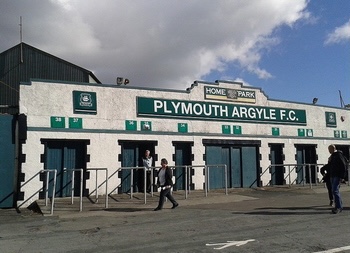
However, and somewhat bizarrely, I was hooked. Most Saturdays for me meant either playing football myself or, as I grew up being a swimmer, taking part in competitions up and down the westcountry – it should be noted that I was never any good at swimming, but my mum was the coach, so I had limited choice. Even as Argyle slid down the leagues into what was originally Division Four, but was at the time known as Division Three (It’s now called League Two), the experience of going to games was addictive. I grew attached to Argyle as my ‘little club’ and the fortunes of the team and players became as much a part of my fandom as those of Spurs.
Going to matches as a teenager would be restricted to once a month initially, but as I got a bit older I could get to a few more of the bigger matches. In particular, after multiple seasons of decline, Argyle found themselves in the bottom division of elite football, but with an up-and-coming, energetic manager in charge: Neil Warnock. I didn’t really understand what good or bad football was at the time, but Warnock turned the ship at Home Park and the team were on the up. Games were exciting with the team playing fast, attacking football and winning games.
The 1995/96 season would end with Argyle being promoted via the play-offs. I couldn’t attend the final itself but the semi-final second leg remains to this day one of my all-time favourite moments watching football.
Argyle were pitched against Colchester United (more about them another time, probably). Play-off semi-finals are played over two legs, home and away with the winner on aggregate progressing to a winner-takes-promotion final at Wembley. After losing the first leg 1-0 at Colchester’s ground, Argyle knew that they would need to win at home to make it through.
I was stood on the terrace behind the goal – the Devonport End – where all the songs and the noise originated from. As a 15 year old who had never really belonged in any group or felt part of anything before, it was amazing – singing, shouting, swearing – it was liberating and exhilarating.
Argyle were fantastic that day – they raced into a two-goal lead on the night, making the aggregate score 2-1, only to be pegged back to 2-2 with the visitors scoring in the second half. If the game finished that way, it would go to a nervy period of extra-time and potentially a penalty shoot-out.
Into the final five minutes and the action was taking place way down the other end of the pitch. Even 25 years later, I can vividly remember thinking that momentum was going against Argyle and that they had no chance of making it through. Then from nowhere, a cross in from the right hand side found Plymouth’s diminutive left-back, Paul Williams, in space at the back post. His diving header was awkward, but effective, finding the net and giving the hosts a lead they would hold to book their berth in the final.
The stadium erupted – Home Park at the time was a ramshackle collection of terraces, stands and uncovered sections. For a club that normally had attendances of around 5,000, to be part of a 19,000 crowd felt like the biggest barrage of noise, celebration and joy imaginable. Everyone streamed onto the pitch, singing sings of salutation for the players, the manager and even the chairman.
It was an evening that had everything – at its best, football has that ability to ebb and flow between failure and success, with the ultimate outcome in the balance. The best matches are never the 5-0 thrashings, but the ones where your side appears to have thrown it away but somehow manages to steal victory.
There would be times in life where I would attend Argyle games more regularly, especially in my early twenties and with my mum. We formed a really close bond by attending games together (she was originally a fan of Crystal Palace), and some of those games, afternoons and moments before she died in 2004 are among my most treasured memories.
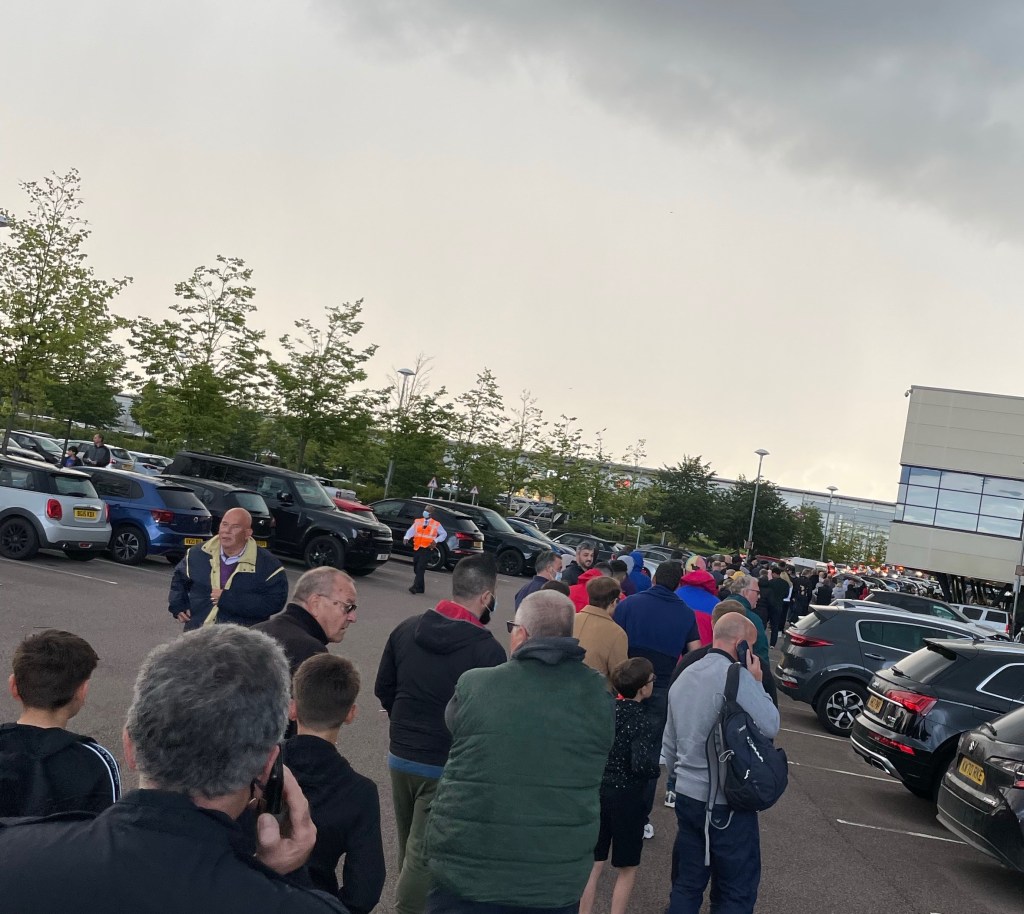
So that’s how I came to find myself stood in a queue in the rain in Milton Keynes in 2021. Because while I know I cannot repeat that sense of belonging and that attachment which grew in my teenage self, I want at least some of the experience to be refreshed.
After deciding that I wanted to get back into watching games live, I thought long and hard about what it was I got out of going to watch games and why it was something I cared about. I could go and watch my big club, especially now they’re in a new, huge stadium – I have been to see Spurs play in the flesh, many times, and have experienced some fantastic atmospheres and occasions at White Hart Lane, but, if the truth be told, I do feel a bit like a tourist when I’ve been there because I don’t go regularly enough – I couldn’t afford the cost or the time.
The commercialisation of top-level football makes following a big club even less attractive – there’s so much discussion and promotion of Premier League football that it feels like a never-ending soap opera; it doesn’t feel real or genuine as the superstars are so vast.
I mulled over some options for securing my football fix: living in MK means there are a number of different options within an hour or so but my instant reaction to paying £25 to watch Northampton or Luton play is that it’s too expensive – not because of the sheer cost, but because I don’t care how they do. Part of the joy of the experience is in the emotions created by the outcome so attending every game as a neutral will always leave something of a hollow feeling.
On the flip side of that, stumping up to watch a Premier League team is an expensive hobby – the cheapest season tickets at Spurs cost more than £900 and a single Matchday, including ticket, travel and food, will set you back around £100. For that kind of investment, its understandable that you want to feel entertained, see attractive football and, ultimately, a positive result – none of these things are guaranteed in sport.
I decided that now was the time to rekindle my love for my small club – Plymouth Argyle at a time when clubs outside the Premier League need all the support they can get. To re-visit the supermarkets analogy, there has been a real energy in the last 18 months to shop local where possible and I feel that supporting your local or lower league club is the football equivalent of this.
It’s not feasible for me to make the 500-mile round trip to Devon every other weekend, but I did consider a season ticket at one point to put something into the club and to show my support. Instead, I’ve opted to use my central location to get to as many away games as I can – there are roughly seven or eight fixtures within a reasonable journey from where I live, including a few that I haven’t been to before. I can’t wait to follow the club’s progress, even if they are among the favourites to be relegated from League One.
Meanwhile, in my research for match options, I came across this season’s promotion from my new(ish) local club, Milton Keynes Dons. The reason I live in MK is that I came here to work for the club and enjoyed seven amazing years doing just that (again, probably more on that another time). After having had no fans in the ground in the last 18 months, you can now buy a season ticket at stadiumMK for £230, which equates to a tenner a game and is much less than during ‘normal’ times.
In my opinion, the club should be applauded for this step and I want to show support for this initiative, so in addition to watching my team on the road throughout the season, I’m now a season ticket holder at stadiumMK – I think League One is going to be really exciting this season with a lot of teams realistically in with a chance of promotion. While I do have a strong affiliation to the Dons after my time on the staff, I’m still of a mindset that I’m going there to watch games involving two teams, not supporting one or the other (except when Argyle visit, of course).
The irony of this situation is not lost on me – I feel totally disenfranchised by my big club and a desire to watch ‘real’ football in person, so part of my solution is to watch the original Franchise Football Club. Much has been written on the story of Wimbledon, MK Dons and everything in between, so there’s no need to add to it here.
In the course of planning this article, I’ve read much about the Dons for this season and they’ve put together an interesting team, looking to play attractive football. However, on the eve of the campaign, their promising young manager, Russell Martin, was spirited away to Championship club Swansea, sending the club into turmoil, which could affect their fortunes through the year – time will tell.
So this marks the start of something, although what that might be is unknown, which is kind of the point. I have no idea what experiences, positive or negative, might be waiting out there or what characters might be encountered along the way.
As football clubs welcome fans back after 18 months away, my social media timelines have been buzzing with positivity and happiness for supporters to be reunited with their heroes, their friends and even their families. It’s been great to see and after my own hiatus stretching back further, it feels even better to be a part of it again.
 sixteeneightyone