
Last weekend’s World Cyclocross Championship was billed as being a clash between two of the sport’s greats, with Belgium’s Wout van Aert and Mathieu van der Poel of the Netherlands going head-to-head on Ostend.
As these two continue their rivalry on the road in addition to their history through the mud, they are increasingly becoming the Federer/Nadal or the Hunt/Lauda of their sport; two geniuses seemingly driving the other to greater and greater heights, something that we as fans can look forward to for years to come.
While the race itself ended as something of an anticlimax as a result of van Aert’s puncture and subsequent deflation, there was another great to be celebrated over the weekend, with arguably the greatest of all time also taking on the dunes, waves and man-made bridges of the World Champs course.
After all, how many cyclists possess a palmares that includes winning the Giro d’Italia on three occasions, three road world titles, seven world cyclocross wins, victory at the Ronde van Vlaanderen and multiple successes at Flèche Wallone as well as their national championships, in both the time trial and road race. Not forgetting Olympic gold medals and a list of further one-day classics as long as your seat post.
Worked who that might be yet? How about if you add in four wins in the Trofeo Binda and one Women’s Tour in 2014? And she’s only 33 years old.
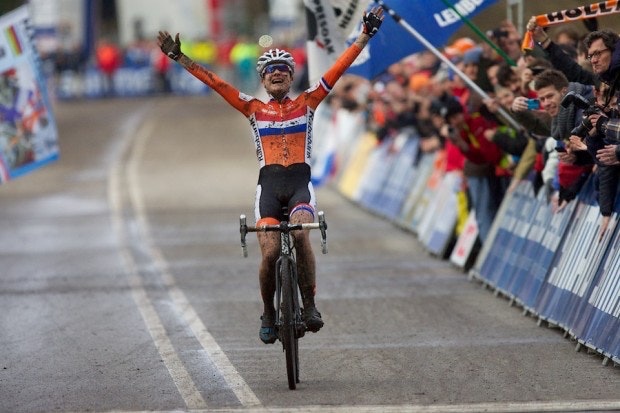
Marianne Vos has to be considered among the greatest cyclists ever. Few athletes have enjoyed the kind of longevity she has endured and continued to claim the highest honours across a variety of disciplines – in addition to the above wins, she has also won World Championships and Olympic gold on the track and she has a history of winning mountain bike races too.
In all honesty, comparing cyclists of different eras is wholly pointless as the sport changes so much from one generation to another as to make those comparisons pointless. This is even more true when it comes to comparing men and women; the worlds in which the two sports exist are so vastly different, with resources, support and coverage being just the clearest contributing factors.
If you’re hoping for a straight-up Vos vs Merckx battle to the death, then this article may be disappointing.
After a change of teams this winter, Vos joins the Dutch Jumbo-Visma squad, making their first forays into women’s cycling after out-Skying Team Ineos over the last couple years in the men’s peloton. This will be Vos’s 17th as a professional as a result, in an elite career stretching back to 2002 when she was just 15 years old. Two years after first making an impression on the Dutch cyclocross scene, she won her first international race in 2004, followed quickly by the junior world championships, indicating the precocious talent she was developing.
Having won the senior world cyclocross title in 2005, her breakthrough season was perhaps more arguably 2006, when, still aged just 19, she retained her world XC crown and then followed it up with a series of successes on the road, leading to claiming the rainbow jersey from a stacked field in Salzburg, Austria. That success was then backed up by overall victory in the Women’s World Cup in 2007, second place in that year’s world champs and then two track gold medals in the 2008 Beijing Olympics.
For a rider to be as consistent as Vos across all the different disciplines is incredible. As she continued to dominate her sport through and beyond another Olympic cycle, including winning the 2012 gold medal on the road from Britain’s home favourite Lizzie Deignan, Vos also won the 2014 Giro d’Italia Femminile and the first edition of La Course, having been instrumental in bringing about the creation of a race in France from the organisers of the men’s Tour.
However, as she continued to rack up the victories, it was clear it would take something huge to halt her ascent, something which arguably came to pass in 2015, where a combination of injuries and overtraining forced the Dutch superstar to take an extended break from the sport.
In recent years, there have been several high profile cases of riders taking time away from competition to evaluate their continued commitment and determine whether or not racing remains a high enough priority to justify the sacrifice and the suffering. The latest example being Vos’s fellow Dutch rider and briefly team mate, Tom Dumoulin, who last month announced that he will be taking a hiatus of unspecified length.
Speaking in October 2015, Vos made it clear that taking time away was the right thing to do, even if it went against every instinct she had grown to rely on. She said: “Rest is currently the best way to return as soon as possible on the bike; that’s the hardest race of my career because I have always achieved results by working hard.” To recognise the signs of overtraining and take steps to address that issue goes against the common characteristics of almost any elite athlete, most of which are used to going further and further to achieve their goals.
However, Vos deserves huge credit for the way she approached her condition, recognising that she couldn’t power through and take her usual winning approach to crushing her opposition, due mainly to the unknown and unpredictable nature of recovering from overtraining. “The only thing against it that helps is complete rest. I then, with the doctors, took up to three months to fully rest.
“Overload is difficult to gauge and for me it’s also unclear. It would have been easier if I had a broken leg. That is easy to explain. I do not feel bad, but I simply do not recover from great efforts… It’s frustrating when you want to perform well and you find you are unable to pick up your level.”
As this kind of career break becomes increasingly prevalent, it only serves to highlight the commitment and resolve that someone like Vos must have needed to return from her own time away when she resumed road racing in 2016. By this time, she surely had done everything she could in the sport and on our return the landscape of competition had changed with compatriots Anna van der Breggen and Annemiek van Vleuten now the dominant forces in the peloton, seemingly sharing the big victories between themselves.
It’s at this point that Vos should be recognised for persisting with her return despite not enjoying the ascendency as she did previously. Surely it would have been easy, perhaps natural, at this time to see that her place at the pinnacle was no longer assured, something which would almost certainly have diluted the enjoyment for many others in her position.
However, Vos was seemingly determined to prove that her joy from cycling went deeper than domination, as she has slotted back in amongst the group, taking opportunities to claim wins as and when they arrive, including two European Championships, another La Course and that fourth Trofeo Binda.
No-one doubts that it’s tough at the top of any sport, but being so clearly better than your competition must make the relationship between the work needed and the success enjoyed more straightforward to comprehend. When you know how it feels to win and you understand the pathway to success, it surely makes the sacrifice needed more bearable.
The reverse of this must also be the case when a true great sees their place in the sport’s order upset by newcomers. The temptation for Vos to walk away from her sport completely after her recuperative period must have been vast, but seemingly not as great as the desire to continue competing and, ultimately, winning.
That level of dedication, to come back after physical and mental fatigue and still be among the regular winners after such a long and celebrated career, demonstrates why Vos must surely be recognised as the campianissimo of the sport – the very, very best.
 sixteeneightyone